The brief#
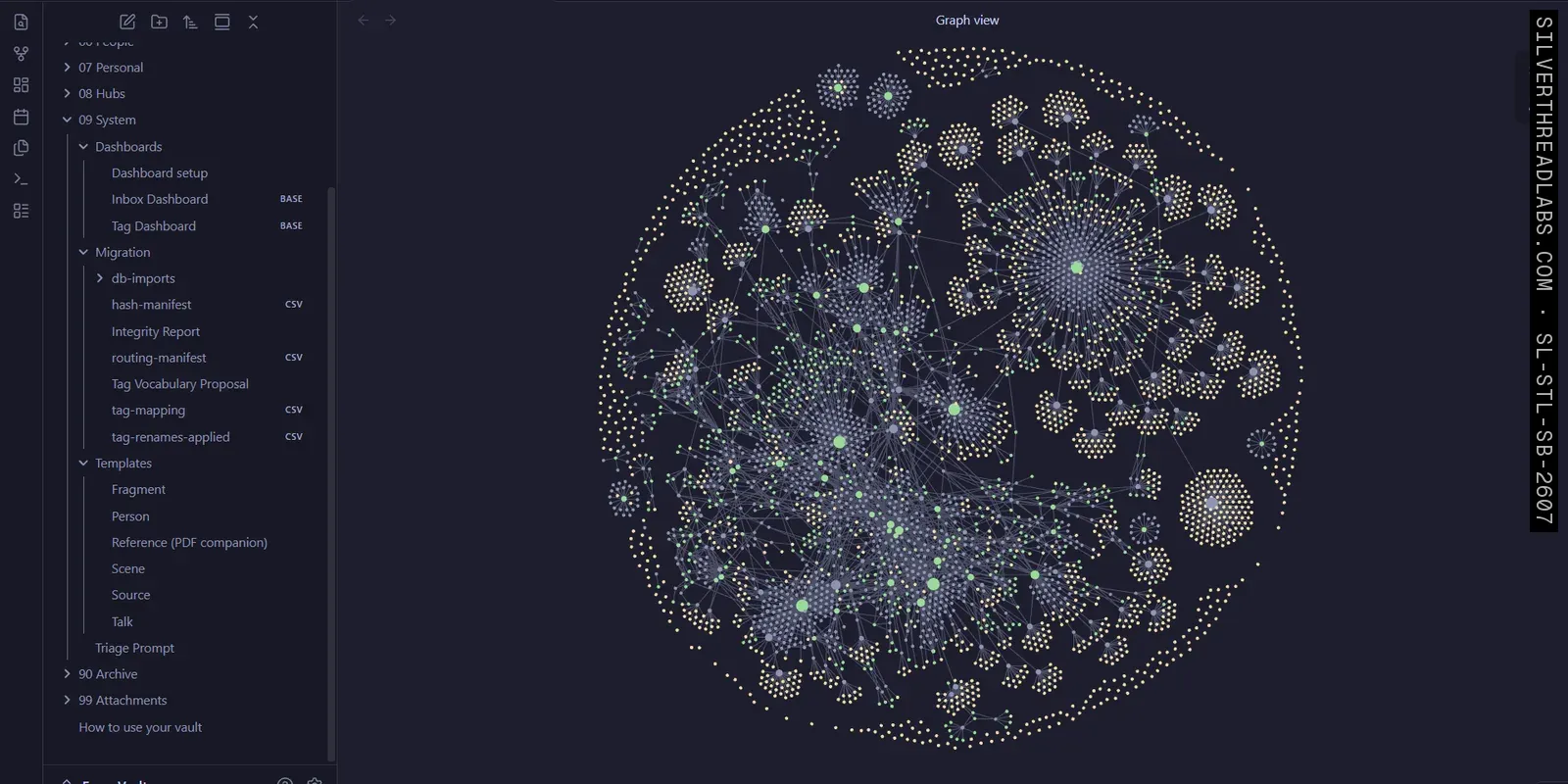
Silverthread Labs handed a New York Times bestselling author one Obsidian vault that holds sixteen years of her notes, sorted by whose words each file contains, with a Claude prompt that files each new note once she approves.
Her essay collection was a New York Times bestseller, and she also writes a newsletter.
She described the job as small: a pile of notes, most of them in Bear, bound for Obsidian. The night they first spoke, Saif Pasha told her that both apps only read Markdown files, so what mattered was the files and how they were organised.
From the first files she sent, he drew up a plan of the vault, folder by folder. She fixed one detail: her newsletter is not a book. Then she named the real goal. She wanted a home for her own writing, the quick thoughts and longer passages buried among material saved from other writers, where she could ask what she had on a subject and let one idea become a book, a memoir or a newsletter issue. Her next book, already under contract, would be the first test.
The hard part: 18 GB no plain import could copy#
Those first files were not all of it. Notion's export had skipped every page nested inside another, so links across her Notion pages led nowhere. Saif asked for a second export with Create folders for subpages switched on. The full set was more than 18 GB: sixteen years from Bear, Evernote and Notion, as Markdown, PDFs, plain text, HTML and complete Notion pages. Saif reran the whole analysis on it, since that much new material could change the plan.
Nothing could be copied over as it stood. Bear's IDs read like timestamps but put the day first, so a standard import would have shifted notes to the wrong dates without a warning. A Mac zip's __MACOSX folder put a ._ stub beside every real file, doubling any naive count. And her private material sat mixed in with everything else.
What Saif built#
He built the vault around two facts about a note that never change: whose words it holds, and what stage it has reached. Her own writing sits on top, her books beside a Notebook for ideas with no project yet. Other writers' words go into an archive below that only grows. Topics are tags, not folders, since one note can cover five subjects but can sit in only one folder. Her private material lives in one folder, so a single rule keeps it out of every sync.
She wanted links with a purpose and her files left alone, so each link had to earn a one-sentence reason, and no link went into her notes. The links live in hub notes instead: each subject has one, which lists its notes and the reason for each, and Obsidian's backlinks show the hub from inside each note it names. Beyond a properties block at the top of each note, none of her words were changed, and Saif fingerprinted every original before the work started.
New notes land in an Inbox, and one prompt files them. She opens the vault in Claude Cowork with the triage prompt Saif wrote, and Cowork returns a table of every file, its proposed place and the reason, and holds every move for her approval. When it can't tell her writing from something she saved, it asks, and keeps each answer as a standing rule, so the questions thin out with use.
The outcome#
Saif handed her the vault together with How to use your vault, a guide meant for her and for any AI she points at it. She replied that night:
Hurrah! It works!
By the handoff call she was running it on her phone and her desktop, in her own colours and fonts, with folders she added herself. After Saif walked her through it, she ran her first prompt on the vault. Within seconds it cleaned up the titles in her Notebook and left the text under each one as it was.
She now has sixteen years of notes from three apps in one vault, sorted by whose words they are, with her own ready to grow into her next book.


