[ SEO agencies ]

AI Search Visibility and SEO Implementation for Agencies

A client asks whether they show up in AI answers, and there is nothing in the dashboard you already pay for that can tell them.

The after state

You answer that question with a figure you can put in front of the client, and the fixes behind it get shipped under your name, on your schedule.

[ The Shift ]

What is breaking right now

  • The question arrives in a renewal meeting

    Somebody asks whether their brand comes up when their buyers ask an assistant. Every tab in front of you reports rankings, sessions and conversions, and none of them can show where the client sits.

  • Traffic fell on a flagship client and you did not cause it

    Nothing in the work changed. The rankings held, the clicks did not, and you have to explain a loss you did not create and propose a fix in the same call.

  • Nobody has agreed how to measure this yet

    The generative-search field says so about itself: measurement standards are not uniform and the platforms change often. What is missing is the measurement substrate, and a substrate is a thing that gets built.

  • You know what to do. You cannot staff it.

    Demand for AI-search work climbs while agency headcount goes the other way. The ceiling is capacity, not knowledge, and the work getting turned down is the work that needed a developer.

[ Where We Fit ]

The part we build

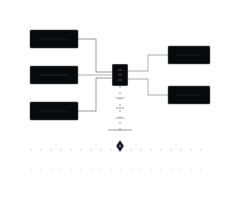
One reporting pipeline

Search Console, Google Analytics and Google Ads land in one pipeline, with citation-share measurement for answer engines built onto it. The AI-search and organic figures reconcile, so you defend both in one meeting.

Fixes shipped in code

Crawl and render faults, schema, internal linking and page structure get implemented in the codebase and the CMS. Monitoring tools name the problem; changing the code is the part we do.

Scheduled data refresh

Event-driven automation pulls each source on a schedule, so nobody exports a CSV the night before a review. A human still approves what reaches the client; nothing publishes on its own.

[ The Ladder ]

Three ways in. Enter at one rung and move when it makes sense.

Every rung here is scoped and quoted against the stack you already run, so no figure on this page stands in for a quote.

The product

ROIkeep, with the client reporting pipeline behind it

Scope
The layer that runs the agency itself, with the client reporting pipeline wired in behind it.
What it covers
  • Work management per client group.
  • People records and console-wide single sign-on.
  • One-time expiring handoff for client credentials.
  • Migration with a preview before import.
  • Outbound and Upwork pipelines tracked as records.
Where it stops
ROIkeep is in alpha, runs the agency rather than client campaigns, and is not an accounting system.
Scope ROIkeep against your stack

Bespoke customization

Technical and content SEO implementation under your brand

Scope
The fixes shipped into your clients' sites, wired into a measurement loop bent to your stack.
What it covers
  • Crawl, render and schema fixes in code.
  • On-page and content work shipped to pages.
  • Citation-share measurement on your reporting pipeline.
  • Client-facing reporting under your name and schedule.
  • ROIkeep bent to how your pods run.
Where it stops
Scope is capped and agreed in writing before work starts, and a change gets scoped as one.
Scope the implementation layer

Full build

The measurement and implementation layer built into your own stack

Scope
The pipeline, reporting surface and implementation workflow built as software you run.
What it covers
  • Data layer built against Search Console.
  • Reporting surface under your brand and domain.
  • Single-tenant deployment, one roster per database.
  • Custody of internal tooling you already have.
Where it stops
Built to a written specification and fixed scope, with custody of existing code scoped case by case.
Talk through the build

[ Proof ]

Figures from outside this company

38%

Organic clicks lost on queries where an AI Overview appears

SourceAgarwal and Sen, 2026. Pre-registered randomized field experiment; measured only on queries where an AI Overview appeared.

42%

Queries that showed an AI Overview during that experiment

SourceAgarwal and Sen, 2026. The same pre-registered field experiment.

15%

Forecast reduction in agency jobs during 2026

SourceForrester, Predictions 2026, following an average 8% headcount cut across agencies in 2025.

[ Questions ]

What buyers ask first

What can you build beyond what this page covers?

Most of it. This page carries the part built for your kind of company; the full build surface, from web and SaaS engineering to self-hosted AI, sits on one page, item by item. Browse everything we build

How do we show a client where they stand in AI answers?

By measuring it on a pipeline built for the purpose. We wire your Search Console, Analytics and Ads data into one place and extend it to track how often a client is cited in answer engines, so the position is a figure with a method behind it rather than a screenshot of someone typing a prompt. What we will not hand you is a claimed improvement percentage. The field has no uniform measurement standard yet, our own methodology is defined per engagement, and a number without a method behind it is worth nothing in a renewal meeting.

Who does the implementation, and whose name is on it?

We do the implementation. Your name is on it. You keep the client, the relationship and the reporting surface; we sit behind you and change the code. The category calls this white-label, and the term is accurate as a description of the channel. It says nothing about what is being labelled, which is why we would rather talk about the implementation than the arrangement.

What happens when a platform changes how its answers work?

It will, and often. That is designed for rather than promised around. The measurement layer is built so a source can be re-pointed without rebuilding the reporting on top of it, and every engagement opens with a discovery phase because the platforms move. When one changes, you get told what moved, what it did to your clients' figures, and what we propose to change. You do not get a silent adjustment to a chart.

What does the first month look like?

Discovery first: we take stock of the data access you already hold, the client roster in scope, and what your current reporting can and cannot show. Then the pipeline gets stood up against a small number of clients rather than all of them, so the baseline is real before anything is presented downstream. Implementation starts on the clients where the baseline shows the widest gap. Nothing reaches your clients until you have seen it.

What does this cost?

Every rung here is quoted after scoping, and this page carries no figure at all. Rung one is a product you take as it ships. Rungs two and three are work, and work gets quoted against your client count, the access you already hold and how much of the implementation you want to keep in house. Book the scoping call and you get the number for your situation instead of a band that fits nobody.

We are a one-person shop. Is this for us?

Probably not this page. What is here assumes a team: pods, a client roster, and somebody other than you presenting the reporting. If you are running solo, the one of ours most likely to earn its keep is Ezly, which is shipped rather than in alpha. That is a different product for a different job, and it is not what this page is about.

[ How It Works ]

Free Automation Audit

We find the 20% of your manual work that costs you the most, then show you exactly how to eliminate it.

STEP 1.0
Tell Us What Hurts

Tell Us What Hurts

A 30-minute call. Walk us through your daily operations and we'll spot the bottlenecks you've stopped noticing.

STEP 2.0
We Rank the Wins

We Rank the Wins

We score every opportunity by impact and effort, so you can see where AI saves the most time and money.

STEP 3.0
You Get the Playbook

You Get the Playbook

A prioritized roadmap you can act on. Execute it with us or on your own. Yours to keep either way.