[ Capabilities ]
What we build, item by item, with the page behind each one.
High-level categories, each listing concrete items. Every line names the mechanism rather than the mood, and where a service page carries the detail, the link sits on the item. Check the work before you talk to us.
[ Development ]
The software the business runs on: the web product, the mobile app, the extension, the contract on chain. We build it, and we keep running what we shipped.
Web and SaaS engineering
A product a paying customer can use, not a demo that lasts until the first real user arrives. React, Next.js and Node.js, with the auth, the billing wiring and the data model built rather than stubbed.
Mobile
One app your customers install, on both stores. Native iOS and Android where the hardware matters, React Native or Flutter where a single codebase is the better trade, and we scope which one before anyone writes code.
Extensions and desktop apps
Your tool sits where the work already happens, in the browser tab or on the desktop. Manifest V3 builds for Chrome, Firefox and Edge, plus Electron and Tauri when a tab is not enough. AI Toolbar, a Chrome extension we designed and still maintain, reports 70,000 professionals on its own site.
Blockchain
Contracts and tokenized assets with an audit trail somebody can follow afterwards. Permuto Capital, built for Chia Network, has been under our maintenance since the day it shipped.
Client reporting pipeline
One branded report per client, on a schedule, instead of somebody rebuilding the same spreadsheet every month. Search Console, Analytics and Ads pull into one place, so the number a client reads is the number in the source.
Build and technical vetting
A candidate or a contractor is judged on the code and the system design, by engineers who would have to work with them. We read the pull request and run the design conversation, so a keyword match on a resume never stands in for a signal.
[ AI ]
Systems that read your own data and act inside your own tools. Nothing here writes, sends or publishes without a person seeing it first, and that is a standing rule rather than a setting.
MCP development
An assistant reaches your CRM, your database and your internal APIs, with the tool surface and the permissions defined by you. Production MCP servers, scoped per tool instead of handed a master key.
RAG and knowledge bases
Answers that name the document they came from, drawn from your files rather than a general model's memory. Retrieval pipelines over contracts, tickets and manuals, with the source shown next to every answer.
Voice and call intake
Every call answered, booked and logged, including the ones that arrive at two in the morning. Built on open voice infrastructure and wired to the calendar and CRM you already run, across 14 published build patterns from receptionist to outbound campaign.
Brand-trained image models
Generated work holds one look across a campaign instead of drifting a little with every image. Governed ComfyUI and LoRA models trained on roughly twenty curated reference images, with the art direction and the guardrails set alongside your team.
Agents and automation
A process runs without somebody nudging it, and shows what it is about to do before it does it. Multi-agent orchestration for research, scoring and routing, with the decision points named and a person standing on the ones that matter. Where a decision is a classification, a typed-decision model such as Jev answers it in milliseconds instead of a full LLM call.
n8n automation
The handoffs between your tools stop being somebody's afternoon. Self-hosted n8n workflows for intake, enrichment, routing and ATS or CRM sync, running on infrastructure you own, so the workflow stays yours to change.
Content engine
Every client account posts on schedule, and nobody retypes the same caption three times. Drafting, sizing per platform and scheduling live in one place, and nothing goes live until a human approves it. Latent, our own post generator, runs on this and is in alpha.
[ Design ]
Design that ships. The same people draw the interface and build it, so nothing is lost in a handoff and a client clicks the real thing early.
Prototype to production
The build that impressed the room becomes something you can put a paying customer on. We take the v0, Lovable or Cursor output, close the auth and payment holes, wire a real backend, and leave it maintainable.
Brand and design systems
The fifth screen looks like the first without a designer policing every pull request. Tokens and components shipped as code, and designrift, our open-source token and Tailwind tool, is the public version of how we do it.
[ DevOps ]
Where the software runs, and who can read the data while it runs.
Self-hosted AI
Model inference never leaves your network, so a patient record or a case file is never handed to a third-party API. Ollama, vLLM and Open WebUI running inside your environment, with the data path written down.
Single-tenant deployments
Your instance, your database, your upgrade window. One tenant per deployment for the clients whose procurement will not sign off on shared infrastructure, with the isolation in the architecture rather than in a row filter.
Infrastructure
The deploy is boring and the rollback is one command. Docker, CI, Nginx or Caddy, and monitoring wired so a failure pages a person before a customer notices.
[ How It Works ]
Free Automation Audit
We find the 20% of your manual work that costs you the most, then show you exactly how to eliminate it.
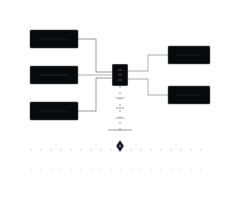
Tell Us What Hurts
A 30-minute call. Walk us through your daily operations and we'll spot the bottlenecks you've stopped noticing.
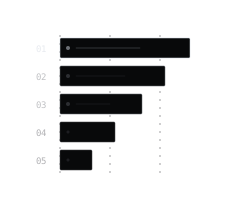
We Rank the Wins
We score every opportunity by impact and effort, so you can see where AI saves the most time and money.
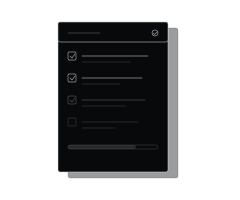
You Get the Playbook
A prioritized roadmap you can act on. Execute it with us or on your own. Yours to keep either way.