[ software and web development studios ]

Production engineering for software studios

The prototype is almost right, and almost is where the weeks go: it demos on Friday, and auth, error paths, tests and contrast ratios are still nobody's job.

The after state

The build your client signed off ships on the date you promised, hardened, accessible and tested, and it lands in your repository under your name.

[ The Shift ]

What is breaking right now

  • Almost right, and the last mile eats the schedule

    In the 2025 Stack Overflow Developer Survey, the biggest frustration developers named was AI output that is almost right, but not quite. The prototype demos on the first try; the edge cases and error paths are where the week goes.

  • The generated code arrives with security flaws at a measurable rate

    Veracode tested code generation with no security prompting, and roughly 45% of the tested tasks introduced a known security flaw. Your client's security review finds what the prototype skipped, on their timeline rather than yours.

  • Accessibility is never in the prototype

    WebAIM's automated checks across the top million home pages detected WCAG 2 failures on almost all of them, with low-contrast text the most common error. AI prototypes optimize for looking finished, not for contrast ratios or ARIA.

  • Adding one feature breaks a different one

    No tests, no boundaries, and a client who will not fund a rewrite of something they already signed off. Every new ticket becomes a coin flip, the estimate stops meaning anything, and the studio absorbs the overrun.

[ Where We Fit ]

The part we build

Prototype to production

The app your client approved ships, screens unchanged. We close the gap to production: auth and sessions, the error paths nobody wrote, input validation, the backend the prototype faked, tests, logs and traces.

Security & accessibility hardening

Findings close before launch: authorization at the boundary, secret and dependency hygiene, ARIA and contrast fixed at the token level, tests that fail loudly. Client systems we built have cleared external security audits.

AI & ML depth

Agents that call real tools and stop when they should, cited retrieval over client documents, model integration, MCP servers for typed tools. The depth is for the engagement, not in place of your engineers.

Self-hosted AI deployment

The regulated end client gets the feature anyway, with no third-party model in the path. Self-hosted models on infrastructure you or your client control, plus single-tenant deployment so no client's data reaches another's.

Senior overflow capacity

Two builds land in one month and you need senior hands, scoped and bounded, without opening a role. We bring engineers and the technical vetting behind them; payroll placement is the IT recruiting page.

Whether we have ever carried a product past the demo#

Silverthread Labs is a B2B SaaS development company, and we run three products of our own: ROIkeep for operations and Latent for marketing through social media, both in alpha, and Ezly for communication, which is shipped and selling today. They are the record, not the pitch. designrift, our open-source CSS token and Tailwind theme generator with WCAG-compliant contrast at every step, is the part you can check without asking us.

Two boundaries. Brand and image work lives on design studios, and placement lives on IT recruiting. This page owns build capacity: we ship the work, you ship it under your name, and no engineer of ours appears on your payroll.

[ The Ladder ]

Three ways in. Enter at one rung and move when it makes sense.

Every rung here is scoped and quoted against the stack you already run, so no figure on this page stands in for a quote.

The product

The codebase audit

Scope
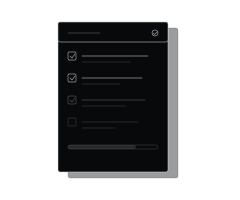
A fixed-scope diagnostic: somebody senior reads the codebase you have and says what it will take.
What it covers
  • Security read of the generated code
  • Accessibility pass against WCAG 2, failures listed
  • Maintainability and test-coverage read
  • Backend wiring gaps the prototype faked
  • Prioritized hardening plan with written exit criteria
Where it stops
It produces a plan, not a fix, and nothing is committed until you approve the scope.
Book the audit call

Bespoke customization

The hardening build

Scope
The normal deliverable here: scope comes from the diagnostic and is fixed in writing before the first commit.
What it covers
  • Security, accessibility and maintainability closed to plan
  • Backend and data model wired for real
  • Tests, plus logs and traces for incidents
  • Shipped to production, your repository, your brand
  • Optional: AI and ML feature depth
Where it stops
Scope is capped before work starts, and new scope is a new agreement rather than an absorbed extra.
Scope the hardening build

Full build

Full builds and standing capacity

Scope
Builds from nothing, or standing capacity after a build ships, where returning studios usually land.
What it covers
  • Greenfield builds under your brand
  • Overflow capacity during crunch, bounded and agreed
  • Maintenance and monitoring after launch
  • Continuous AI and ML feature work
  • Custody of an existing codebase, scoped here
Where it stops
Standing capacity is bounded in engineers and weeks, never open ended and never a headcount promise.
Talk about standing capacity

[ Proof ]

Figures from outside this company

66%

Developers naming almost-right AI output as their biggest frustration

SourceStack Overflow 2025 Developer Survey, AI section, multi-select.

~45%

Tested code-generation tasks that introduced a known security flaw

SourceVeracode, Spring 2026 GenAI Code Security. Veracode sells code-security scanning, so read it as an interested party with a disclosed method.

94.8%

Home pages with detected WCAG 2 failures

SourceWebAIM Million 2025, automated checks across the top million home pages; detected errors only.

[ Questions ]

What buyers ask first

What can you build beyond what this page covers?

Most of it. This page carries the part built for your kind of company; the full build surface, from web and SaaS engineering to self-hosted AI, sits on one page, item by item. Browse everything we build

Do you work under our brand?

Yes, and it is the normal arrangement rather than a special case. You keep the client, the brand and the relationship. Commits land in your repository, and nothing we build carries our name unless you decide it should. Being willing to work this way is table stakes in this category, so treat it as a precondition rather than the reason to pick us.

Who talks to our client?

You do, by default. If it helps to put an engineer on a call, we join as part of your team and follow whatever introduction you give us. We do not contact your client on our own and we do not pitch them anything.

What does the diagnostic actually produce?

A written document, not a conversation. Security findings, the WCAG 2 failures listed one by one, the test-coverage read, the list of backend wiring the prototype faked, and a hardening plan ordered by what blocks launch first. It carries written exit criteria, so you can hand it to your client as your own assessment and quote from it. It does not include the fix.

Can you take on AI and ML work we have never shipped?

That is a large part of why studios call. Agents that call real tools, retrieval over a client's own documents with citations, model integration, MCP servers for typed tool access, and self-hosted or single-tenant deployment when the client's data cannot leave their control. The capabilities page names each engine and links to the service page behind it, so you can check the depth before you commit to it.

What if the prototype turns out to be worse than it looks?

Then the diagnostic says so before you have promised your client a date. If the honest read is that rebuilding the parts that matter is the shorter path, the plan says that in writing and lays out both routes with their consequences, so you are choosing rather than discovering. We would rather lose the build than sell a hardening job that cannot land.

We are weighing an internal AI hire against a partner. Why partner?

Read it as a risk question rather than a staffing one. MIT's Project NANDA study of enterprise GenAI adoption in 2025 found that roughly 95% of pilots stalled with no measurable effect on the P&L, and that buying from or partnering with a specialized vendor succeeded around 67% of the time while internal builds succeeded one-third as often. A hire is a bet on one person clearing that bar. A bounded engagement is a bet you can stop.

How is this priced?

It is quoted, and it is quoted after the diagnostic rather than before it. There is no rate card on this page and no band, because a number written before anyone has read the codebase is a guess that one of us pays for later. The diagnostic is fixed in scope and is its own deliverable. The build is quoted against the plan the diagnostic produces.
[ How It Works ]

Free Automation Audit

We find the 20% of your manual work that costs you the most, then show you exactly how to eliminate it.

STEP 1.0
Tell Us What Hurts

Tell Us What Hurts

A 30-minute call. Walk us through your daily operations and we'll spot the bottlenecks you've stopped noticing.

STEP 2.0
We Rank the Wins

We Rank the Wins

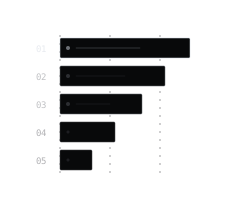
We score every opportunity by impact and effort, so you can see where AI saves the most time and money.

STEP 3.0
You Get the Playbook

You Get the Playbook

A prioritized roadmap you can act on. Execute it with us or on your own. Yours to keep either way.