The brief#
The founder behind Aiden is in Australia, runs a marketing agency and was already Saif Pasha's client. His business had people answering customers' questions, and most of those answers were already written down, whether in a manual, a policy or a catalogue.
He wanted a chatbot for every business, one that had read that business's own documents and could sit on its own website, so customers found their answers there.
What we built#
Aiden lets a business sign up, upload its manuals and catalogues, and build a bot on top of them. The business sets the bot's name, prompt, welcome message and error message, then its logo, colours and font. A few lines of embed code put the bot on the business's website.
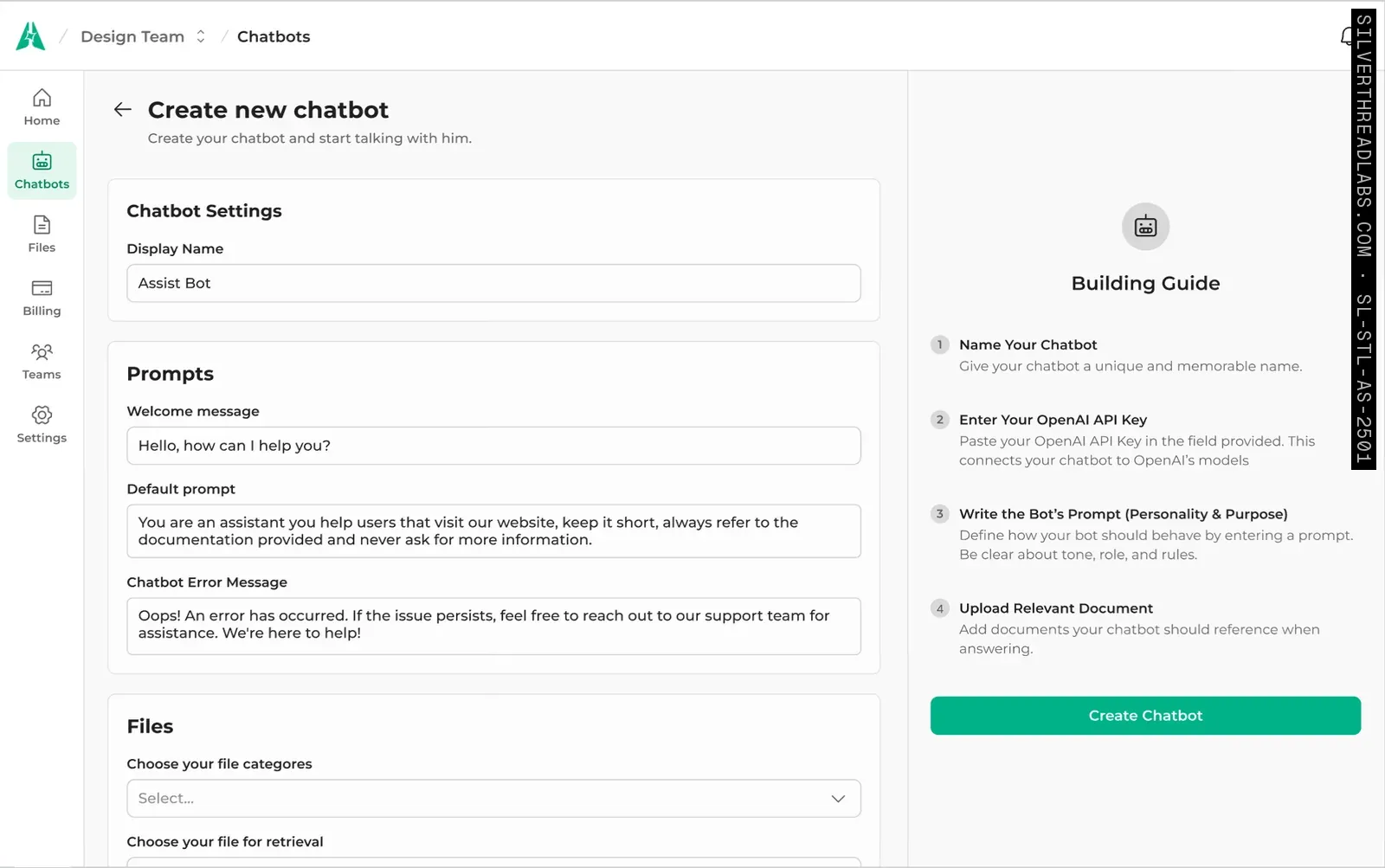
Our team proved each feature could be built before designing any screen, because what the core could do would shape so much of the interface. The founder's first look was a short video, not a mockup: a bot answering from files given to it just beforehand. He showed the video to his stakeholders.
Each bot runs as an assistant on OpenAI's Assistants API and searches its business's files with file_search. OpenAI parses, chunks and embeds the files, so we wrote none of that ourselves.
Supplier catalogues ran to 50 MB and would not upload on the free tiers the platform had been tested on, so it moved off them. The subscription plans had been created in US dollars, yet every customer was going to pay in Australian dollars. Once anyone has used a Stripe price it cannot be changed, so each plan was made again and the app switched to the new set. That was the day before the first client signed.
The hard part: a bot that answers to one key#
We built on the Assistants API while it was still in beta, and it made decisions it did not show. Each OpenAI key sits in an OpenAI project, and an assistant, its vector store and all of its files belong to the project of whichever key created them. Every business could bring a key of its own, so each bot answered to that key and no other.
It surfaced when Aiden's first client, a 4x4 suspension maker, had its key swapped for one from another project. All of the client's bots went silent at once, while new bots answered normally. The old bots were intact, and the new key could not see them.
Rebuilding them under the new key was the only fix, and duplicating a bot, a feature Aiden had by then, made that a single click. When OpenAI later deprecated the Assistants API, we moved Aiden onto the Responses API.
How Aiden grew#
More businesses signed on, and the product grew with them. Our team built teams, whose viewers, editors, admins and owners are invited by email. It was the most complex piece of the build. Technicians can now take a photo of an error message or a part and ask the bot about it. Photos are JPEG, PNG, GIF or WebP files up to 5 MB, uploaded with purpose: 'vision' and sent as an image_file content part.
Voice followed. The founder's three options ran from dictation up to a conversation that was fully hands-free, and he picked the middle one: one button starts a conversation in which the bot listens, replies and then reads its reply aloud. The browser's Web Speech API takes the speech in, with react-speech-recognition. Answers go out through tts-1 in the alloy voice, one sentence at a time, so the bot starts speaking before the full answer is finished.
Bulk upload and duplication came next. Then a customer could drop in a document of their own, such as a lease, and ask about it. The file goes into the customer's message as attachments with file_search, so it is searched in that conversation alone and the bot's vector store stays untouched.
Everything looks good to go, mate
Aiden then got a new design and a new brand. The public site now lets anyone try a bot with no account: the playground stores each visitor's ID in an httpOnly cookie, which is encrypted with AES-256-CBC, and counts that visitor's messages against it. Emails arrive from Aiden, not from the services it runs on. Every word is in Australian English. A business once had to supply its own OpenAI key, and that key is now Aiden's to manage.
The outcome#
Within days of launch, the founder signed his first client, the 4x4 suspension maker. The maker put its dealers on Aiden, where answers come from its own product documents.
That left the founder with a product that answers customers from the documents a business already wrote, under that business's own brand. Our team still keeps Aiden running for him.


