Classway
222,000 registered users. 3 million questions answered. A Chrome extension that stays inside the tab.
Industry: Education, EdTech | Stack: Chrome MV3, TypeScript, LLM API, React | Status: Live | Visit Classway | Chrome Web Store
what Classway does#
Classway is a Chrome extension that provides AI-powered academic assistance from inside the active browser tab. Students highlight text, ask questions, or paste content, and the extension returns contextual answers, rephrased text, essay structure suggestions, and content analysis without leaving the page.
Built for a US-based client, Classway runs on a subscription model: a free tier with limited credits, and unlimited access at $9.99/month.
the browser extension problem in edtech#
Building an AI tool for students sounds simple until you think about where students actually work. They are in Google Docs, on research sites, inside Canvas or Blackboard, reading PDFs. They are not going to open a separate app, paste in their text, wait for a result, copy it back, and pick up where they left off. That round-trip friction is where most tools lose students.
The client framed it cleanly: students need AI help in context, not in a separate window. The tool had to work inside the tab, respond fast, and fit into the workflow naturally.
That constraint ruled out a web app with an extension layer on top. The extension had to be the whole product.
what we built#
Chrome Manifest V3 architecture#
We built Classway natively on Chrome's Manifest V3 architecture. MV3 is meaningfully more restrictive than MV2: service workers replace background pages, cross-origin requests require explicit permissions, and content script injection follows stricter lifecycle rules. Starting from MV3 rather than migrating from a legacy codebase meant these constraints shaped the architecture from day one instead of surfacing late as rework.
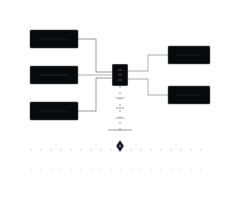
When a student highlights text, the content script captures the selection and hands it to the service worker, which routes the request to the LLM API and returns the result rendered inline in the page. Nothing navigates. Nothing opens a new tab.
LLM integration for academic context#
The AI layer handles four distinct interaction patterns: contextual answers from highlighted text, rephrasing with adjustable tone and formality, essay structuring from rough notes, and summarization of long-form reading material.
Each pattern needed its own prompt logic and output format. Rephrasing has to hold the original meaning while changing the structure. Essay structuring has to find a thesis in scattered notes and build a logical argument around it. Contextual answers have to stay grounded in the specific page content, not drift into general training data. We built separate processing pipelines rather than routing everything through a single prompt.
customizable highlight mode#
Students can choose how the extension responds when they highlight text: a brief answer, a detailed explanation, or an expanded analysis. The response depth adjusts to the mode.
The reason this mattered: a student writing a quick response paper needs different output than a student working through a research assignment. Making them configure a settings panel would have killed the interaction. The choice lives on the selection itself.
Answer Assistant#
The Answer Assistant works on the active page content. When a student hits a question in their coursework, whether in a textbook PDF, a Canvas assignment, or a Google Doc, they can invoke the assistant directly. It reads what is on the page and answers from that context, not from a generic knowledge base.
capabilities#
- In-tab AI assistance: no window switching, no copy-paste workflow, everything happens where the student already is
- Contextual rephrasing: rewrites content while preserving meaning, with control over tone, formality, and structure
- Essay structuring: builds outlines from rough notes, with thesis identification and argument flow
- Highlight mode: three response depth levels (brief, detailed, expanded) accessible from the selection itself
- Answer Assistant: reads the active page and answers from what is actually there
Free tier available. Unlimited access at $9.99/month.
results#
222,000 registered users. 3 million questions processed. The extension is live on the Chrome Web Store.
What the project reinforced: students did not need a smarter model. They needed one that worked where they were already sitting. The context problem was the actual problem, and the extension architecture solved it without asking students to change anything about how they work.
Building a Chrome extension or browser-based AI tool? See our Browser Extension Development or book a free Automation Audit.