Claude Fable 5 or Mythos 5: The Difference Comes Down to Who You Are
One model, two names, and the question everyone's asking#
Anthropic launched two models on the same day: Claude Fable 5 and Claude Mythos 5. Read the coverage and you'd think they're siblings. They're not. They are the same underlying model. Identical weights, identical capabilities, identical price.
The only difference is what each version is allowed to tell you. And which one you get isn't a checkout option — it's determined by who you are.
- Fable 5 is the public version. Anyone can use it today, with safety classifiers that intercept queries in a few sensitive areas.
- Mythos 5 is the unrestricted version (in some areas). It's limited to vetted cyber defenders and infrastructure providers working with the US government, with a trusted access program coming for biomedical researchers.
That split is new. No frontier lab has shipped a model this way before: full capability for everyone, full access for a select few. Whether that's a sensible safety architecture or a preview of a two-tier AI future depends on where you sit. Either way, it's worth understanding exactly how it works — because this is probably the template for every major release from here on.
What "Mythos-class" actually means#
Anthropic introduced the Mythos class in April 2026 with Claude Mythos Preview, a model it considered too capable in cybersecurity to release publicly. Instead, it went to a limited group of cyber defenders and critical-infrastructure providers through Project Glasswing, a collaboration with the US government.
The capability bar for the class is simple to state: models whose skills in areas like offensive cybersecurity and biological research could cause serious damage in the wrong hands. Not hypothetically — measurably, on internal evaluations.
Fable 5 is the first Mythos-class model the general public can touch. Anthropic's own framing is telling: it's "a Mythos-class model that we've made safe for general use." The capability came first. The public version is the derivative.
What the model can actually do#
The capability claims are aggressive, but several come from named customers and concrete tasks rather than benchmark tables:
- Software engineering. Stripe reported that Fable 5 performed a codebase-wide migration on a 50-million-line Ruby codebase in a day — work estimated at over two months for a full team. It also tops Cognition's FrontierCode evaluation among frontier models, even at medium effort settings. If your team already runs AI coding tools like Claude Code, Cursor, or Copilot, this is the model that changes what "large task" means.
- Vision. Earlier Claude models needed elaborate helper harnesses to play Pokémon FireRed. Fable 5 beat the game with a minimal, vision-only harness — raw screenshots, no maps, no extra game state. That matters well beyond games: it's the same capability that powers computer use agents, which depend entirely on reading screens accurately. The model also extracts precise numbers from scientific figures and rebuilds web app source code from screenshots alone.
- Long-horizon work. The model stays coherent across millions of tokens and improves its own performance using persistent file-based memory — three times more improvement than Opus 4.8 got from the same setup. This is the trait that separates a chatbot from a genuinely agentic AI system that can run for hours unattended.
- Drug design. Anthropic's internal protein design experts used Mythos 5 to accelerate parts of the drug design process roughly tenfold. Given protein design and bioinformatics tools but no human assistance, the model matched or beat skilled human operators — choosing binding sites, running design tools, recovering from failures. Nine of 14 protein targets yielded strong drug-design candidates.
- Novel science. In blinded comparisons, Anthropic's scientists preferred Mythos 5's molecular biology hypotheses about 80% of the time over Opus-class models. One hypothesis — a novel mechanism for an E. coli protein — was independently corroborated by an outside lab working on the same problem.
The pattern across all of it: the longer and more complex the task, the bigger the gap over previous models. That's the Mythos-class signature, and it's exactly why the safeguards exist.
How Fable 5's safeguards actually work#
Here's the part most coverage gets vague about. Fable 5 doesn't refuse restricted queries. It reroutes them.
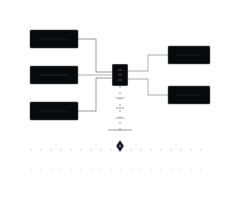
Separate classifier models watch incoming requests. When one detects a query in a covered area, the response is generated by Claude Opus 4.8 — Anthropic's next-most-capable model — instead of Fable 5. You're told when it happens. No refusal wall, just a quieter answer from a slightly less capable model.
Three areas trigger the fallback:
- Cybersecurity. Mythos-class models are exceptional at finding and exploiting software vulnerabilities, and at agentic hacking — chaining reconnaissance, discovery, and lateral movement into full attack workflows. The classifiers cover both exploitation and offensive cyber tasks broadly. On Anthropic's evaluations, they prevent Fable from making any progress on offensive cyber tasks.
- Biology and chemistry. This one is tuned deliberately wide. Anthropic tested whether the model could predict how genetic modifications affect viral shell assembly in adeno-associated viruses (gene therapy components) — and it beat dedicated protein language models without ever being trained for the task. Useful for therapeutics; dangerous in the wrong hands. For now, most biology and chemistry requests fall back to Opus 4.8.
- Distillation. Anthropic has identified large-scale attempts to extract Claude's capabilities to train competing models. Flagged distillation attempts get the fallback treatment too.
The numbers that matter: the fallback triggers in less than 5% of sessions. For the other 95%+, Fable 5's performance is effectively identical to Mythos 5's. Anthropic is open about the classifiers being tuned conservatively — benign requests will sometimes get caught, and reducing those false positives is the stated post-launch priority.
How robust is the routing? An external bug bounty produced no universal jailbreaks in over 1,000 hours of testing, and one external partner found Fable 5's cyber safeguards the most robust of any model they'd tested — zero compliance with harmful single-turn cyber requests across 30 public jailbreak techniques. The UK AISI made partial progress toward a jailbreak in a brief testing window, which Anthropic discloses itself. Their goal isn't a perfect wall; it's making any bypass slow and costly enough to detect before it scales.
So who gets Mythos 5?#
Right now, three groups — and you'll notice none of them is "people who ask nicely":
- Project Glasswing partners. Cyber defenders and critical-infrastructure providers working in collaboration with the US government. They get Mythos 5 with the cyber safeguards lifted, as an upgrade from Mythos Preview.
- Vetted biomedical researchers (soon). A trusted access program will give a small number of life science researchers a version with biology and chemistry safeguards removed — but cyber safeguards still in place. The unlocks are à la carte, not all-or-nothing.
- A broader trusted access program (planned). Anthropic intends to let cybersecurity organizations apply systematically, expanding in consultation with the US government.
That's the "who you are" part. Access to full capability is now an identity and vetting question, not a pricing tier. A security researcher at a vetted firm and a hobbyist with the same skills get different models — by design.
What it costs, and the subscription catch#
Both models are priced identically: $10 per million input tokens and $50 per million output tokens — less than half of Claude Mythos Preview. Developers can use claude-fable-5 via the Claude API today.
The catch is on subscription plans. Anthropic expects demand to outstrip capacity, so the rollout is staged:
- Now through June 22: Fable 5 is included on Pro, Max, Team, and seat-based Enterprise plans at no extra cost.
- From June 23: it drops off those plans and requires usage credits, unless capacity allows an extension.
- Eventually: Anthropic aims to restore it as a standard part of subscriptions "as quickly as we can."
If you're on a subscription plan and want to evaluate Fable 5 properly, the free window is short. Plan your testing now, not on June 21.
One more change worth knowing: all Mythos-class traffic carries a mandatory 30-day data retention policy, on both first- and third-party surfaces. Anthropic says the data won't train new models and access is logged, but if your compliance posture assumes zero retention, this is the line item to flag for legal before you ship anything on it. For some teams, this tips the cloud vs. self-hosted AI calculation — frontier capability through an API now comes with retention terms you can't negotiate away.
The two-tier question#
Here's my honest read. As a safety architecture, the fallback design is genuinely clever — rerouting to Opus 4.8 instead of refusing means the failure mode for a false positive is "slightly less capable answer," not "blocked." That's a much better user experience than a refusal wall, and tuning conservatively at launch with a public commitment to narrow the safeguards is the right order of operations.
But the precedent deserves attention. The gap between what Fable 5 is and what it's allowed to say is now a formal product line. As models keep getting more capable — and Anthropic says more are coming within months — that gap widens, and the question of who qualifies as "trusted" gets more consequential. Today it's cyber defenders and biologists. The criteria for tomorrow's list will be one of the more important policy decisions in the industry, and it's currently being made by one company in consultation with one government.
For practical purposes, though, the answer to the title question is simple:
- You're a developer, a business, or a regular user? You're using Fable 5, and for 95%+ of what you do, you're getting full Mythos-class capability at half the old price.
- You're a vetted cyber defender or (soon) a biomedical researcher? You can apply for the version with your domain's guardrails lifted.
- You're hoping to jailbreak your way from one tier to the other? More than 1,000 bounty hours say good luck.
The full announcement, including benchmark tables and the system card, is on Anthropic's site.
Where to go from here#
If you're reading this as a business decision rather than industry news, the question isn't "is Fable 5 impressive" — it's whether your team is set up to get value from a model that can run two-month engineering tasks in a day. Most teams aren't. The bottleneck has shifted from model capability to integration: tooling, workflows, guardrails, and knowing which tasks to hand over.
That's the work Silverthread Labs does. We build custom AI solutions and agentic AI systems around frontier models like Fable 5, and we run AI developer tooling engagements that get engineering teams from "we have Copilot licenses" to production-grade AI workflows — tool selection, configuration, custom MCP servers, and training.
The free evaluation window on subscription plans closes June 22. If you want help figuring out what Fable 5 changes for your stack before then, get in touch — we'll give you a straight answer.