Workflow Automation Services
Most operations teams don't have an automation problem. They have a backlog problem: the quiet accumulation of manual steps that nobody's had time to fix, spread across tools that were never meant to talk to each other.
We build workflow automation on n8n and Make that runs on your infrastructure, integrates with your existing stack, and costs a fraction of what cloud automation platforms charge at scale. If your team is spending hours on work a well-designed system could handle in seconds, that's the problem we solve.
The Operational Backlog No One Talks About#
What manual workflows actually cost per week#
The cost of manual workflows rarely appears on a balance sheet, but it shows up everywhere else: in the recruiter spending two hours a day copying candidate data between systems, in the ops lead manually routing support tickets because the integration broke, in the billing team running end-of-month reports by hand.
Workflow automation saves small businesses an average of 10-15 hours per week while reducing manual errors by up to 80% (Activepieces, 2025). Across a 10-person team, that's the equivalent of a full-time employee's productive output recovered, without a new hire.
The harder cost is decision latency. When data moves by hand, it moves slowly. A recruiting workflow that takes three days from start to finish because someone manually triggers each step doesn't just cost time. It costs candidates.
The SaaS trap: tools that don't talk to each other#
Most mid-market operations run on five to fifteen SaaS tools. Each one solves a specific problem well. None were designed with your exact stack in mind.
The result is a patchwork of native integrations that half-work, cloud automation connections that hit task limits, and manual workarounds that become permanent. The tools are doing their jobs. The space between the tools is where the work falls.
When your team becomes the integration layer#
When there's no reliable connection between systems, people fill the gap. Someone ends up being the human glue between platforms, copying, reformatting, re-entering, and routing data that should flow automatically.
These are also the workflows that never get documented, because the person doing them learned it by watching someone else. When they leave, the process leaves with them.
What We Build and How It Works#
Workflow types we automate (with named examples)#
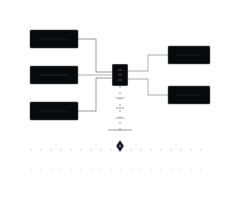
Data sync and enrichment. Moving records between CRMs, databases, spreadsheets, and external APIs, with transformation logic applied at each step. A concrete example: a deal closes in the CRM, which triggers enrichment from a third-party data source, creates a project in the project management tool, and notifies the delivery team in Slack, all within seconds.
Intake and routing. Inbound requests (form submissions, emails, calls) parsed, categorized, and routed to the right person or queue without manual triage. An inbound insurance claim gets extracted, coverage-checked, and assigned to an adjuster based on claim type and region.
Scheduled reporting and data pipelines. Pulling data from multiple sources on a schedule, transforming it, and delivering it where it needs to go. Nobody has to touch it.
Approval and notification loops. Multi-step workflows that require human review at defined checkpoints, with automatic escalation if approvals aren't received in time. These come up frequently in legal, insurance, and finance, where sign-off is required before work moves forward.
How n8n and Make fit different build requirements#
We use n8n and Make as our primary automation platforms, and the choice between them is a function of your requirements.
n8n is the platform we recommend when data privacy, cost at scale, or complex custom logic are priorities. It's open source, self hostable, and executes workflows by the run rather than by the task, which means a 10-step workflow processing 1,000 records costs the same as a 1-step workflow on an equivalent cloud platform. n8n also supports custom JavaScript and Python nodes directly in the workflow.
Make is better suited to rapid multi-system integrations where the primary requirement is breadth of native connectors and visual clarity. A lower setup floor for standard use cases, but cloud-hosted only.
When we write custom code instead#
Some automation requirements are better served by purpose-built code than a visual workflow platform. We build Python or Node.js services when transformation logic is too complex for node-based tools, when native connectors don't exist for a required system, or when throughput requirements exceed what an automation platform supports.
Voice agent + workflow convergence: the phone is part of the loop#
One of the clearest gaps in most automation setups is the phone. Voice interactions (inbound calls, outbound follow-ups, intake conversations) typically happen entirely outside any workflow system. Someone answers, takes notes, and manually enters data later.
We build automation that treats voice as a trigger and a destination. An inbound call can start a workflow: structured data extracted from the conversation, routed to the right system, followed up automatically. A workflow can trigger an outbound call: a patient reminder, a candidate follow-up, a status update that would otherwise require manual dialing.
Connecting voice agents to workflow automation is where the real operational gains tend to show up. The individual channels are already functional. The gap is that they've never talked to each other.
The Self Hosted Difference#
Why 44% of enterprises won't touch cloud-only automation#
44% of enterprises cite data privacy as their number one barrier to AI adoption (McKinsey, 2025). The same concern applies to workflow automation. When you route business data through a cloud automation platform, that data passes through a third party's infrastructure. For most use cases, this is an acceptable tradeoff. For healthcare, legal, insurance, and financial services, or any company with data residency commitments, that tradeoff isn't available.
What self hosted n8n actually means for your data#
Self hosted n8n runs on your server: a cloud instance you control (AWS, Azure, a private VPC) or on-premises hardware. The n8n application, workflow definitions, execution logs, and any data processed in transit all stay within your environment.
You get the full platform functionality. You do not get a vendor with access to your data. We handle deployment, updates, monitoring, and incident response.
Compliance environments where self hosting is the only viable path#
For teams operating under HIPAA, SOC 2 Type II, or contractual data residency obligations, self hosted automation isn't optional. It's the only architecture that works. Self hosted n8n keeps PHI within your environment, audit logging within your own infrastructure, and opens up integration with on-premises systems that cloud platforms simply can't reach.
Cost reality: 500-1000% cheaper than cloud automation at scale#
Cloud automation platforms charge per task. A 10-step workflow processing 1,000 records generates 10,000 billable tasks. n8n charges per execution: the same workflow generates 1,000 executions, a 10x reduction in billable units (Digidop, 2025). At high volume, the operational cost difference reaches 500-1000%. For organizations running tens of thousands of workflow executions per month, the math adds up fast.
How We Build: The Process#
Step 1: Workflow audit, map what's manual, measure the cost#
Every engagement starts with a workflow audit. We map your current manual processes: what triggers them, what steps they involve, what systems they touch, how long each step takes. This produces a prioritized list of automation candidates ranked by time cost, error risk, and implementation complexity.
Step 2: Architecture scoping, tool selection and data flow design#
Once we know what to build, we scope the architecture: platform selection, how workflows connect to your systems, where data flows, and how the automation will be monitored. For self hosted deployments, this includes infrastructure planning: server sizing, database configuration, authentication, and backup strategy.
Step 3: Build and test, iteration with your team in the loop#
We build in iterations with your team reviewing each workflow before it goes live. Testing covers unit tests on individual nodes, integration tests across connected systems, and edge cases pulled from real production failure modes: partial data, API timeouts, duplicate records. The last category is usually the most interesting.
Step 4: Handoff, documentation, training, and monitoring setup#
Handoff is a deliverable. You receive full workflow documentation, a monitoring setup that alerts the right people when a workflow fails, training for whoever owns the workflows operationally, and a defined support path for the first 30-90 days post-launch.
Industries We've Automated#
Recruiting: screen 100+ candidates per day without more headcount#
Recruiting teams spend an outsized amount of time on intake work that could run automatically. We build automation that handles candidate intake from submission to initial screen, routes qualified candidates to the right recruiter, triggers scheduling workflows, and keeps the ATS current without manual data entry. Teams using this architecture process 100+ daily applications without additional headcount. See the recruiting automation workflow.
Insurance: claims intake to adjuster assignment in one loop#
We build claims intake workflows that extract structured data from inbound submissions, run automated coverage checks, apply assignment logic based on claim type and adjuster availability, and notify all parties without manual coordination. Submission to assigned adjuster runs in seconds. See insurance workflow automation.
Legal: intake workflow triggered by a single inbound call#
An inbound call triggers the full intake sequence: voice agent captures structured information, workflow creates the matter record, assigns the intake attorney, and sends an acknowledgment to the prospect, before anyone picks up the phone manually. The client feels attended to immediately. The intake attorney gets a clean record. See the legal intake workflow.
Healthcare: patient intake to claim submission, HIPAA-compliant#
We build healthcare automation on self hosted n8n, keeping PHI within the client's environment throughout. Workflows cover patient intake to EHR record creation, appointment scheduling and reminders, and intake-to-claim submission sequences that reduce billing lag without exposing data to third-party platforms. See healthcare workflow automation.
Pricing#
Workflow automation engagements are priced by scope. We do not charge based on execution volume once the system is built.
Single-process automation#
$3,000 - $8,000
A single workflow connecting two to four systems, with documentation and a 30-day support window post-launch. Suitable for a specific manual process with a clear trigger, defined steps, and a known destination.
Timeline: 1-3 weeks from kickoff to live.
Multi-system workflow builds#
$8,000 - $25,000+
Multiple interconnected workflows spanning four to eight systems, with architecture scoping, custom logic, and testing across integration points. Suitable for teams replacing a manual process that involves multiple departments or approval chains.
Timeline: 3-8 weeks from kickoff to live.
Ongoing management and optimization retainers#
$1,500 - $5,000/month
Monitoring, incident response, workflow updates as systems change, and a defined hours allocation for new automation requests. Most clients on retainer add two to four new workflows per quarter as they identify additional processes worth automating.
FAQ#
How much does workflow automation cost for a small business?
A single-process build typically runs $3,000-$8,000 for a workflow connecting two to four systems. Multi-system builds range from $8,000 to $25,000+. Approximately 60% of automation projects return 30-200% in the first year (Latenode, 2025). We offer a free workflow audit to scope your specific situation before you commit to anything.
What is the difference between workflow automation and RPA?
Workflow automation connects systems through their native APIs and webhooks: data moves in structured form. Robotic process automation (RPA) simulates a human interacting with a UI and is typically used when a system has no API. We build API-first automation wherever possible because it's faster, more reliable, and easier to maintain. RPA is a fallback for legacy systems with no other integration path. If you're not sure which applies to your situation, the workflow audit will tell you.
Which processes should I automate first?
Prioritize by three criteria: frequency (the more often it happens, the more a fix saves), error risk (manual data entry into critical systems is a liability), and handoff points (anywhere work passes between people or systems manually is a candidate). Our workflow audit maps and ranks these for you in about two hours.
Can workflow automation integrate with my existing tools?
n8n has native integrations for over 400 applications including Salesforce, HubSpot, Slack, Google Workspace, Microsoft 365, Airtable, and most common CRMs, ERPs, and support platforms. For systems without native connectors, we build custom integrations using REST or GraphQL APIs. See a full comparison of n8n vs. cloud automation platforms.
How long does it take to implement workflow automation?
A single-process build is typically live in one to three weeks. Multi-system builds run three to eight weeks depending on integration complexity and the number of approval checkpoints. Timeline is heavily influenced by how quickly your team can provide system access and review iterations. The most common delay is access: API keys, credentials, and test environments that take longer to provision than expected.
Book a Free Workflow Audit#
If you have a manual process that costs your team more than a few hours a week, it's worth mapping. Our workflow audit takes about two hours of your time and produces a prioritized list of automation candidates with estimated time savings and implementation complexity.
No obligation on your end. If nothing on the list is worth building, you still walk away with a clear inventory of where your team's time is actually going.