What Is Agentic AI? A Plain-English Guide
Agentic AI is software that pursues a goal by reasoning, planning, and taking action inside real systems: calling APIs, reading databases, sending messages, without a human directing each step. Unlike chatbots, which respond to prompts, agentic systems execute multi-step workflows on their own.
That definition is the one that actually holds under scrutiny. Everything else you have heard, autonomous agents, AI agents, agent frameworks, is variation on that core idea. This post covers how the technology works, what it does in practice, which frameworks actually get used in 2026, and where it still falls short.
the one-sentence answer#
An AI agent is software that can observe a situation, decide what to do, use tools to act, and evaluate what happened, then repeat that loop until a goal is complete.
The key difference from a standard large language model (LLM): an LLM generates text. An agentic system generates text and then does something with it, writes to a database, calls an API, triggers a downstream system. The output is not a message. It is an action.
how agentic AI works: the perception-reasoning-action loop#
Most agentic AI systems follow four repeating steps.
step 1: perception#
The agent receives input: a user message, a webhook, a scheduled trigger, data from a database. It assembles this into a working context, what it knows, what it has been asked to do, what tools are available.
This step matters more than people realize. An agent with access to live CRM data, current calendar availability, and relevant conversation history behaves very differently from one operating on a static prompt with nothing else to go on.
step 2: reasoning#
The language model at the agent's core evaluates the situation and decides what to do next. In most modern frameworks, this involves chain-of-thought reasoning, where the model thinks through intermediate steps before committing to an action. More advanced architectures give the model a scratchpad or memory so it can reason across multiple turns without losing context.
Not all reasoning leads to correct plans. This is the step most people underestimate. Well-designed agents include guardrails, human-in-the-loop checkpoints for high-stakes decisions, and fallback behavior when the model is uncertain.
step 3: action#
The agent calls a tool. Tools are functions it can invoke: querying a database, making an API call, reading a file, sending a message, booking an appointment, creating a record.
Scope matters here. An agent that handles appointment booking should have access to the calendar API and the CRM, not the billing system or employee records. Least-privilege design is not optional in production.
step 4: feedback#
The agent receives the result of its action and updates its internal state. Did the booking succeed? Did the API return an error? Was the data incomplete? It incorporates this feedback and decides what to do next, whether that is finishing the task, trying a different approach, or escalating to a human.
This loop is what separates an agentic system from a single LLM call. The agent runs it until the task is done or it hits a defined stopping condition.
agentic AI vs. generative AI: what is actually different#
generative AI responds; agentic AI acts#
Generative AI produces output: text, images, code, summaries. You provide a prompt; the model generates a response. The interaction ends there.
Agentic AI takes the next step. The agent does not just draft the email, it sends it. Does not just suggest an appointment time, it books it. Does not just summarize the support ticket, it creates the Jira issue, assigns it to the right team, and posts the update to Slack.
One produces a completion. The other changes something in a real system.
the chatbot comparison people get wrong#
Chatbots are reactive. They wait for input, produce a response, and stop. A chatbot that tells you your order is delayed is doing its job.
An agentic system that detects a delayed order, contacts the shipping carrier, finds the next available window, messages the customer, updates the order record, and logs the exception is doing something fundamentally different. The conversation is not the product. The resolved situation is.
This matters because most enterprise "AI assistant" implementations are chatbots with better language. They answer questions. They do not complete work. Calling them agents is, frankly, a marketing decision.
what agentic AI can do in a real business#
autonomous lead research and enrichment#
An agent monitors new leads entering a CRM and fills in missing fields automatically: industry, headcount, tech stack, recent funding, pulled from LinkedIn, company websites, and firmographic databases. It scores the lead against your ICP criteria, routes it to the right rep, and drafts an outreach message.
The sales rep gets a fully enriched record with a draft email. Their job is to read it and decide whether to send.
document processing and data extraction#
An agent receives scanned insurance forms, legal contracts, or intake documents. It extracts relevant fields, validates them against existing records, flags discrepancies for human review, and creates or updates records in downstream systems.
Structured data that used to require a data entry team is ready in seconds. The tricky part is not the extraction, it is handling documents that do not match the expected format. That is where agents still need human backup.
multi-agent orchestration#
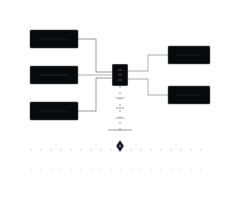
Production deployments often involve orchestration: one agent coordinating several specialized sub-agents, each handling a specific task. A claims processing system might have one agent for document extraction, one for policy lookup, one for eligibility verification, and one for routing. The orchestrating agent manages the workflow and passes results between them.
This improves reliability because each sub-agent has a narrow scope, which makes failures easier to isolate. It also adds complexity. More agents means more things that can go wrong in unexpected combinations.
voice agents that handle calls end-to-end#
Voice AI agents combine speech recognition, language model reasoning, and text-to-speech to handle a complete phone conversation: collecting information, booking appointments, routing calls, triggering post-call workflows.
A well-built voice agent for a dental practice answers every call, identifies new versus existing patients, books directly into the scheduling system, sends a confirmation, and logs the summary. No human involved unless the caller's situation falls outside what the system was built to handle.
These are not IVR menu trees. They handle natural, unscripted dialogue. Learn more about how voice AI agents work in practice.
the frameworks practitioners actually use#
LangGraph: stateful orchestration for production#
LangGraph, maintained by the LangChain team, is the go-to for production agentic systems that need state management across complex multi-step workflows. It models agent behavior as a graph: nodes are processing steps, edges are transitions based on conditions. State persists explicitly across the workflow.
LangGraph v1.0.10 is the current stable release as of early 2026. It is the default choice for teams that need observability, reliable state management, and multi-agent coordination.
Claude Agent SDK and OpenAI Agents SDK#
Anthropic's Claude Agent SDK (v0.1.48 as of early 2026) and OpenAI's Agents SDK (v0.10.2) are lighter-weight abstractions built on their respective models. Both prioritize developer ergonomics over advanced state management, which makes them a good fit for simpler agentic tasks or teams tied to one model provider.
The tradeoff is real: less framework overhead, but you own more of the orchestration logic yourself.
Agno and Pydantic AI#
Agno (formerly Phi-3) and Pydantic AI are newer frameworks that gained traction through 2025-2026. Agno optimizes for speed and minimal overhead. Pydantic AI brings type-safe agent development with the ergonomics of the Pydantic validation library, which many Python developers already know.
Neither has displaced LangGraph for complex stateful workflows. Both are worth knowing for the right use case.
For a full comparison of these frameworks in production deployments, see AI Agent SDKs Compared.
MCP: the integration layer that connects agents to your real data#
Model Context Protocol (MCP) is the open standard, released by Anthropic in November 2024 and donated to the Linux Foundation in December 2025, that gives agents a standardized way to connect to external tools and data sources. Without it (or equivalent integration work), an agent operates on whatever data is in its context window. With it, the agent can query live databases, read files, call APIs, and update records through a consistent interface.
By late 2025, over 10,000 production MCP servers existed for tools ranging from Google Calendar to Salesforce to custom internal systems. MCP is not required to build agentic AI. It is increasingly the default integration approach for teams who do not want to build their own connectors from scratch.
what agentic AI still cannot do#
Here is where a lot of writing about this technology goes soft. These are real limits, not caveats.
It does not handle genuinely novel situations well. Agentic systems are built and tested for a defined set of scenarios. When they hit something outside that scope, a caller making an unusual request, a document in an unexpected format, a workflow that requires judgment the system has never seen, they behave unpredictably. Sometimes they fail loudly. Often they fail silently, producing a plausible-looking result that is just wrong. Well-designed systems escalate these cases. Poorly designed ones don't.
Silent failure is the real risk, not dramatic failure. An agent that books the wrong appointment, extracts the wrong field, or routes to the wrong team will keep doing it until someone notices. Without a monitoring layer and human review for high-stakes decisions, you will not notice quickly. Observability is not optional; it is the part most teams skip until something goes wrong.
It does not replace judgment-intensive work. Clinical diagnosis, legal strategy, complex negotiation, nuanced client relationships: these involve contextual judgment that current models do not replicate reliably. The honest use case for agentic AI is well-defined, repeatable workflows with structured data. Not open-ended judgment calls.
Cost scales with complexity. Multi-agent systems with heavy orchestration have real inference costs at scale. Designing for efficiency, tool call frequency, context window size, model selection per task, is actual engineering work that gets underestimated in early planning.
how to know if agentic AI is right for your business#
The clearest signal is a workflow with two properties: it is repetitive with defined exceptions, and it crosses multiple systems where human time gets consumed passing data between them.
Volume matters too, but it is not the only test. A workflow that happens twice a week with a 30-minute cost is a reasonable target. One that happens twice a year probably is not, regardless of how painful it feels.
Industries where these conditions show up most reliably: healthcare and dental operations, legal intake, home services scheduling, insurance processing, and businesses with high inbound call volume and appointment-driven revenue.
If you are not sure whether your workflows qualify, a structured review is the logical starting point. Silverthread Labs offers a free automation audit that does exactly this: reviewing your current operations and identifying where agentic AI delivers real return versus where it does not.
frequently asked questions#
What is the difference between agentic AI and generative AI? Generative AI produces output, text, images, summaries, in response to a prompt. Agentic AI takes action: it uses tools, calls APIs, writes to databases, and completes multi-step workflows without a human directing each step. One produces a completion. The other changes the state of a real system.
How does an AI agent actually work step by step? An agent runs a loop: perceive (reads input and context), reason (uses a language model to plan), act (calls a tool or API), evaluate (checks the result). If the task is not complete, it loops again. This continues until the goal is reached or the agent hits a stopping condition or escalation rule.
What tools and frameworks are used to build agentic AI systems? As of 2026, the primary production frameworks are LangGraph (complex stateful multi-agent systems), the Claude Agent SDK and OpenAI Agents SDK (lighter-weight single-agent builds), Agno and Pydantic AI (speed-optimized or type-safe builds), and n8n (workflow orchestration connecting agents to business systems). Model Context Protocol (MCP) is the dominant integration standard for connecting agents to external data sources.
What can agentic AI do that a chatbot cannot? A chatbot responds to messages. An agentic system takes action: books the appointment, creates the record, sends the message, updates the CRM, routes the call, triggers downstream workflows. The chatbot produces a conversational output. The agent changes something in a real system.
How much does it cost to build an agentic AI system? A focused single-agent deployment, a voice agent for appointment booking with calendar integration, typically runs $5,000-$15,000 to build. Most business deployments with multiple workflows and CRM integration are $15,000-$35,000. Complex multi-agent systems with compliance requirements can run $50,000-$75,000 and above. Ongoing costs depend on infrastructure and call volume.
Is 79% of organizations really using agentic AI? The 79% adoption figure in some surveys reflects any level of agentic AI use, including pilots and early experiments. The same research reports that only 11% of organizations have agentic AI systems actively running in production at scale (Landbase, 2025). The gap between interest and production deployment is real.