MCP Server Development
A custom MCP server is the connection layer between your AI agents and the tools they need to act: your CRM, your EHR, your internal databases, the APIs your team built over the last decade. Without it, your agent can reason but cannot reach.
The Model Context Protocol has become the industry standard for that connection. One year after its release, it powers more than 10,000 public servers and sees 97 million monthly SDK downloads across Python and TypeScript. OpenAI, Google DeepMind, Microsoft, AWS, and Salesforce all standardized on it by mid-2025. In December 2025, Anthropic donated MCP to the Agentic AI Foundation under the Linux Foundation, making it vendor-neutral open infrastructure governed by a cross industry coalition including AWS, Google, Microsoft, OpenAI, Bloomberg, and Cloudflare.
Silverthread Labs builds production grade MCP servers, with auth layers, logging, compliance controls, and a versioning strategy scoped from day one.
what MCP actually does (and why it matters for AI agents)#
the context problem every AI agent hits#
An AI agent is only as capable as the context it can access. Most enterprise deployments hit the same wall at roughly the same moment: the agent reasons well and handles complex instructions, but when it needs to look up a customer record, query a database, or call an internal API, it is blocked. The data exists. The agent just cannot reach it.
The traditional answer has been ad-hoc tool integrations: bespoke API wrappers built per project, each with its own auth pattern and error handling. When you have three agents and six tools, you have 18 integration surfaces to maintain.
how MCP solves it: a standard connection layer#
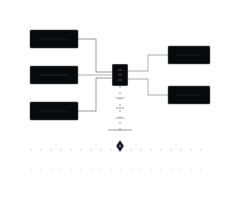
Model Context Protocol defines a uniform interface between AI agents and external systems. An MCP server exposes your tools, data sources, and services as a structured catalog of capabilities (resources, tools, and prompts) that any MCP-compatible agent can discover and call without custom integration code per pairing.
The agent sends a request to the MCP server. The server handles translation, auth, and response formatting. The protocol is transport-agnostic: servers run over stdio for local setups or HTTP with Server-Sent Events for remote deployments. An agent built on any MCP-compatible framework can connect to your server without rewriting integration logic for each model upgrade.
MCP as open infrastructure: the Linux Foundation donation#
On December 9, 2025, the Linux Foundation announced the Agentic AI Foundation (AAIF), with MCP as a founding project. The governance model mirrors what the Linux Foundation has done for decades: the spec evolves in the open, no single vendor controls the roadmap, and commercial implementations compete on quality rather than protocol lock-in.
For enterprise buyers, this matters. You are building on a standard with the same backing profile as Kubernetes and OpenTelemetry, not a single vendor's product roadmap.
what we build#
CRM, EHR, and internal tool connectors#
The most common MCP engagement starts with a specific gap: an AI agent needs to read from and write to a system that has no off-the-shelf adapter. A proprietary CRM. An EHR built on HL7 or FHIR. A homegrown internal tool that predates modern APIs. We design and build those connectors from the protocol up. What the agent can see, and what it cannot, is an architectural decision with real operational consequences.
database and API adapters for agentic workflows#
An agent may chain dozens of tool calls in a single session, each informed by the last. We build adapters that expose the right query surface, enforce row-level and schema-level access controls, and return structured data in formats the agent can reason over efficiently. For REST and GraphQL APIs, we handle schema translation, pagination, rate limiting, and error normalization: work that usually gets discovered in production and retrofitted.
multi-tool orchestration across your stack#
Most production use cases require an agent to coordinate across multiple systems in a single workflow: check a CRM record, query an order database, send a notification, update a ticket. We design MCP server architectures that expose multi-source capabilities through a coherent interface, so the agent sees one well-organized tool catalog rather than disconnected endpoints. Dependency ordering and graceful partial-failure handling are built in from the start.
enterprise MCP with auth, logging, and compliance#
Authentication, logging, and compliance controls are baseline deliverables in our engagements, not optional add-ons. We design auth layers that map to your existing identity infrastructure: OAuth 2.0, SAML, API key rotation, role-based access controls tied to your directory. We implement structured request/response logging at the MCP layer for audit trails that satisfy SOC 2, HIPAA, and GDPR requirements.
why production MCP is harder than it looks#
authentication adds 4-6 weeks most teams don't budget#
The MCP spec defines the protocol. It does not handle your organization's auth requirements. Enterprise authentication, OAuth flows, service account management, token refresh, permission inheritance from your directory, is a separate engineering problem that runs parallel to connector work. Authentication alone typically adds four to six weeks to enterprise MCP builds (Intuz / Zeo, 2025-2026). Most teams discover this in week two or three. We scope it explicitly at the start.
security: prompt injection, tool permissions, and lookalike tool risks#
Security researchers documented active MCP production risks in April 2025. OWASP ranked prompt injection as the number one vulnerability in its Top 10 for Large Language Model Applications 2025. The attack surface has three main vectors:
Prompt injection via tool responses. A compromised data source can embed instructions in content returned to your agent, redirecting its behavior through data it reads, not prompts it receives directly.
Over-permissive tool scopes. Invariant Labs demonstrated in 2025 that a malicious MCP server could silently exfiltrate sensitive data by exploiting over-permissive tool configurations alongside a legitimate server in the same agent session.
Lookalike tool substitution. MCP tools can mutate their own definitions after installation: a tool that appears safe at approval time may route requests differently a week later.
We scope permissions at minimum viable access per workflow, implement tool definition integrity checks, and actively verify that the data the agent retrieves is not being used to manipulate its responses.
versioning and schema drift over time#
The systems your MCP server connects to will change: APIs get versioned, database schemas evolve, third-party response formats shift. An MCP server built without a versioning strategy will break in production. By 2026, Gartner projects 75% of API gateway vendors will have MCP features, which means your server will increasingly need to coexist with vendor-managed adapters in the same agent environment. We design the versioning strategy at the architecture phase, before any of that becomes someone's emergency.
what "production-ready" actually means for an MCP server#
A production-ready MCP server handles auth failures gracefully without exposing raw error states to the agent. Request logging is structured and queryable. The tool catalog is documented clearly enough that a new engineer can understand what each tool does, what it can access, and what it cannot. The deployment has a health check, alerting, and a runbook for the most likely failure modes. That is the bar. We build to it.
how we scope and build#
step 1: stack audit and integration mapping#
Every engagement starts with a structured audit of what you are connecting. We map your target systems against what agent workflows actually need to access, surface auth dependencies early, and identify the highest-risk integration surfaces before any code is written. The output is an integration map and scoping document: what gets built, what gets deferred, and why.
step 2: server architecture and transport selection#
We select the right architecture for your deployment context: stdio for agent-local setups, HTTP/SSE for multi-tenant or cloud-hosted environments. We define resource and tool schema with naming conventions that scale as more tools are added. For multi-source builds, we design the orchestration layer at this stage.
step 3: auth layer and security hardening#
Auth runs as a parallel workstream, not an afterthought. We integrate with your existing identity infrastructure, define the tool permission model (which agent roles invoke which tools, what data each returns, what audit events get logged), and implement prompt injection mitigations and tool definition integrity checks at the server level.
step 4: testing, staging, and handoff with documentation#
We run unit tests per tool, integration tests against staging systems, and adversarial tests that probe security controls. We stand up a staging deployment mirroring production, run a handoff session with your engineering team, and deliver documentation covering the tool catalog, auth model, deployment configuration, and operational runbook. You own the server: source code, infrastructure-as-code, and documentation thorough enough to extend and maintain without calling us first.
engagement options and pricing#
SMB MVP ($25K-$50K): single-source connector, 2-4 week timeline#
One well-defined integration, a single CRM, database, or internal API, with a production quality server, basic auth integration, structured logging, and documentation. Good for teams that want to validate the MCP pattern with something real before committing to a broader rollout.
production grade ($60K-$120K): multi-source, auth, logging, 8-12 weeks#
Two to five integrated data sources, a full auth layer with your IdP, comprehensive logging for audit trails, tool permission scoping, versioning strategy, and the full testing and handoff process. This is the right scope when data accuracy, access controls, and operational visibility are non-negotiable.
enterprise with compliance ($100K+): regulated industries, full audit trail#
For healthcare, financial services, and other regulated industries where HIPAA, SOC 2, GDPR, or FedRAMP requirements shape every architectural decision. This tier adds compliance-mapped audit logging, data residency controls, role-based access aligned to your compliance framework, and incident response runbooks. Healthcare builds at this tier typically require twelve weeks with a three-person team, and total first-year investment often runs 2-3x initial estimates when compliance reviews and staged rollouts are factored in (Intuz, 2025). We scope that reality in at the start.
FAQ#
What is an MCP server and why does my AI agent need one?
An MCP server exposes your tools, databases, and APIs to AI agents using the Model Context Protocol standard. Your agent needs one when it has to act in the real world: reading records, querying databases, calling APIs, rather than just generating text. Without it, every agent-to-tool connection requires custom integration code that breaks when either side changes.
How much does it cost to build a custom MCP server?
Custom MCP development ranges from $25,000 for a single-source connector to $120,000 or more for multi-source enterprise builds with full auth, logging, and compliance controls. The main cost drivers are the number of integrated systems, authentication complexity, and compliance requirements. Enterprise auth alone typically adds four to six weeks of work that most initial estimates skip.
Which AI tools support the Model Context Protocol?
MCP is supported by Claude, GPT-4 and ChatGPT, Gemini, Microsoft Copilot, and major agent frameworks including LangChain, CrewAI, and AutoGen. An MCP server you build today connects to this entire ecosystem without modification.
How long does it take to build a production MCP server?
Single-source connectors take two to four weeks. Multi-source production builds with auth, logging, and compliance controls take eight to twelve weeks. Full enterprise rollouts, including security review, compliance validation, and staged deployment, can run six to eighteen months from planning to production at scale.
What is the difference between MCP and a standard API integration?
A standard API integration is point-to-point: custom code for one endpoint, repeated for every agent-tool pairing. If you have ten agents and eight tools, that is up to 80 integrations to maintain. MCP is a single interface layer: one server exposes all your tools, and any MCP-compatible agent connects without new integration work. It also adds capability discovery, so agents can query what tools exist and what they do.
What happens when our underlying systems change after deployment?
Schema drift is one of the most common reasons MCP servers fail in production. We design versioning strategies at the architecture phase and hand off a runbook that covers how upstream schema changes get handled without breaking active agent workflows.
book a free architecture audit#
If you are scoping a build and want a clear picture before committing, book a free architecture audit.
We will review your stack, map the integration surfaces your agent actually needs, flag the auth and security requirements you are likely to hit, and give you an honest estimate, including the parts most scoping conversations skip.
Book your free audit: no pitch. If we are not the right fit, we will tell you.
Related services: Agentic AI Development -- AI Developer Tooling
Further reading: What is MCP? -- MCP Servers Explained