agentic AI systems
Most companies aren't failing at AI because they lack access to models. They're failing because they're applying AI to the wrong layer. They build chatbots on top of workflows that need to be replaced, add copilots to processes that need to be automated, and deploy demos in contexts that demand production systems.
Agentic AI systems are different. They reason, plan, and act inside your real operations. They pull from your databases, write to your CRMs, trigger downstream processes. They close loops that currently require a human to babysit. We build them from scratch, connected to the tools your business actually runs on, deployed where your data governance requires.
the problem with most AI implementations#
why chatbots and copilots fall short of operational impact#
A chatbot answers questions. A copilot makes suggestions. Neither one does the work.
That distinction sounds obvious until you see how many organizations spend real budget on AI tools and walk away with an interface. A place where staff type questions and get answers. Not a system that closes a loop, processes a document, or runs a workflow without being asked twice.
The ROI from conversational AI is real but narrow. It reduces time to answer. It doesn't eliminate the human steps surrounding the conversation. Organizations deploying purpose-built agentic AI systems report average ROI of 171%, with U.S. enterprises hitting 192%, more than 3x the return from traditional automation (Landbase / Onereach AI, 2025). That gap exists because agentic systems act rather than respond.
the gap between AI demos and systems that do real work#
Every AI demo looks the same: a prompt goes in, an impressive output comes out. What the demo hides is the manual data cleaning before the prompt, the review step after the output, and the fact that none of it connects to the systems your team actually uses.
Production agentic systems handle incomplete data, retry on failure, escalate to a human when confidence is low, and write outputs to real databases. They do this reliably enough that your team trusts the results. That's an engineering problem, not a prompting problem. We spend most of our time here.
what agentic AI actually means in a production context#
An agentic AI system takes multi-step actions in the real world: it retrieves context from external data sources, reasons about what to do with it, calls tools and APIs to execute decisions, and passes results through a workflow without a human initiating each step.
In practice: an agent receives a new lead, researches the company, scores it against your ICP, drafts personalized outreach, and routes it to the right rep. Nobody touches it between trigger and delivery. Gartner projects 40% of enterprise applications will embed task-specific AI agents by 2026, up from less than 5% in 2025 (Gartner, 2025).
what agentic AI systems can do for your business#
autonomous lead research and enrichment#
An agentic lead research system receives a new contact from your CRM and works through multiple data sources on its own: company databases, news feeds, domain registries. It consolidates what it finds, scores the lead against your ICP criteria, and writes a structured summary back to the CRM before the rep opens it.
This isn't a data enrichment API with a UI wrapper. The difference matters when data conflicts across sources, or when a record needs a second lookup from a different provider. The agent handles that judgment call. A static pipeline doesn't.
document processing and data extraction pipelines#
Contracts, intake forms, invoices, compliance submissions. Most organizations still process these by hand or with brittle rule-based parsers.
A document processing agent handles variable layouts and extracts structured fields with confidence scores. It validates against your schema, routes exceptions for human review, and pushes clean data downstream. We've built these pipelines in environments with KYC/AML compliance constraints and HIPAA-adjacent data handling requirements where off the shelf tools can't operate.
multi-agent orchestration for complex operational workflows#
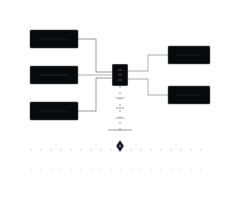
Some workflows need multiple agents coordinating: one to identify vendor candidates, a second to validate compliance requirements, a third to draft RFP language, a fourth to route approvals. An orchestrator manages state across the full process.
The hard part isn't getting agents to talk to each other. It's making the system observable when something goes wrong, and recoverable without a developer debugging it manually.
AI-powered internal operations assistants#
An internal operations assistant connected to your CRM, databases, support system, and ERP via MCP servers lets any team member ask operational questions in natural language. Current pipeline by segment. Bottlenecks in a process. Accounts untouched in 90 days. The agent handles query translation, retrieval, and synthesis, so your team gets answers without waiting on a data analyst.
automated reporting and insight generation#
Weekly reviews. Monthly summaries. Compliance reports. Most of these follow a predictable structure pulling from sources your systems already maintain, yet assembly is still manual.
An agentic reporting system runs scheduled pulls, applies your analysts' logic, and delivers a structured draft ready for review. Your team edits and approves rather than building from scratch.
customer onboarding automation#
Much of what makes onboarding high touch is coordination overhead, not actual human judgment. Sending the right materials at the right stage, collecting required information, routing provisioning requests, following up on incomplete submissions. These follow deterministic logic an agentic system handles reliably. Pair it with our voice AI capability and the agent handles outbound check-in calls alongside asynchronous coordination.
how we build agentic AI systems#
discovery: mapping the workflow and defining agent scope#
Every engagement starts with an Automation Audit. We map the workflow in detail: what triggers it, what data it touches, where decisions get made, where exceptions arise, what the current failure modes are. The output is a workflow map and agent scope definition covering what the agent will do, what it won't, and where human in the loop boundaries sit.
Vague scopes produce vague systems. We've learned this the hard way.
architecture: single-agent vs. multi-agent vs. orchestrated systems#
We design the simplest architecture that reliably produces the target outcome. A linear workflow with clear inputs and outputs usually calls for a single-agent pipeline. Workflows with parallel workstreams or role-based logic get a multi-agent architecture for separation of concerns. If human checkpoints span long time horizons, we build stateful systems that pause, resume, and maintain context across sessions.
The choice is driven by the workflow, not by what's technically impressive.
integration: connecting agents to your real data sources via MCP#
MCP server integrations give agents structured, permissioned access to your CRM, databases, internal APIs, and third party services without exposing raw credentials or bypassing access controls. An agent connected via MCP accesses your real operational context dynamically, which means it handles edge cases that a brittle hardcoded integration fails on. See MCP Development for more.
deployment: on your infrastructure or cloud, with full code handoff#
We deploy where your requirements dictate. Organizations with data residency or air-gapped infrastructure needs get on-premises deployment with no data leaving their environment. See our on-premises AI services for details. Where cloud is appropriate, we optimize for your existing stack.
Either way, you get full code ownership. No platform lock-in. No subscription dependency on our infrastructure.
observability: evals, guardrails, and human in the loop checkpoints#
Production agentic systems need to be trustworthy, more than functional. We build in structured logging, LLM evals to catch degraded output quality, guardrails that prevent agents from acting outside defined boundaries, and human in the loop checkpoints at stages where the cost of an error is high.
The goal is a system your operations team can trust without a developer validating every run.
our technology stack#
orchestration: LangGraph, LangChain, Agno, Pydantic AI#
LangGraph is our default for stateful multi-agent systems. Its graph-based execution model gives precise control over flow, state management, and conditional routing. We use LangChain for well-tested pipeline components, and Agno and Pydantic AI for typed, schema-validated outputs where data accuracy can't be compromised. We pick the framework that matches the problem.
models: Claude, GPT-4o, Gemini, DeepSeek, model-agnostic by design#
We select the right model for each task in the workflow. Claude leads on instruction-following and document analysis. GPT-4o leads on function calling and structured output at scale. Gemini's context window changes what's possible for long document workflows. DeepSeek opens on-premises deployment options that were previously uneconomical. The architecture keeps the model layer swappable as better options emerge.
integration: MCP servers for CRM, EHR, databases, and internal APIs#
Salesforce, HubSpot, common EHR systems, PostgreSQL, MySQL, internal REST and GraphQL APIs. We've built the connectors and know where the edge cases are. When a client system doesn't have a ready-made MCP server, we build one.
infrastructure: n8n, on-premises Ollama, or cloud#
Our workflow automation infrastructure uses n8n for broader operational orchestration, with agentic components embedded where reasoning is required. For on-premises LLM inference, we deploy Ollama with the right open-weight model sized for your throughput. For cloud deployments, we optimize for latency, cost, and reliability at your scale.
real outcomes from production agentic systems#
what 70% workflow cost reduction actually looks like in operations#
Organizations using agentic AI achieve up to 70% cost reduction by automating workflows from trigger to completion (Onereach AI / Master of Code, 2025). In a document processing workflow, that means a team managing exceptions on a system processing 4x the previous volume, doing higher judgment work instead of data entry. In a lead enrichment workflow, it means BDR research time dropping from 45 minutes per account to 5, with pipeline velocity accelerating because reps focus on qualified conversations.
The cost reduction is real. What matters more is where it comes from: time shifted from manual, repeatable work toward work that requires human judgment.
the compounding effect: agents get more useful as they run longer#
A well-designed agentic system improves over time. Guardrails get tuned as edge cases surface. Integration coverage expands as new data sources come online. Evals catch model drift before it affects output quality.
The global agentic AI market is projected to grow from $7.55 billion in 2025 to $199.05 billion by 2034 at a 43.84% CAGR (Precedence Research, 2025). That growth reflects something practical: most organizations that try agentic AI expand their use of it, and most that haven't started are planning to (Landbase, 2025).
pricing and engagement model#
starting with an Automation Audit#
Every engagement starts here: a structured working session where we map your highest value manual workflows, identify which are technically ready for agentic automation, and produce a prioritized implementation roadmap with effort and impact estimates. The audit is the right first step whether you're early in your AI thinking or have already tried tools that didn't fit.
implementation projects: $5,000 to $50,000+#
Single-agent pipelines for defined workflows typically run $5,000 to $15,000 including integration and deployment. Multi-agent orchestration systems run $20,000 to $50,000. Compliance-grade or on-premises deployments are scoped after the audit. The range reflects genuine architectural variation. We scope after we understand the actual workflow; quotes built from a brief conversation are guesses.
ongoing retainer: iteration, maintenance, and expansion#
Production agentic systems need ongoing engineering attention: model updates, prompt tuning as workflows evolve, integration maintenance as upstream systems change, expansion as new use cases emerge. Retainer clients get priority access, faster iteration cycles, and a team that already knows their systems.
frequently asked questions#
What is an agentic AI system and how does it work?
An agentic AI system takes multi-step actions autonomously. It receives a trigger, retrieves context from external data sources, reasons about what to do, calls tools and APIs to execute decisions, and passes results through a workflow without a human initiating each step. This could be a lead research agent updating your CRM, a document pipeline populating a database, or multiple coordinated agents handling a complex operational workflow.
What is the difference between a chatbot and an agentic AI system?
A chatbot responds. It takes input and produces output but doesn't act on anything. An agentic system acts: it calls external APIs, writes to databases, triggers downstream processes, and executes multi-step workflows.
What tools and frameworks are used to build agentic AI systems?
LangGraph and LangChain for orchestration, Agno and Pydantic AI for typed agent pipelines, and MCP for integration. On the model side, we are provider-agnostic: Claude, GPT-4o, Gemini, and DeepSeek all have roles depending on task requirements. Infrastructure runs on n8n, with on-premises or cloud LLM inference depending on your data requirements.
Can agentic AI integrate with existing business software like CRMs and ERPs?
Yes. We use MCP servers to give agents structured, permissioned access to Salesforce, HubSpot, common EHR platforms, SQL databases, and internal REST and GraphQL APIs. When a ready-made MCP server doesn't exist for a system you use, we build one.
How much does it cost to build a custom AI agent?
Single-agent pipelines typically run $5,000 to $15,000. Multi-agent orchestration systems run $20,000 to $50,000. Compliance-grade or on-premises deployments are scoped after the Automation Audit. The audit is the right starting point; it produces an honest scope and prevents both underbuilding and overbuilding.
How long does it take to build and deploy an agentic system?
A single-agent pipeline with straightforward integration typically deploys in three to six weeks. Multi-agent systems with extensive integration work run eight to sixteen weeks. The timeline depends on integration complexity and the number of edge cases in the workflow, both of which the audit surfaces before the build begins.
Do we own the code after the project is complete?
Yes. Full code ownership at project completion. No dependency on our infrastructure, no platform subscription, no lock-in of any kind.
Can agentic systems run on-premises for data privacy?
Yes. For organizations with data residency requirements, HIPAA-adjacent compliance constraints, or air-gapped infrastructure needs, we deploy fully on-premises systems with no data leaving your environment, including local LLM inference using Ollama with open-weight models. See on-premises AI services for detail.
If your team spends 20 or more hours per week on workflows that follow deterministic logic (data entry, document processing, lead research, report assembly), there's almost certainly a case for agentic automation. The Automation Audit is the fastest way to figure out where to start and what it would actually take to build.