AI Automation for Recruiting
Recruiters save 15-20 hours per week on initial screenings alone when automation handles the pipeline. That's before you count interview scheduling, ATS updates, and candidate follow-up. If your team is processing 15-20 candidates per day manually and watching the funnel slow every time volume spikes, the ceiling isn't a talent problem. It's an infrastructure problem.
The recruiting bottleneck isn't a talent problem#
Why high-volume recruiting breaks manually#
Manual recruiting doesn't fail because recruiters aren't skilled. It fails because the work is overwhelmingly repetitive, and repetitive work doesn't scale with headcount. Every new recruiter you hire handles roughly the same candidate volume as the last one. You're adding bodies, not capacity.
The bottleneck shows up in three places: screening the wrong candidates too long, spending hours coordinating interviews that could be scheduled in seconds, and maintaining ATS records that drift out of sync because updates require manual entry after every touchpoint.
At 50 open roles, those inefficiencies are manageable. At 200, they become the constraint that limits how fast you can close.
The hidden cost: 15-20 hours per week lost to screening and scheduling#
According to data from HRMless (2026), recruiters lose 15-20 hours per week to initial screening tasks alone. Add interview coordination, and you're looking at roughly half a workweek consumed by logistics before a single hiring decision gets made.
AI-led scheduling cuts interview coordination time by 60-80%. 41% of talent acquisition teams had already piloted AI scheduling tools as of 2025 (HeroHunt). The numbers aren't the argument, though. The question is whether you build a workflow that actually integrates with your existing stack, or add another siloed tool that requires its own maintenance.
What the pipeline looks like before automation#
Before automation, a typical mid-volume recruiting pipeline looks like this: applications arrive in the ATS from multiple job boards, a recruiter opens each one manually, scores them against a mental model of the ideal profile, drafts and sends a screening email, waits for a response, coordinates availability across multiple calendar threads, updates the ATS record, and moves to the next candidate. Multiply by 50 applications per open role.
Every step in that sequence takes under 30 seconds for a workflow.
What AI recruiting automation actually does#
Resume screening and candidate scoring#
The first node in the workflow receives the application, parses the resume, and scores the candidate against a rubric you define: years of experience, required skills, role-specific criteria, disqualifying factors. Scoring happens against structured criteria, not keyword matching. The output is a pass/hold/reject classification with a confidence score, written to the ATS record automatically.
This is not a black box. The scoring criteria are documented, adjustable, and yours to update as your hiring requirements evolve.
AI-led interview scheduling (60-80% time reduction)#
Qualified candidates receive an automated outreach sequence, email, SMS, or both, with a scheduling link that syncs directly to interviewer calendars. No email threads. The candidate picks a slot, the interview is confirmed, and calendar holds are created for everyone involved.
For shortlisted candidates, a voice screening agent can run a structured pre-interview call: asking qualifying questions, capturing responses, and appending a summary to the candidate's ATS record before the human interview begins.
ATS updates and status notifications#
Every state change in the pipeline, new application received, screened and passed, interview scheduled, offer extended, triggers an automatic ATS update and a notification to the relevant recruiter. No manual record-keeping. The system writes the record when the event occurs.
Voice screening calls for shortlisted candidates#
For roles where a brief screening conversation matters before a full interview, an AI voice agent handles that call. It works from a structured script you define, captures responses in structured format, and appends a transcript summary to the candidate profile. Recruiters review a summary, not a raw recording.
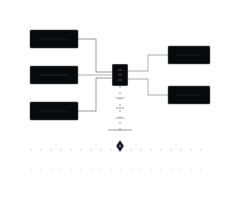
How we build it: the workflow architecture#
Step 1: application intake and resume parsing#
Applications from your ATS, or directly from job boards via webhook, enter the workflow. Resume content is extracted and normalized: work history, skills, tenure, education, and any custom fields your scoring model requires. This happens in real time as applications arrive.
Step 2: scoring against your criteria#
We define the scoring rubric with you during scoping: required skills, preferred experience ranges, deal-breaker conditions. The output is human-readable, a plain explanation alongside the score, so a recruiter can audit any decision. Results are written to the ATS record with a status tag.
Step 3: automated outreach and scheduling#
Passed candidates receive a personalized outreach sequence. Subject lines, message copy, and scheduling links are configured during build. The workflow handles follow-ups on non-response, typically two over 72 hours before the lead goes cold. Scheduling confirmation triggers a calendar hold and a confirmation message to the candidate.
Step 4: ATS push and recruiter notification#
Every workflow event pushes data to the ATS in real time. Recruiter notifications, Slack, email, or both, fire on events that need human attention: a candidate who passed scoring but left a flag in their responses, a scheduling conflict that needs manual resolution, a hire-ready candidate sitting in a queue. Everything else runs automatically.
Integrations we build against#
ATS: Greenhouse, Lever, Workable#
We build directly against the APIs of the three major mid-market ATS platforms. Candidate records, pipeline stages, job requisitions, and status fields are read and written through the native API: not scraped, not emailed, not synced via a CSV export. Data stays in your ATS where your team already works.
If you're running a different ATS, the integration is still usually possible. Most platforms expose REST or webhook endpoints. We scope this during discovery.
Calendar and scheduling systems#
Scheduling integrations work with Google Calendar and Microsoft Outlook/Teams. Interview slots are offered based on real time interviewer availability, and confirmed bookings create calendar holds automatically. No double-booking, no manual calendar management.
Communication: email, SMS, Slack#
Candidate outreach runs over email by default. SMS can be added for mobile-first candidate populations. Recruiter notifications route to Slack or email based on your team's preference. All outreach templates are configurable: you control the copy, the cadence, and the tone.
n8n as the workflow backbone#
The entire automation stack runs on n8n, an open-source workflow platform we deploy on your infrastructure or a private cloud environment. n8n connects every system in the pipeline without vendor lock-in. You own the workflows. If your team wants to modify a step six months from now, the tooling is transparent and accessible.
What this looks like for a 10-person recruiting firm#
Before: capacity ceiling at 15-20 candidates per day manually#
A 10-person recruiting firm processing candidates manually can typically handle 15-20 qualified candidate reviews per recruiter per day before quality drops. At peak, with multiple open roles and high application volume, the pipeline backs up. Qualified candidates wait days for a response, and some take offers elsewhere before anyone contacts them.
The bottleneck is time, not judgment.
After: 100+ candidates per day processed without additional headcount#
With automation handling screening, scoring, outreach, and scheduling, the same 10-person team can process 100+ candidates per day. Recruiters spend their time on evaluation and candidate experience, not on logistics.
The numbers from Second Talent: 31% faster time-to-hire, 50% improvement in quality-of-hire metrics, 20-40% lower cost-per-hire. DemandSage reports that among companies using recruitment automation, 66% have reduced hiring costs post-adoption.
ROI anchor: 340% average within 18 months#
PwC's AI Workforce Analysis (via Shortlistd) puts the average ROI of AI recruitment tools at 340% within 18 months. That figure accounts for both direct savings, time recovered and redeployed, and revenue upside from faster time-to-fill on roles with direct revenue impact.
For a firm billing on placements, every day shaved off average time-to-fill has a dollar value. The more open roles you're running, the faster that compounds.
FAQ#
How is AI used in the recruitment process?
AI handles the repeatable steps: parsing resumes, scoring candidates against defined criteria, sending outreach, coordinating scheduling, updating ATS records, and running structured pre-screening calls. Human recruiters stay focused on evaluation, relationship management, and final selection.
How much time does recruitment automation save per recruiter?
Data from HRMless (2026) puts the savings at 15-20 hours per week on initial screening tasks alone. Add scheduling automation, and total time savings typically exceed 20 hours per recruiter per week on administrative work.
What recruiting tasks should be automated first?
Resume screening and interview scheduling are the two highest-volume, most time-consuming tasks, so that's where to start. ATS status updates and candidate outreach sequences are typically added in the same build. Voice screening can be layered in for roles where a brief qualifying call is standard practice.
What is the ROI of AI in recruiting?
PwC's AI Workforce Analysis reports a 340% average ROI within 18 months. Time-to-hire typically drops 31%, cost-per-hire falls 20-40%, and recruiter capacity for qualified candidate review increases significantly. The ROI scales with volume: the more candidates you're processing, the faster the return.
Can workflow automation integrate with Greenhouse, Lever, or Workable?
Yes. We build directly against the native APIs of all three platforms. Candidate records, pipeline stages, and status fields are read and written in real time. If you're running a different ATS, most platforms expose REST or webhook endpoints that can be connected. We scope this during discovery.
Book a workflow audit to map your current recruiting pipeline. We'll identify where automation has the most impact and give you a build estimate.
Explore the workflow automation service overview or see how AI voice agents pair with recruiting workflows to handle candidate screening calls from application to confirmed interview.