Workflow Automation for Insurance Agencies
Insurance operations run on repetitive, high-stakes work: claims intake calls, policy renewal notices, document collection requests, adjuster assignments, status updates. Each task follows a defined process. Most happen on the phone or in an inbox. None require human judgment, yet almost all of them consume human time.
AI workflow automation for insurance agencies connects those processes, from the first FNOL call through document collection, fraud checks, and adjuster assignment, without rebuilding your agency management system or moving policyholder data somewhere you don't control.
where insurance operations break down#
manual claims intake: the first bottleneck#
When a policyholder calls to report a claim, someone has to answer, collect the incident details, verify coverage, create the claim record, and route it to the right adjuster. In most independent agencies, that sequence takes 20-40 minutes per claim and requires an experienced staff member to handle it correctly.
At 10 claims per day, that's manageable. At 50, you've given a large portion of the team's capacity to intake alone, before anyone has reviewed coverage, assessed damages, or made a payment decision. Claim that should reach an adjuster in an hour instead waits in a queue until someone is free.
policy renewal cycles that slip through the cracks#
Renewal outreach depends on someone pulling the expiring policy list, drafting a communication, and following up with clients who haven't responded. When staff is absorbed in claims handling, renewals fall behind. Clients who don't hear from their agency shop around, and many don't come back.
Inconsistent outreach is an operational problem. The relationship follows from the process, not the other way around.
document collection delays that extend claim resolution#
After intake, every claim requires documentation: police reports, medical records, repair estimates, photos, contractor invoices. Collecting those documents manually means sending requests, waiting, following up, chasing, and waiting again. Each delay extends the claim cycle. Extended cycles produce more dissatisfied policyholders, raise the chance of litigation, and compound cost. A 30-day cycle becomes 60 not because the claim is complicated, but because nobody followed up on the document request.
call center costs that compound at volume#
Each inbound service call costs an insurance agency an estimated $2.70-$5.60 in direct handling cost. Most of those calls are status inquiries, document requests, or renewal confirmations. None require a licensed agent. They just require someone to pick up.
how workflow automation closes the loop#
from FNOL call to adjuster assignment, automated#
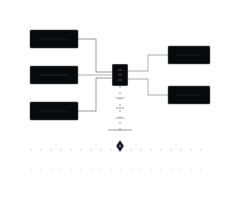
An AI voice agent answers the First Notice of Loss call, walks the policyholder through structured intake questions, verifies policy coverage in real time, creates the claim record in your agency management system, and routes the claim to the appropriate adjuster, all without a human in the loop.
The voice agent handles the structured parts of FNOL intake. When a call requires human judgment, a complex coverage question, an escalation, a distressed policyholder, it transfers to a staff member with the intake data already filled in.
policy renewal reminders and endorsement processing#
Renewal workflows trigger automatically based on policy expiration dates pulled from your AMS. Outreach, email, SMS, or voice, goes out at the intervals you configure: 90 days out, 60 days, 30 days, and a final notice. If a client doesn't respond, the workflow escalates to a staff member. If they respond with an endorsement request, the workflow captures the change and routes it for processing.
No manual list-pulling. No dropped renewals. No client surprises.
automated document requests and status updates#
After intake, the workflow sends document request sequences automatically, with links, deadlines, and follow-up reminders built in. When documents arrive, they're logged to the claim record and the next step triggers. If a deadline passes without a response, the claim is flagged for staff review.
Policyholders get status updates at each stage of the claim lifecycle, intake confirmed, documents received, under review, payment issued, without anyone drafting those updates manually.
fraud signal detection before a claim escalates#
Early fraud detection reduces payout risk. The workflow checks incoming claims against fraud indicator patterns: duplicate claims, inconsistent incident details, policy age at time of claim, claimant history. Claims that trip those signals are flagged for adjuster review before processing moves forward, before documents are requested, before any payment commitment is made.
According to Geniusee (2025), automated fraud detection identifies suspicious claims 50% faster and reduces fraudulent payouts by up to 40%.
the tech stack: n8n, AMS integrations, and hosted infrastructure#
why n8n for insurance workflows#
n8n is an open-source workflow automation platform that connects systems via API without locking your processes into a proprietary platform. For insurance agencies, that matters: your workflow logic runs in your environment, on your infrastructure, and your team can audit or modify any step without going back to a vendor.
n8n handles the routing, transformation, and sequencing that connects your AMS, communication stack, document management system, and voice channel into a single pipeline.
AMS integrations: Applied Epic, HawkSoft, EZLynx, and others#
We build directly against the APIs of major agency management systems. Claims, policies, contacts, and documents are read and written through the native API, not synced via export files or manual data entry. The claim record in your AMS stays current throughout the lifecycle because the workflow updates it at each step.
If your AMS exposes a REST API or webhook endpoint, integration is standard. If it doesn't, we evaluate alternative connection methods during scoping.
on-premises deployment for compliance and data sovereignty#
Policyholder data is sensitive. State privacy regulations, E&O exposure, and basic data hygiene all argue against routing it through third-party automation platforms where data handling is opaque. With on-premises n8n, the automation infrastructure runs inside your environment, your cloud account or your on-premises server. Policyholder data stays on infrastructure you control.
We take the same approach for healthcare automation where HIPAA requirements make data sovereignty non-negotiable. For insurance agencies, it's a risk management decision as much as a technical one.
voice agent and workflow: AI handles FNOL calls and triggers the automation chain#
The AI voice agent for insurance is the intake layer. When a policyholder calls to report a claim, the voice agent handles the structured intake conversation, writes the data to the workflow, and the automation chain begins, claim creation, document requests, adjuster routing, without staff intervention.
The voice agent also handles outbound renewal calls, payment reminders, and status inquiries at a fraction of the cost of call center handling.
what gets automated first#
claims intake and triage#
First FNOL call to claim record creation with adjuster routing. This is typically the highest-volume, highest-cost manual process in an independent agency, with the clearest, most repeatable structure. It's almost always the first build.
policy renewals and lapse prevention#
Renewal outreach sequences are straightforward to automate and have a direct revenue impact. Lapse prevention workflows, identifying policies at risk of non-renewal and triggering outreach, typically run alongside renewal automation.
document processing and extraction#
Document requests, receipt confirmation, and data extraction from standard documents, repair estimates, medical records, invoices, can be automated once the intake and routing workflows are stable. AI document extraction pulls structured data from unstructured PDFs and routes it to the correct claim record.
client status notifications and follow-up sequences#
Status notification workflows run throughout the claim lifecycle. Low-complexity to build and high-value to clients: they cut inbound status calls and improve policyholder satisfaction without requiring any change to how adjusters work.
results: what changes after automation#
claims cycle time reduced by 47-75%#
V7 Labs (2025) reports AI-driven claims processing delivering 5-10x faster claim cycles with resolution cost reductions up to 75%. FlowForma (2025) puts claims processing time reductions at up to 50%, days instead of weeks, with 20-30% operational cost reduction.
Wait time between process steps drives most of the current cycle length. When document requests go out automatically and follow-ups run on schedule, claims move continuously rather than sitting idle.
operational cost reduction of 20-65%#
Cost reduction depends on current automation baseline and process complexity. FlowForma puts the range at 20-30% for mid-complexity operations. BizData360 (2025) documents 65% operational cost reductions for agencies that automate onboarding, policy management, and claims simultaneously.
Call center cost is a significant component. Each service call handled by an automated voice agent instead of a staff member saves $2.70-$5.60 in direct handling cost. At 100 calls per day, that adds up fast.
fraud detection 50% faster#
Automated fraud flagging reviews every incoming claim against detection criteria in real time. The 50% faster detection figure from Geniusee (2025) translates to earlier intervention and lower payout exposure. Suspicious claims get flagged before any processing begins, which means before documents are requested and before any payment commitment is made.
staff time shifted from data entry to coverage decisions#
Once automation handles intake, document chasing, status updates, and scheduling, the claims team can spend time on what they're licensed and trained to do: reviewing coverage, managing complex claims, working with policyholders through difficult situations. That shift matters both for outcomes and for retention.
ARDEM (2025) documents an average 240% ROI within 6-12 months for insurance automation deployments, consistent with the cost and throughput figures above.
FAQ#
How is AI used in insurance claims processing?
AI handles the structured parts of claims processing: intake data collection via voice agent, fraud signal detection, document extraction and routing, adjuster assignment based on claim type and capacity, and status notification throughout the lifecycle. Human adjusters handle coverage review, complex claim decisions, and any client interaction that requires judgment or de-escalation.
What is the ROI of automation in insurance agencies?
ARDEM (2025) documents an average 240% ROI within 6-12 months. The main drivers are claims cycle time reduction (47-75%), call center cost reduction ($2.70-$5.60 per call avoided), and fraud detection improvement (up to 40% reduction in fraudulent payouts).
How long does it take to automate insurance workflows?
A standard claims intake and routing workflow with AMS integration typically deploys in 6-10 weeks. More complex builds, adding document extraction, renewal automation, and voice agent integration, take longer. We scope the build in detail before any development starts.
What insurance processes should be automated first?
Claims intake and triage is almost always the first build. It's the highest-volume process with the most repeatable structure. Policy renewal outreach sequences come next because of their direct revenue impact. Document processing and status notifications are typically added in subsequent phases.
Can workflow automation integrate with my agency management system?
Yes, for major platforms including Applied Epic, HawkSoft, and EZLynx. Integration is built against the native API so claim records, policy data, and document routing all stay inside your AMS. If your AMS isn't on that list, we evaluate integration feasibility during scoping.
Want to see where your claims process is losing time? Book a workflow audit and we'll map it against an automation architecture, with a concrete build estimate.
See how our AI infrastructure keeps policyholder data on your own servers, or explore the workflow automation overview to understand how the full stack fits together.