Systems Integration Services
You have the right tools. HubSpot tracks your deals. QuickBooks handles the invoices. Airtable manages the projects. But when a deal closes, someone still copies data from one screen to another. When a payment comes in, the project tracker doesn't know. When a form is submitted, the CRM waits.
The tools work. The stack doesn't.
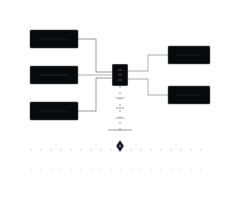
Systems integration is the engineering work that connects your software at the API level, so data moves when it should, errors surface when they happen, and your team stops doing work that machines should be doing.
the problem: your tools work. your stack doesn't.#
the average business runs nearly 900 applications, 71% of them unconnected#
The average organization runs 897 applications. Only 28% of them are integrated (MuleSoft Connectivity Benchmark Report, 2025). 72% of your software operating in isolation is a structural problem, and it costs real money.
Poor data quality from disconnected systems costs organizations an average of $12.9 million per year (Gartner, 2024). For smaller businesses, the number is lower in absolute terms but proportionally just as damaging: duplicated records, delayed billing cycles, missed handoffs, reporting that takes hours to produce manually and is stale before anyone reads it.
68% of organizations ranked data silos as their single biggest operational challenge in 2024, up 7% from the prior year (DATAVERSITY, 2024). The more software your team adopts, the more acute the problem becomes, unless the connections are built deliberately.
what that actually costs#
The costs compound in ways that don't show up on a single line item:
- Manual re-entry. Your ops team keys the same deal data into three systems. Each entry takes time and introduces error.
- Delayed reporting. Your weekly revenue number requires pulling from four tools and reconciling discrepancies. By the time it's ready, the week it describes is over.
- Broken handoffs. A new client signs. Someone has to remember to create the project, trigger billing, and notify the team. When one step is missed, the client experience suffers before the work has started.
- Stale data. Your CRM says "prospect." The billing system says "paying customer." Neither trusts the other, so someone has to check both.
None of these problems require new software. They require the software you already have to talk to each other.
where no-code automation tools fall short#
No-code automation platforms are a legitimate starting point for simple, linear triggers. The limits appear fast once complexity enters:
- Field changes break flows. If someone renames a field in your CRM, the flow fails silently: no alert, no fallback, just missing data until someone notices.
- No real error handling. Most no-code platforms log errors but do not retry, route around failures, or notify your team in any structured way.
- Rate limits. High-volume data syncs hit platform throttling, and the workarounds are unstable.
- Conditional logic hits a ceiling. Multi-branch flows with exception handling and data transformation require code. No-code tools approximate this but do not replace it.
When a business has outgrown these tools, or the complexity was always there, the right answer is custom API integration built to production standards.
what systems integration actually means#
API integration vs. no-code connectors: when each is the right call#
The distinction is about fitness for the job, not sophistication.
No-code connectors are appropriate when the trigger-action logic is simple and linear, both systems have stable connectors, data volume is low, and speed of setup matters more than durability.
Custom API integration is appropriate when data must transform between systems, error handling and retry logic are required, authentication is complex, volume is high enough to hit rate limits, or the integration needs to be maintained and versioned alongside the business.
Silverthread Labs builds in the second category. That is not a preference: it is what the work requires when the stack is real and the business depends on it.
sync timing: tradeoffs that matter#
Not every integration should sync immediately. The choice has meaningful operational and cost implications.
| Live Sync | Scheduled Batch Sync | |
|---|---|---|
| Latency | Seconds | Minutes to hours |
| Use case | Notifications, billing triggers, live dashboards | Reporting, data warehouse updates, bulk exports |
| Complexity | Higher: webhook endpoints, retry logic | Lower: scheduled runs, failure logs |
| Best for | Customer-facing triggers, financial transactions | Analytical pipelines, non-urgent syncs |
Most production stacks use both. The engineering decision is which connections warrant live handling and which can tolerate a delay.
one-way push vs. bidirectional data flow#
A one-way push moves data from a source system to a destination. Simple, lower-risk, easier to maintain.
Bidirectional sync introduces conflict resolution requirements: what happens when the same record is edited in both systems simultaneously? Which system wins? These are predictable scenarios that require explicit design decisions before the first line of code is written. We make those decisions during architecture, not after a production incident forces the conversation.
what we connect (and how)#
CRM to billing and finance: HubSpot, Salesforce, Pipedrive to Stripe, QuickBooks#
When a deal closes in your CRM, downstream events should trigger automatically: invoice creation, customer record setup, project intake. None of that should require a human to log into three tabs and copy fields by hand.
We build the API connectors that handle this reliably, including error alerting, field mapping that survives CRM customizations, and idempotency checks that prevent duplicate records on retry.
Common integrations: HubSpot to Stripe deal-close automation, Salesforce to QuickBooks contract-to-billing sync, Pipedrive to Xero pipeline stage events.
operations and project management: Airtable, Notion, Monday.com to Slack, email#
Project trackers should surface updates where your team already works. We connect your project management layer to communication channels so status changes, due dates, and new assignments reach the right people without anyone checking a separate tool or copy-pasting updates manually.
forms and intake pipelines: Typeform, JotForm to CRM, Google Workspace#
Every form submission is a data entry event that, without integration, requires a human to process. We connect intake forms directly to your CRM, project management system, and document tools, so onboarding starts the moment a form is submitted.
This layer typically includes data transformation: structuring form responses into exact CRM fields, routing submissions based on response values, and triggering follow-up sequences.
legacy system API bridging: connecting old infrastructure to modern tooling#
Not every system in your stack has a modern REST API. We build bridge layers that translate legacy formats (SOAP, FTP, proprietary database connections) into modern API-compatible structures, letting older infrastructure participate in your connected stack without a full replacement.
how we build it#
stack audit#
Before writing any code, we document which systems hold which data, where data moves today including manual steps, and where the gaps are. This surfaces the integrations with the most immediate operational impact and identifies dependencies that affect sequencing.
integration architecture#
With the data map in place, we design the architecture: live versus batch, bidirectional sync requirements, transformation logic placement, and monitoring needs. We document this before building. You know what you are getting and why before a line of code is written.
build, test, and handle edge cases#
Integration development includes staging environments and explicit testing of failure scenarios, including failure paths alongside the happy path. We build error handling, retry logic, and fallback behavior into every production integration. Edge cases covered: duplicate record prevention, rate limit management, authentication token refresh, partial payload failures, and schema drift when upstream systems update.
monitoring, alerting, and documentation#
We instrument every integration with logging and alerting. When a sync fails, the right person knows immediately with enough context to fix it fast. We deliver documentation covering what the integration does, how it is structured, what the failure modes are, and how to update it when underlying systems change.
how systems integration supports your agentic AI layer#
why agents need clean, connected data to act reliably#
AI agents do not operate on data they cannot access. An agent handling lead qualification, follow-up scheduling, or support ticket routing needs accurate, current data from across your stack.
95% of IT leaders report that integration gaps are the primary barrier to AI implementation in their organizations (Bizdata360, 2025). Teams invest in AI tooling, then discover agents underperform because the underlying data infrastructure is not connected. The agents are not the problem. The unconnected stack is.
integration as the foundation for workflow automation#
Workflow automation operates on top of integrated systems. Automating a multi-step business process, whether onboarding, billing reconciliation, or client reporting, requires that the systems involved pass data to each other reliably. Without that foundation, automation requires constant human intervention to correct the gaps.
We build integration and automation together. Many clients start with integration work that immediately unlocks automation that was previously impossible.
from connected stack to autonomous operations#
If your goal is AI agents handling sales qualification, operations management, or customer support, the first engineering question is always: what data do those agents need, and can they access it reliably? That is an integration question. We answer it before building the agentic AI layer on top.
pricing and scope#
We scope integration projects based on the number of systems, data complexity, and whether the work requires custom API development.
point-to-point integration (2 systems)#
Connecting two systems with a defined data flow: one source, one destination, one set of transformation rules.
Typical scope: 2-4 weeks Typical range: $1,500 - $4,500 Includes: Architecture design, custom connector build, error handling, alerting, documentation
Examples: HubSpot to Stripe deal-close automation, Typeform to Airtable intake pipeline, Slack notification layer for a project management tool.
multi-system integration (3-6 systems)#
Connecting multiple systems into a coherent data layer, including live and batch sync components across tool categories.
Typical scope: 4-10 weeks Typical range: $5,000 - $15,000 Includes: Full stack audit, integration architecture document, multi-system connector build, bidirectional sync where required, monitoring infrastructure, complete documentation
ongoing integration maintenance and expansion#
Integrations evolve as your stack changes: API versions update, new tools get added, processes shift. We offer ongoing maintenance arrangements covering monitoring, incident response, and expansion. Several clients treat us as their integration engineering team on retainer, calling on us when something breaks or when a new system needs to be wired in.
frequently asked questions#
How much does systems integration cost for a small business?
Point-to-point integrations connecting two systems typically range from $1,500 to $4,500. Multi-system integrations spanning three to six tools typically range from $5,000 to $15,000. The primary cost drivers are the number of systems involved, whether bidirectional sync is required, data transformation complexity, and whether custom API connectors need to be built from scratch. We scope every project before quoting.
How long does CRM and billing system integration take?
A standard CRM-to-billing integration, connecting a deal-close event in HubSpot to invoice creation in Stripe or QuickBooks, typically takes 2-4 weeks from kickoff to production deployment. That includes architecture design, build, testing with real data, error handling, and documentation. Integrations with additional systems or bidirectional sync requirements take 4-10 weeks.
What tools do you use to integrate business software?
We build custom integrations using direct API calls, OAuth authentication flows, and middleware where appropriate. Our engineers write integration logic in Python and TypeScript, deploy on infrastructure that fits your environment, and instrument everything with logging and alerting. We do not rely on a single platform: we choose the right tooling for each layer.
Can you integrate HubSpot with QuickBooks without replacing either?
Yes. We connect systems at the API level. Your existing tools stay in place. The integration adds a data layer between them, so when a deal closes in HubSpot, QuickBooks is updated automatically. No replacement required.
What is the difference between workflow automation and systems integration?
Systems integration is the foundational layer: it establishes reliable data connections between your tools. Workflow automation is what you build on top, multi-step business processes that execute automatically once the underlying systems are connected. The two are closely related, and many clients pursue them together. See our workflow automation services for more.
What happens when an integrated system updates its API?
API updates are a predictable maintenance event. When an upstream system changes its API version or field structure, the integration needs to be updated. For clients on maintenance arrangements, we monitor for API deprecation notices and handle updates proactively. For clients who take the integration in-house, the documentation we deliver makes it straightforward for your engineering team to maintain.
Do you work with legacy systems that don't have modern APIs?
Yes. We build bridge layers for older systems that expose data via SOAP, FTP, database connections, or proprietary formats, translating legacy data into modern API-compatible structures so older infrastructure can participate in your connected stack without requiring replacement.
get a stack audit#
We map your current data flows, identify the highest-value connections to build, and deliver a clear integration architecture before any development begins. You get a concrete plan with scope and cost estimates. No open-ended engagement, no surprise scope creep.
Request a stack audit to get started.