Automation Audit
You know your team spends too many hours on manual work. You've probably said "we should automate something" more than once. But here's where it stalls: you don't know which process to start with, what it'll cost to build, or whether your current tools can even support it.
That uncertainty is the most common barrier keeping capable operations teams from making a move. The Silverthread Labs Automation Audit is built for that exact moment, before you commit to a build, before you hire anyone, before you buy new software.
We map your operations, score every workflow by ROI impact and implementation complexity, and hand you a written roadmap you can act on with any engineering team. Ours included.
the problem before the problem#
why "we should automate something" stalls before it starts#
The phrase sounds like a decision, but it isn't one. "We should automate something" is a feeling: the weight of repetitive work, a suspicion that things could run faster, frustration with tools that almost talk to each other but don't. It's a signal. Not a plan.
What stops organizations from converting that signal into action isn't laziness or budget. It's the absence of a clear starting point. Every operations team has a dozen candidates for automation, and without a structured way to evaluate them, the ones that get picked tend to be the noisiest (most recently complained about, most visible to leadership) rather than the ones with the highest return.
So nothing gets built. Or worse: something does get built, but the wrong thing.
the cost of automating the wrong process first#
Automating the wrong process doesn't just waste the budget on that specific build. It damages confidence in automation as a strategy, eats engineering capacity that could have gone toward a higher return target, and often creates technical debt when a broken manual process gets codified into a broken automated one.
The numbers on this are rough but consistent: between 70 and 85% of automation projects fail to deliver expected ROI, with 68% abandoned within 18 months (Conversant Tech, 2025). The most common preventable cause is starting with the wrong process, or starting before the process is documented well enough to automate correctly. One documented case reached $2.3M in total investment and returned negative 180% ROI because the team built on top of an unvalidated, inconsistent workflow (Latent Bridge, 2025).
If a process is broken manually, automation makes it broken at scale.
what a prioritized roadmap actually changes#
Organizations that prioritize and validate automation use cases upfront are 2.5x more likely to achieve positive ROI from their investments (Sayl Solutions, 2025).
A written, scored, sequenced roadmap converts "we should automate something" into "we're building this first, here's the tool stack, here's why, and here's what comes next." That's a decision. Defensible to a CFO. Actionable by an engineering team. Useful whether or not you proceed to a build right away.
what the automation audit covers#
phase 1: operational workflow mapping, every manual step documented#
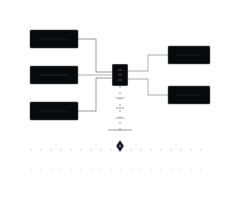
We start by mapping what your team actually does, not what the org chart implies they do. This phase produces an inventory of every significant manual workflow in scope: who performs it, how often, how long it takes, what triggers it, and where it breaks down.
We document at the step level. "Approves invoice in email, copies amount into spreadsheet, forwards to finance Slack channel" rather than "handles AP." Most operations teams have never seen their own workflows written down in full, and the inventory alone tends to surface inefficiencies that aren't obvious from inside the day to day.
phase 2: ROI scoring, impact vs. implementation complexity for each target#
With the inventory complete, every workflow becomes a candidate. We score each one on two axes: ROI impact (time savings, error reduction, downstream revenue or cost effects) and implementation complexity (integrations required, data quality, exception handling volume, tool compatibility).
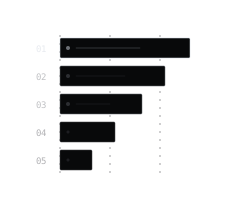
The output is a priority matrix. High impact, low complexity workflows sit in the first build quadrant. High impact, high complexity workflows get sequenced later or broken into phases. Low impact targets get deprioritized, regardless of how loudly they're complained about internally.
Here's where the math matters: basic automation reduces operational costs by 20 to 30%, and AI native workflow automation can deliver 50 to 70% cost reduction, but only when targets are correctly identified and sequenced (ARDEM, 2025). Sequencing is the difference.
phase 3: stack assessment, what your current tools can and cannot support#
Underestimating integration complexity is the second most common cause of blown automation budgets after wrong process selection. Before recommending anything, we assess your current stack: what native automation capabilities your existing tools offer, what's API accessible, where no code platforms like Make or n8n can bridge gaps without custom development, and where custom engineering is genuinely required.
This prevents overbuilding (paying for custom development when a native feature covers it) and underbuilding (assuming a tool can do something it can't).
phase 4: deliverable, a written, prioritized implementation roadmap#
Everything from the previous three phases feeds a single document: your implementation roadmap. It names your top automation targets in priority order, provides time to ROI estimates, specifies the tool or architecture recommendation for each target, and sequences the build so that earlier projects create the infrastructure later ones depend on.
There's enough specificity that a competent engineer can scope a project from it. It doesn't require us to execute it.
how the audit works#
format options: live call, async Loom teardown, or written intake#
The audit comes in three formats to fit how your team works:
Live session (default): A 60 to 90 minute working session over video call. Best for teams where operational knowledge and implementation budget sit with the same person or in the same room.
Async Loom teardown: You record a walkthrough of your workflows: screen share, verbal description, whatever you have. We return a written analysis and roadmap within three business days.
Written intake: A structured intake form covering workflow inventory, tool stack, team size, and priorities. Best when you have existing documentation and want fast turnaround with minimal meeting overhead.
All three formats produce the same deliverable.
what we need from you before the session#
Before your audit, we ask for a rough list of workflows you're considering for automation, your current tool stack, approximate weekly time your team spends on the top three manual processes, and any previous automation attempts (what was tried, why it didn't scale). We'll work with whatever you have. Complete answers aren't required.
how the roadmap is structured and delivered#
You'll receive a PDF and Google Doc within two business days of the session (three to five business days for async and written intake engagements). It's organized by implementation phase, not by department, because automation projects succeed or fail based on build sequence, not org chart.
what the deliverable looks like#
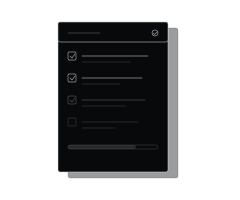
The roadmap has four components:
Workflow inventory: every manual process documented by department, with frequency, estimated weekly time cost, team members involved, and known failure points.
Priority matrix: every automation candidate ranked and scored. Top targets include time to ROI estimates based on current time cost, expected automation fidelity, and implementation timeline. Businesses that automate the right processes see an average of $46,000 per year in savings from reduced manual errors and labor reallocation (Vena, 2025).
Tool recommendations: specific platforms and architecture for each priority target. Not "a workflow automation platform," but the specific tool (n8n, Make, a custom Python service, a voice agent on a specific telephony stack) with reasoning tied to your process, data, and stack.
Implementation sequencing: what to build first and why, accounting for infrastructure dependencies. 60% of organizations achieve positive ROI from automation within 12 months; those who scope and sequence correctly get there faster (Latenode, 2025).
what happens after the audit#
It's yours. No obligation to continue with Silverthread Labs.
option 1: proceed to an implementation project with Silverthread Labs#
Most clients who run the audit proceed to at least one build with us. Having a shared, specific starting point means scoping is faster, estimates are more accurate, and projects are less likely to expand unexpectedly. The audit cost applies as a credit toward the first project.
option 2: use the roadmap with your internal team or another vendor#
Tool recommendations and architecture guidance are written to be actionable without our involvement. Some clients bring it to their engineering team; others take it to a development partner they already work with.
option 3: nothing, the roadmap still has value on its own#
Sometimes the audit surfaces that a top automation candidate is actually a process design problem or a data quality problem, not a software problem. That's a useful finding on its own. When you're ready to build, you'll know exactly where to start.
pricing#
Pricing scales with scope. All tiers include the four phase process, the written deliverable, and a 30 minute readout session after delivery.
solo founder and small team audit#
$500, 1 to 2 departments, up to 10 workflows
For founders, solo operators, and teams under 10 people. Priority matrix and tool recommendations for your top three automation targets. Delivered in three business days.
SMB multi-department audit#
$1,200, 3 to 5 departments, up to 30 workflows
The most common engagement. Covers operations across sales, finance, support, and internal communications. Full workflow inventory, priority matrix, stack assessment, and sequenced roadmap. Delivered in five business days.
enterprise pre-project assessment#
$2,500, full scope, multi team environments
For organizations with complex stacks and automation targets spanning multiple teams or systems. Includes stakeholder interviews and a roadmap structured for phased delivery. Timeline depends on scope, contact us to discuss.
FAQ#
How much does a business automation audit cost?
$500 to $2,500, depending on scope. The number of departments and workflows determines the tier. All tiers include the same four phase process and written roadmap.
What does the automation audit cover, and what is the deliverable?
Four phases: workflow mapping, ROI scoring, stack assessment, and roadmap production. You get a written implementation roadmap with a workflow inventory, priority matrix with ROI estimates, specific tool recommendations, and a sequenced build plan. Delivered as PDF and Google Doc within two to five business days.
How do I know which business processes to automate first?
That's what the priority matrix answers. Every identified workflow gets scored on ROI impact and implementation complexity, then ranked. High impact, low complexity workflows go first. It makes the decision visible and defensible rather than gut-driven.
What tools does an automation audit assess?
Whatever you're currently running: CRM, project management, finance, customer support, communication, data storage. We look at native automation features, API accessibility, and compatibility with no code platforms (Make, n8n, Zapier) and custom built systems to understand what your stack can support before recommending a build path.
How long does an automation audit take?
The live session runs 60 to 90 minutes. Roadmap delivery is two business days after the session (three to five for async and written intake). From booking to roadmap in hand: typically one week.
Do I have to build with Silverthread Labs after the audit?
No. It's yours. If you proceed with us, the audit cost applies as a credit toward the first project. If you take it to your internal team or another vendor, it's structured for that handoff.
What if the audit shows I shouldn't automate anything yet?
It happens. Sometimes a process needs redesign before it can be automated, or the bottleneck turns out to be data quality or team structure rather than missing software. That saves you from building something that won't work.
Is this an AI readiness assessment?
It covers AI readiness as part of the stack assessment: whether your workflows produce the structured, consistent data that AI native automation requires, and which processes are candidates for agentic AI versus simpler rule based automation. 92% of corporate executives plan to implement AI enabled automation within core workflows by end of 2025, but most don't have a structured way to identify where to start (BigSur AI, 2025). The audit is built for that problem.
Ready to find out what your operations can actually support, and what to build first?
Book your automation audit and get a written roadmap within five business days.
Not sure which tier fits? Review the workflow automation service page to understand what a full build looks like, or see how we work for how engagements run from audit through delivery.