Cowork plugin & desktop agent development
Anthropic launched Claude Cowork as a research preview on January 30, 2026. The plugin ecosystem built on top of it is younger still. For most enterprises, the gap between what Cowork ships with and what their actual technology stack requires hasn't been touched.
That gap is what we build into.
Silverthread Labs develops custom Cowork plugins and MCP connectors that take Cowork past Anthropic's default integrations, into internal ERPs, proprietary databases, legacy CRMs, and the operational systems that don't show up on any standard connector list. We already run an MCP development practice, so connector infrastructure is something we've been doing, not something we're figuring out alongside the plugin work.
what Cowork actually does (and where it stops)#
the desktop agent that plans and runs multi-step tasks#
Cowork takes the agentic capabilities of Claude Code and makes them accessible to non-engineers. Where Claude Code operates on codebases, Cowork operates on files, applications, and external services across a full desktop environment.
A knowledge worker can describe a multi-step objective in plain language: "pull last quarter's contract data from our database, flag terms outside our standard SLA, and draft a summary memo for legal review." Cowork plans the steps, calls the right connectors, runs the sequence, and hands back a completed output. No programming knowledge required. This isn't a chatbot that writes text when prompted. It takes real actions across connected systems.
what ships out of the box: connectors, plugins, slash commands#
Anthropic launched Cowork with 11 open source plugins covering common knowledge work functions. A February 2026 update added 13 more enterprise connectors, including Google Workspace, DocuSign, Apollo, FactSet, and Harvey, bringing the total to 24 publicly available integrations (Anthropic, February 2026).
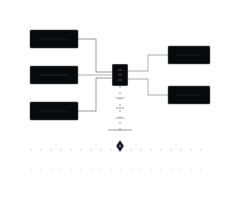
Each plugin bundles four building blocks: skills (step by step domain workflows Claude runs automatically), slash commands (explicit actions users invoke by name), sub-agent definitions (specialist agents that handle specific subtasks), and MCP connectors (the bridge between Cowork and external tools or data sources).
the gap between default connectors and your actual stack#
The 24 connectors Anthropic provides cover widely adopted SaaS platforms. They do not cover the ERP your finance team has been running for eight years, the proprietary client database your operations team built in house, or the custom workflow tools that have piled up across departments.
If your stack is mostly standard SaaS, the default connectors may be enough. If you have any amount of custom infrastructure, they are a starting point, not a solution.
Custom plugin development fills that gap.
what custom plugin development looks like#
plugin architecture: markdown, JSON, no build steps#
The Cowork plugin architecture is deliberately lightweight. A plugin is a structured directory of flat files: markdown files defining skills and commands, a plugin.json file registering the plugin's identity, and an .mcp.json file mapping connector placeholders to actual MCP server endpoints.
No build pipeline, no compilation step, no deployment infrastructure for the plugin layer itself. The plugin format is simple. What's hard is the MCP connectors the plugin calls and the security architecture wrapped around them.
skills, sub-agents, and slash commands#
Skills are the core of a plugin's domain intelligence. Each skill is a markdown file that defines the steps Claude follows for a given task type. A finance plugin's "variance analysis" skill specifies how to pull budget vs. actuals data, compute variances, flag items above threshold, and format the output. Skills fire automatically based on task context.
Slash commands are user-initiated actions, like /run-compliance-check or /summarize-contracts. They give users a direct entry point to specific workflows without having to describe the task from scratch each time.
Sub-agents are specialist agent definitions embedded within a plugin. A single plugin can coordinate multiple sub-agents, one for data retrieval, another for document drafting, within a single workflow.
MCP connectors: how Cowork reaches your internal tools#
Every connection between Cowork and an external system goes through an MCP server. Building a custom connector involves API or database interface design, authentication handling (OAuth, API keys, SSO, or enterprise identity providers), access scoping, error handling and retry logic, and the server infrastructure to run the connector reliably in production.
This is software development, not configuration work. If the connector is unreliable, every plugin built on top of it is unreliable too.
Our MCP development practice is the foundation every plugin engagement builds on. We don't scope a plugin project without understanding and engineering the connector layer first.
private plugin marketplaces for enterprise distribution#
As of the February 2026 update, Cowork supports private plugin marketplaces: admin-controlled repositories that organizations use to distribute approved plugins to their teams (Anthropic, February 2026). Admins control which plugins are available to which employees, with per-user provisioning and auto-install support. We build every plugin to this deployment standard, including the metadata and access configuration that marketplace distribution requires.
what we build#
workflow-specific plugins for ops, finance, legal, and engineering#
The best targets are workflows that run frequently, follow a defined structure, and are still being done by hand.
Operations: Vendor reconciliation, procurement status, operational reporting, cross-system data pulls, approval routing.
Finance: Budget vs. actuals analysis, invoice processing, variance flagging, report generation, regulatory filing prep.
Legal: Contract review against standard terms, clause flagging, risk identification, summary drafting, version comparison. Legal plugins tend to need the most careful scoping because the tolerance for wrong answers is lowest.
Engineering: Internal tooling queries, infrastructure status reporting, incident triage workflows, documentation generation.
For each of these, we design a purpose-built plugin with a clear operational scope. Not a general purpose agent trying to do everything.
internal tool connectors: ERP, CRM, proprietary databases#
If your target workflows depend on systems outside Anthropic's connector library, we build the MCP connectors those workflows require. We have built MCP integrations for ERP platforms, internal databases, legacy CRM systems, and proprietary data APIs across industries. Our standard: authenticated, scoped, monitored, and limited to the data the plugin actually needs.
Access scope gets defined during the design phase and enforced at the connector level. It's not left as a configuration concern for later.
For teams considering broader internal tool integration, our AI developer tooling service covers MCP infrastructure at scale.
cross-app workflows and multi-step task chains#
The highest value Cowork use cases usually coordinate across multiple tools in a single task. A sales operations workflow might pull deal data from a CRM, check it against a pricing database, look up contract status in a legal repository, and output a formatted pipeline summary, all triggered by one Cowork request. We scope multi-tool plugins carefully and test each connector independently before wiring them together.
admin controls: access policies, data boundaries, audit logging#
We work with your IT and security teams to define access policies: which employees can use which plugins, which data sources those plugins can reach, and what counts as an out of bounds action. Every connector gets audit logging so agent actions are traceable. For organizations with SOC 2, HIPAA, or financial services compliance requirements, we build the architecture to those standards from the start. Retrofitting controls after the fact costs a lot more.
how the process works#
step 1: workflow audit#
Every engagement starts with a workflow audit. We figure out which workflows run most often, depend most on structured data retrieval, and are most likely to produce reliable agent outputs. We also flag where Cowork is likely to struggle, which is usually tasks with too much ambiguity or judgment for a deterministic sequence.
Output: a ranked workflow list with feasibility notes, a connector dependency map, and a proposed plugin architecture for the first build.
step 2: plugin design and connector scoping#
We produce a plugin design document covering skill definitions, command structure, sub-agent architecture, and connector requirements. For systems we haven't built for before, we run a technical discovery session with your engineering team before quoting connector work. Complexity varies too widely to estimate blind.
step 3: build, test, and security review#
Connector development comes first because everything else depends on it. Then skill and command authoring, integration testing with real workflow scenarios, and a security review against the access controls from step 2.
We spend time on edge cases deliberately: upstream API errors, unexpected data shapes, partially complete results. A plugin that fails gracefully is far more useful than one that demos well and breaks silently once real data hits it.
step 4: deployment, team rollout, and documentation#
We deploy to your private plugin marketplace and coordinate with IT. Every plugin ships with user-facing documentation and a technical reference covering connector architecture, access scope, and monitoring configuration. We include 30 days of post-deployment support as standard. Most production issues show up in the first two weeks anyway.
pricing and engagement models#
single plugin build#
A single focused plugin, one domain, two to four connectors, standard access controls, typically runs $8,000 - $15,000. Good for organizations validating a specific workflow before broader deployment. Includes the plugin, all connectors, documentation, and 30 day support.
plugin suite for a department or function#
A department level suite, three to six plugins with shared connector infrastructure, typically runs $18,000 - $40,000. Shared infrastructure reduces per-plugin cost. Includes all plugins, unified connector layer, admin controls, private marketplace configuration, and team training.
ongoing development retainer#
For organizations expanding Cowork usage across multiple departments over time, a monthly retainer covers continuous plugin development, connector maintenance, and iterative improvement. Retainers start at $4,500/month, scoped to expected development volume. Retainer clients get priority support and proactive updates as Anthropic expands the MCP ecosystem.
All engagements begin with a workflow audit, scoped separately. Most audits take one to two days and can be done remotely. Start on our audit page.
FAQ#
What is a Cowork plugin and how is it different from an MCP server?
A Cowork plugin bundles skills, slash commands, sub-agent definitions, and MCP connector configurations into a directory of markdown and JSON files. An MCP server is the infrastructure that actually connects Cowork to an external system. The plugin defines what to do. The MCP server provides the connection. A complete integration requires both.
Can you build connectors for internal tools that aren't on Anthropic's connector list?
Yes. This is the main reason companies hire us. Proprietary databases, legacy ERPs, custom internal APIs, industry-specific platforms. The connector engineering is the hard part; the plugin layer follows once connectors are stable.
How do enterprise teams control which plugins employees can use?
Two layers. Cowork's admin controls let IT define a private plugin marketplace with only approved plugins, provisioned per-user or per-group. At the connector level, we build access controls that scope what data each plugin can reach regardless of who runs it. Marketplace controls handle who gets access. Connector scoping handles what they can touch.
What's the difference between a custom plugin and Cowork's built-in customization flow?
The built-in flow works well for adapting existing plugins or building lightweight workflows on Anthropic's standard connectors. Custom development handles what the built-in flow can't reach: connectors to systems outside Anthropic's library, workflows with error handling and data validation, enterprise access controls, audit logging, and production level reliability. If a workflow matters enough that your team depends on it daily, it warrants proper engineering.
How much does custom Cowork plugin development cost?
Single plugin: $8,000 - $15,000. Department level suite (three to six plugins): $18,000 - $40,000. Monthly retainer: starts at $4,500/month. All engagements begin with a workflow audit. Contact us to discuss scope.
Is the Cowork ecosystem stable enough to build on?
Cowork launched in January 2026. Anthropic has shipped updates roughly monthly since then, including Windows support and 13 new enterprise connectors in February (VentureBeat, February 2026). The platform is early and still moving. We design connectors with that in mind, and retainer clients get updates when Anthropic releases changes that affect their plugins. Building now means learning the platform while the field is still thin.
What happens if our internal systems change or a connector breaks?
Retainer engagements include connector maintenance. For fixed-price builds, we include 30 days of post-deployment support; updates after that are available under a support agreement or as separate engagements. Every connector is fully documented, so maintenance is straightforward whether our team handles it or yours does.
65% of enterprises are already running AI agents in production, and 100% plan to expand in 2026 (CrewAI State of Agentic AI Survey, February 2026). Cowork is where a lot of that expansion is going to happen for non-technical teams.
We build the plugins and connectors. If your team needs them, request a workflow audit.