OnlyAutomator
A creator with 50,000 followers cannot personally respond to 2,000 messages a day. But every unanswered message is lost revenue. OnlyAutomator handles the conversation at scale.
Industry: Creator Economy, Marketing | Stack: Next.js, TypeScript, LLM APIs, CRM Architecture, Stripe | Status: Live | Visit OnlyAutomator
what OnlyAutomator does#
OnlyAutomator is an AI-powered CRM and automation platform built for the creator economy. It manages fan communication, automates chat workflows, optimizes content pricing with AI, and runs the operational side of a creator business so the creator can focus on producing content. The platform covers work that typically requires a team of virtual assistants: responding to messages, managing pay-per-view content delivery, tracking subscriber engagement, and running revenue optimization workflows.
For creators and the agencies that manage them, OnlyAutomator replaces manual chat management with intelligent automation that keeps the personal feel subscribers expect while operating at a volume human teams cannot sustain.
the creator economy operations problem#
The creator economy exceeds $250 billion globally (Forbes, 2025). Creators monetize directly through subscriptions, tips, and premium content. The operational reality is rough. Revenue scales with engagement, and engagement scales with responsiveness. Every hour a message sits unanswered, conversion probability drops.
Mid-tier creators (10,000 to 100,000 subscribers) hit a specific inflection point. Below 10,000, a creator can handle their own messages. Above that threshold, the volume makes it impossible. The standard solution is to hire virtual assistants or agencies to manage chat. That works, but it introduces cost overhead, quality inconsistency, timezone coverage gaps, and the risk of a human representative going off-brand.
The core technical question was whether AI could handle creator-to-fan communication with enough nuance that subscribers would not notice the difference, while still maintaining the engagement rates that drive revenue. A generic chatbot would not cut it. The system needed to understand each creator's voice, adapt to individual subscriber behavior, and optimize for the specific economics of the creator platform.
This was built for a French client operating a creator management agency. They managed multiple creator accounts and needed infrastructure that could handle hundreds of simultaneous conversations across accounts, each maintaining a distinct creator voice.
what we built#
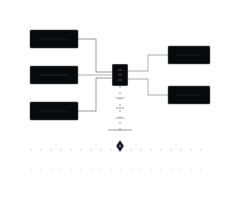
CRM architecture. The foundation is a CRM built specifically for creator businesses, tracking every subscriber interaction. Fan profiles aggregate conversation history, spending patterns, content preferences, and engagement metrics. The AI chat system draws on those profiles to personalize responses; the pricing engine uses spending history to optimize offers; the analytics dashboard surfaces revenue opportunities from aggregate data. Everything else in the platform runs on top of this layer.
AI chat management. The chat module handles inbound subscriber messages with AI-generated responses trained on each creator's existing message history. It learns tone, vocabulary, and how a particular creator tends to move through a conversation. Routine interactions run autonomously. Anything complex or sensitive gets escalated to a human operator with the full thread attached. Subscribers are not supposed to know the difference, and in practice they generally do not.
Dynamic pricing. Not all content has the same value to all subscribers, and flat pricing leaves money on the table. The pricing module analyzes each subscriber's engagement frequency, spending history, and content preferences, then recommends pay-per-view prices that maximize conversion for that segment. A subscriber who regularly purchases premium content sees different pricing than someone who has never bought anything. The system targets total revenue, not the highest per-item price.
Workflow automation. Beyond chat, the platform automates the operational work that fills creator hours: content scheduling, promotional campaigns, revenue tracking, performance reports. These run on triggers. When a subscriber crosses a spending threshold, the system sends a personalized offer. When engagement drops for a segment, it fires a re-engagement sequence. Most of this ran manually before, or did not happen at all.
Agency-level account management. The platform supports managing multiple creator accounts from a single dashboard, with isolated data, separate AI models, and independent analytics per account. The French client could monitor their entire portfolio, switch between accounts, and push automation templates across creators without touching each one individually.
Architecture:
- Next.js application layer with TypeScript
- CRM data model designed for subscriber lifecycle tracking and behavioral analytics
- LLM integration for conversational AI with per-creator fine-tuning
- Dynamic pricing algorithms using subscriber behavior data
- Workflow automation engine with trigger-based execution
- Stripe integration for payment and subscription tracking
- Role-based access control for creator vs. agency vs. operator permissions
results#
The client went from managing creator chat manually (or through hired assistants) to running it through automated workflows across multiple accounts simultaneously. The AI chat system covers the volume that previously required human coverage at all hours. The dynamic pricing module is live and optimizing offers per subscriber segment. The agency dashboard lets a small team oversee a creator portfolio that would otherwise need account managers for each creator.
Full product: architecture through production deployment, delivered.
Building automation for the creator economy or a CRM with AI capabilities? See our Workflow Automation service or book a free Automation Audit.