n8n workflow automation: what it is and how we use it
n8n is an open-source workflow automation platform that connects apps, APIs, and AI models using a visual node editor. It runs on a self hosted server or n8n's cloud, supports approximately 1,000 native integrations plus unlimited custom HTTP connections, and executes workflows based on events, schedules, or webhook triggers. Self hosted deployment is free; cloud plans start at $20/month.
If you have used Zapier or Make, the concept is familiar. What is different about n8n -- and why we build on it for client deployments -- is the pricing model, the native AI integration, and the self hosting option. This guide covers how n8n works, why we chose it, how to build a workflow in it, and where the complexity actually lives.
what n8n actually is#
the node-based model: triggers, actions, and data flow#
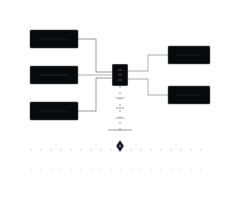
n8n models automation as a graph of nodes connected by edges. Every workflow starts with a trigger node -- something that initiates the workflow: a webhook call, a scheduled time, an event in a connected app, an incoming message. Trigger nodes pass data to action nodes that do things: make an API call, transform data, send a message, write to a database, or run a conditional branch.
Data moves between nodes as JSON objects. Each node receives the output of the previous node, does something with it, and passes the result forward. If you want to understand a workflow, reading the node graph tells you the full story -- what started it, what happened to the data, what conditions branched the flow. That traceability is genuinely useful when something goes wrong at 2am.
The visual editor is more than a pretty interface for writing config files. Complex workflows with branching logic, error handlers, and conditional paths are navigable as diagrams in a way that YAML or JSON are not. I have handed workflows off to clients who are not engineers, and they can read them.
how executions are counted -- and why it changes the cost math#
This is the detail that changes the economics comparison with Zapier and Make.
n8n counts one execution per workflow run, regardless of how many nodes are in the workflow. A 10-node workflow triggered 1,000 times uses 1,000 executions.
Task-based platforms count per node per run. The same 10-node workflow triggered 1,000 times generates 10,000 tasks (Digidop, 2025). That gap is the entire cost argument for n8n.
Take a recruiting intake workflow: resume received, parsed by an AI node, written to the ATS, notification sent to the hiring manager, calendar invite created -- 5 nodes per run. At 500 weekly applications, the task-based cost is 2,500 tasks per week. On n8n, it is 500 executions. At 2,000 applications per week, the task-based platform is 5x more expensive. The math gets worse, not better, as you scale.
cloud vs. self hosted: what the choice means in practice#
n8n Cloud handles hosting and infrastructure. Plans start at $20/month with 2,500 executions per billing period. You get a managed environment, automatic updates, and no server to maintain. n8n Cloud runs from Frankfurt, EU, which matters for GDPR-sensitive workloads.
Self hosted n8n runs on your infrastructure -- a VPS, a cloud VM, an on-premise server. There are no execution limits and no license fee. You pay for the infrastructure: typically $20-$100/month depending on workload and server size. You manage updates, backups, and the deployment itself.
For compliance-sensitive environments -- healthcare, legal, financial services -- self hosting is usually the right call, and I'll keep coming back to this throughout the guide because it is genuinely where the decision lives for most of our clients. Your workflow data, including any patient, client, or financial information that passes through n8n's execution log, stays on your infrastructure. That matters.
why we chose n8n over other automation tools#
execution-based pricing vs. task-based pricing at scale#
At the volume that production client workflows generate, task-based pricing becomes a real cost. We have modeled this for multiple client scenarios: an insurance intake pipeline processing 300 claims per day, a recruiting firm processing 1,000 applications per week, a legal practice handling 200 new contact form submissions per month. In every case, the execution-based model is materially cheaper -- often 5-10x less expensive than equivalent task-based platforms at those volumes.
native AI nodes: LangChain built into the workflow layer#
n8n ships with approximately 70 AI-dedicated nodes built on the LangChain framework (Contabo, 2025). This is not a minor feature. It means you can drop a reasoning step into a workflow without writing code and without a separate API integration:
- AI Agent node: Accepts a task, calls a connected LLM, uses tools, returns a result -- a full agentic step inside a workflow node
- Summarize Chain node: Takes a long document and returns a summary
- Retrieval-Augmented Generation (RAG) nodes: Connects to a vector store, retrieves relevant context, passes it to the model
- Memory nodes: Maintains conversation state across multiple invocations
Workflows that used to require a custom Python service just to add one AI reasoning step can now be built entirely in the n8n editor. For non-AI workflows that need one AI-powered step -- extract key fields from this document, classify this support ticket, score this lead -- the AI nodes handle it without a second service to maintain.
the self hosting argument for compliance-sensitive environments#
For healthcare, legal, and financial services clients, the data that flows through workflows often constitutes ePHI, privileged client communications, or financially sensitive records. Self hosted n8n keeps that data on the client's own infrastructure. The execution logs, the workflow inputs and outputs, the credentials stored in n8n -- none of it leaves the client's network.
n8n supports the technical requirements for HIPAA, GDPR, and SOC 2 compliance when deployed correctly. The tool does not stand in the way of compliance. Implementation and configuration still have to be done right.
code nodes: when visual is not enough#
n8n includes a Code node that accepts JavaScript or Python. When the visual toolset does not cover a transformation, a complex parsing task, or a custom integration, you write the code in the node. The workflow stays in n8n; you do not need a separate function service.
Most workflows never need it. For the ones that do, it is there.
how to build a workflow in n8n: a practical walkthrough#
step 1: map the process before opening the editor#
Before touching n8n, write down the exact steps in the process: what triggers it, what data moves, what systems are involved, and what the output should be. This takes 30 minutes and prevents hours of mid-build rework. Skipping it is the most common reason a build takes twice as long.
For a recruiting intake flow, this might look like: new application submitted via Typeform -> parse resume -> extract name, email, skills, experience -> check against existing ATS records -> create or update ATS record -> score application against role requirements -> notify hiring manager with summary -> add to calendar review queue.
step 2: choose deployment -- self hosted or cloud#
Self hosted: Deploy via Docker with docker run -it --rm --name n8n -p 5678:5678 n8nio/n8n. Set environment variables for database (SQLite for small workloads, Postgres for production), set your webhook base URL, and configure the credentials encryption key.
Cloud: Create an account at n8n.io. Specify your cloud region. You are running within minutes.
If your data has compliance requirements -- HIPAA, GDPR, SOC 2 -- self hosting is the right call. The cloud is faster to start, but once you have ePHI or privileged records flowing through a workflow, the question of where that data lives matters and is harder to change later.
step 3: install and configure n8n#
Self hosted setup:
- Deploy the Docker container with a persistent data volume
- Set
DB_TYPE=postgresdband configure the Postgres connection for production workloads (SQLite works for small deployments and local testing) - Set
N8N_HOST,WEBHOOK_URL, andN8N_ENCRYPTION_KEYenvironment variables - Configure a reverse proxy (nginx or Traefik) for HTTPS
- Set up automated backups for the database
n8n encrypts stored credentials at rest. The encryption key you set at deployment is the key -- store it securely, and do not change it after the first real workflow runs. Rotating it requires re-entering every credential.
step 4: build and test your first workflow#
Open the visual editor. Add a trigger node -- Webhook, Schedule Trigger, or an app-specific event trigger. Add action nodes for each step in your documented process. Connect them in sequence; add IF nodes for conditional branches; add Set nodes for data transformations.
Use the "Execute Step" button to test each node individually before running the full flow. This is the fastest way to debug: run one node at a time, inspect the output JSON, confirm the data structure before the next node reads it. Do not wait until the full workflow is wired up to test -- by then, a bad data structure in node 2 has caused four downstream problems.
step 5: handle errors and edge cases#
Production workflows fail. The question is whether they fail silently or visibly.
- Add an Error Trigger node to the workflow -- it fires when any execution fails, routing to your error handling path
- Add Slack or email notification nodes in the error path so failures surface immediately
- Set retry behavior on HTTP Request nodes for transient API failures
- Use IF nodes to route unexpected data formats to a human review queue rather than crashing the workflow
The most expensive failures are the ones that look like they succeeded. A booking that was never created, an email that was never sent, a record that was never updated -- silent failures are worse than noisy ones. Every production workflow we build has an error path. It is not optional.
step 6: add AI nodes for agentic steps#
Connect an AI Agent node. Configure it with an LLM credential (OpenAI, Anthropic Claude, Google Gemini, Mistral, or Ollama for local/self hosted models). Add a Memory node if the step requires context from previous interactions. Add Tool nodes for any actions the agent should be able to take.
One thing worth knowing before you start: getting clean structured output from an AI Agent node usually takes 3-4 prompt iterations, not one. The first version will either over-explain or miss edge cases in the input. Budget time for this -- it is not a sign that n8n is doing anything wrong, it is just how prompt engineering works in practice.
In a legal intake workflow, for example, the AI Agent node receives the form submission text, classifies the legal matter type, extracts key facts, and produces a structured intake summary that the next node picks up. Getting the classification to handle ambiguous submissions -- "I think I need help with a contract dispute but maybe it's employment law?" -- is the part that takes a few iterations.
step 7: monitor and iterate in production#
n8n logs every execution with full input/output visibility. After the first week in production, review the execution log:
- Are any workflows failing consistently? At what node?
- Are any workflows taking unusually long to complete?
- Are there data format variations that the workflow is not handling?
Most workflows go through 2-3 cycles of fixes before they run cleanly at volume. This is normal. The gap between "works in testing" and "handles everything that comes in from real users" is where most of the actual work lives.
real n8n workflow examples from our builds#
recruiting: resume intake to ATS update in one flow#
For a recruiting firm: new application lands in an email inbox -> webhook triggers n8n -> an HTTP Request node calls the resume parsing service -> parsed structured data (name, email, skills, experience, education) passes to an IF node that checks whether the candidate already exists in the ATS -> if new, creates the ATS record; if existing, updates it -> the AI Agent node scores the application against the role's criteria -> a Slack notification sends the hiring manager a structured summary with the score -> a Calendar node creates a review slot.
Total nodes: 8. Total staff time per application: near zero. Previous process: manual email review, copy-paste to ATS, Slack message by hand.
The trickiest part of this build was not the AI scoring -- it was the resume parser. Resumes arrive in PDF, Word, HTML, and plain text, all formatted differently. We ended up routing parse failures to a human review queue rather than crashing the workflow. About 3% of submissions go there.
insurance: inbound call to claim record creation#
For an insurance operations team, the flow connects a voice AI agent to a claim management system: call ends -> voice agent posts the transcript and extracted fields (claimant name, policy number, incident description, date) to a webhook -> n8n receives the data -> an AI Agent node validates the extracted fields and flags ambiguities for human review -> an HTTP Request node creates the claim record -> an HTTP Request node sends a confirmation SMS to the claimant -> a Slack alert fires to the adjusters' channel.
The claim record exists within 30 seconds of the call ending. The adjuster gets a structured summary, not a raw transcript.
One honest note: voice AI transcripts are messier than they look in demos. Overlapping speech, background noise, and non-standard pronunciations mean the AI Agent node needs to handle a lot of partial or ambiguous field values. We built a validation step that flags low-confidence fields for human review before the record gets created. Without that, the adjuster was getting records with wrong policy numbers.
legal: new contact form to case management and calendar invite#
For a law firm: contact form submission -> webhook to n8n -> an AI Agent node classifies the matter type (personal injury, estate planning, family law, other) and extracts key facts -> IF nodes route to the appropriate attorney's intake queue based on matter type -> the firm's case management system gets a new matter record via API -> the attorney's calendar gets a 15-minute intake review event -> an automated email goes to the prospective client with next steps.
Response time from form submission to follow-up email: under two minutes.
self hosting n8n: what it actually involves#
infrastructure requirements and monthly cost reality#
Self hosted n8n runs comfortably on a small VPS for light workloads: 2 vCPU, 2GB RAM, 20GB SSD. That runs $6-$12/month on most cloud providers.
For production workloads with concurrent executions, external webhook volume, and AI node calls: 4 vCPU, 8GB RAM, 50GB SSD. That runs $20-$60/month depending on provider and region.
Postgres for the database adds a few dollars if you run it on the same server, or $10-$30/month for a managed database instance. Total infrastructure for a production n8n deployment is somewhere between $20 and $100/month. For most clients, the cost savings compared to a task-based SaaS pay for that within the first month.
what data sovereignty means for HIPAA, GDPR, and SOC 2 environments#
When n8n runs on your infrastructure, the data flowing through it -- execution logs, input payloads, output results, credentials stored in the vault -- never leaves your network.
For healthcare clients, patient data that passes through intake workflows is processed inside the covered entity's environment. For legal clients, client matter data stays inside the firm's infrastructure. For financial services, transaction data subject to SEC Regulation S-P stays in a controlled environment.
Self hosted n8n supports the technical prerequisites for HIPAA, GDPR, and SOC 2. You still need proper configuration: encryption, access controls, audit logging, network segmentation, and a BAA with your hosting provider for HIPAA. Self hosting is necessary but not sufficient -- the configuration still has to be done correctly.
what Silverthread Labs handles when we deploy n8n for clients#
When we deploy n8n for a client, we handle infrastructure provisioning and hardening, Docker configuration with Postgres and proper backup setup, SSL/TLS, webhook URL configuration, credential vault setup, initial workflow builds, error handling and alerting, and documentation for the client's ops team.
For compliance-sensitive deployments, we add network segmentation design, encryption verification, access control configuration, and compliance documentation.
n8n and agentic AI: beyond data pipes#
the AI Agent node: reasoning inside a workflow step#
Most n8n tutorials cover the tool as a data pipe: events trigger actions, data transforms between steps, notifications go out. That covers most use cases. What gets less attention is the AI Agent node, which adds a reasoning step inside the workflow -- actual decisions, not just data movement.
An AI Agent node receives a task, a set of available tools, and optional context. It calls the LLM to decide what to do, uses the tools it has been given (read a database record, call an API, write a file), evaluates the result, and returns a structured output that the next workflow node picks up.
A data pipe follows fixed logic. An agent node reads the situation and decides. That difference matters when the input is messy or the right action depends on context that a simple IF node cannot capture.
LangChain nodes: chains, memory, and retrieval#
n8n's approximately 70 AI nodes are built on the LangChain framework. You can build multi-step reasoning chains, connect vector stores for retrieval-augmented generation, maintain conversation memory across sessions, and compose models -- all within the workflow editor, without writing LangChain code directly.
For workflows that need to reason over a document corpus -- legal case law, insurance policy databases, medical literature -- RAG nodes retrieve relevant context before the AI Agent node produces its output. The result is grounded in real data, not model speculation. This is the difference between "give me a summary of this claim type" and "find the three most relevant precedents and explain how they apply."
when to add an AI step vs. when to keep it deterministic#
Not every workflow needs an AI node. If the logic is rule-based and the inputs are structured -- if status is "pending" then route to queue A, otherwise queue B -- a deterministic IF node is faster, cheaper, and more predictable.
Add an AI node when the input is unstructured (free text, documents, voice transcripts), when classification requires judgment across many possible categories, when you need to generate content (summaries, responses, draft communications), or when the right action depends on context that simple conditional rules cannot capture.
When in doubt, start deterministic and add AI only when the rule-based version breaks on real inputs.
when to build on n8n yourself vs. bring in help#
what a capable ops person can build without a developer#
With some time and a willingness to experiment, a technically capable operations person can build and maintain n8n workflows for:
- Simple data-sync workflows (new form submission -> CRM record created)
- Notification workflows (event in system A -> Slack message with details)
- Scheduled report workflows (daily query -> formatted email)
- Basic approval workflows (form submitted -> review email sent -> approval updates record)
The visual editor is genuinely accessible. n8n's documentation is good. The community forum is active and usually has someone who has already hit whatever problem you are facing.
where workflows get technically complex#
Complexity tends to hit in the same places.
API authentication is the first wall most people hit: OAuth2 flows, token refresh, provider-specific auth patterns that the documentation does not fully explain. Error handling at scale is the second: retries, dead letter queues, routing edge cases to human review without losing the record. Data transformation gets painful when you are parsing irregular formats or mapping between APIs with different schemas.
AI node design is its own discipline. Prompt engineering for agentic nodes, tool schema design, managing memory across invocations -- these require iteration that takes time. Compliance configuration -- encryption, audit logging, access control, BAA documentation -- is engineering work, not configuration work. And multi-workflow orchestration, where workflows call sub-workflows and pass state between parallel paths, is architecture, not setup.
If you are hitting those walls, that is when it makes sense to bring in someone who has been there before.
what a workflow audit looks like before we start a build#
Before we start building, we run a brief process review: what triggers the workflow, what data moves through it, what systems need to be connected, what the failure modes are, and what compliance constraints apply. This takes 1-2 hours. It prevents the most common failure mode -- building a workflow that handles the standard case and breaks on the exceptions that make up 20% of actual volume.
If you are wondering whether your automation use case is a good fit for n8n, a free automation audit is the right starting point.
FAQ#
Is n8n really free? Self hosted n8n is free -- no execution limits, no license fee. You pay for the infrastructure, typically $20-$100/month depending on workload and server size. n8n's cloud plans start at $20/month with 2,500 executions per billing period. Whether "free" is accurate depends on whether you count your own engineering time to maintain the deployment.
How does n8n count executions? n8n counts one execution per workflow run, regardless of how many nodes are in the workflow. A 10-node workflow triggered 1,000 times uses 1,000 executions. Task-based platforms count per node per run -- the same workflow registers 10,000 tasks. At volume, that difference is the entire cost argument for n8n (Digidop, 2025).
Can n8n connect to systems that do not have a native integration? Yes. n8n's HTTP Request node connects to any REST API. If a system has an API -- even a private internal one -- n8n can talk to it. Native integrations (~1,000) handle the most common apps; the HTTP node covers everything else.
Is self hosted n8n HIPAA compliant? Self hosting puts you in control of where patient data is stored and processed -- it never leaves your infrastructure. That is the prerequisite for HIPAA compliance. You still need to configure encryption, access controls, and audit logging correctly, and you need a BAA with your hosting provider. The tool supports what is needed; the configuration still has to be done right.
What AI models can n8n connect to? n8n's AI nodes support OpenAI, Anthropic Claude, Google Gemini, Mistral, Ollama (for local/self hosted models), and others via the LangChain integration layer. You can chain models, add retrieval-augmented generation, and maintain conversation memory -- all as nodes inside a standard workflow.
How is n8n different from Make or Zapier? The main difference is how they charge. n8n charges per execution (one per workflow run); Make and Zapier charge per operation or task (one per node per run). At scale, n8n is significantly cheaper. n8n also offers self hosting and has deeper native AI/LangChain integration than either alternative. Zapier has the widest app catalog (~8,000 integrations); Make has more polish for non-technical users. For engineering teams building automation on sensitive data at volume, n8n is the stronger technical choice.