How to Automate Appointment Booking with AI
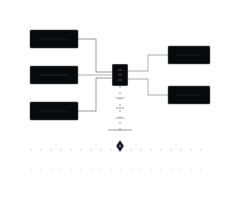
Booking automation has three moving parts: the trigger (how a client initiates the booking), a calendar integration that writes the appointment directly to your scheduling system, and a post-booking workflow that handles everything after. Voice AI agents cover the phone channel. In practices that have deployed this properly, no-show rates drop 25-40% and after-hours bookings climb, capturing calls that would otherwise hit voicemail and vanish.
This guide covers how it actually works, including where it breaks.
why manual booking breaks at scale#
what a missed call actually costs#
Small businesses answer only 37.8% of inbound calls on average. Of the callers who reach voicemail, 85% never call that business again. 62% immediately dial a competitor.
Run the numbers for a dental practice: 100 calls per week, 40% missed, 30% of those are new patient inquiries at $850 each. That is more than $5,000/week in unrealized revenue before anyone has opened the office. Missing calls is a revenue leak, not a staffing inconvenience.
no-shows compound the problem#
Even the appointments you do book are at risk. No-show rates of 10-30% are normal in service businesses without active reminder systems. Each empty slot is a slot that could have gone to someone else.
The research is consistent here: automated reminder sequences produce 30-45% fewer no-shows compared to manual outreach (DentalBase AI, 2026). El Rio Health reduced no-shows by 32% and recovered $100,000/month in revenue after deploying AI scheduling (Droidal case study, 2025). The mechanism is not complicated. Most no-shows are not intentional. People forget, or they know they cannot make it but rescheduling feels like effort. A well-timed reminder with a one-tap reschedule link converts some of those into saved appointments.
the three conditions where manual scheduling fails#
- After hours. 40% of salon appointments are booked after business hours (Zenoti Consumer Trends Survey, 2025). Most service businesses have zero staffed coverage during those windows. Calls go to voicemail; voicemails go unreturned.
- Peak volume. Seasonal surges, marketing campaigns, and post-event spikes overwhelm manual scheduling. Backlogs form. People give up.
- Staff turnover. Scheduling knowledge concentrates in whoever handles the phones. When that person leaves, service quality drops until someone new catches up.
If any of these conditions is persistent and the revenue at stake is material, automation has a clear case.
the three parts of an automated booking system#
Every booking automation setup has the same basic structure, regardless of which tools you use.
the booking trigger#
The trigger is how the client initiates the booking. Phone, web widget, or chat each have different requirements.
- Phone: A voice AI agent conducts the conversation, collects what it needs, and writes the appointment to the calendar before the call ends. No human in the loop unless the call escalates.
- Web form or booking widget: The client picks a time from available slots. Good for simple scheduling where clients are already online and know what they want. Does not handle intake conversations.
- Chat (website or SMS): Collects information by text. Lower friction for clients who dislike phone calls.
Phone is the primary channel for most service businesses. A web widget does not help the caller who dials in at 9 PM because your web form is not visible to them. Voice AI is the only mechanism that handles those calls.
calendar integration and real-time write-back#
"Write-back" means the appointment is created in your scheduling system during the call, not queued for someone to process later. When the call ends, the booking exists. No pending requests. No follow-up from staff required.
This distinction matters operationally. A system that sends a "booking request" email to your front desk has not automated booking. It has automated the notification that someone wants an appointment. The staff work still happens; it just arrives in a different inbox.
Write-back requires a direct API connection to your calendar. Google Calendar and Calendly both have well-documented APIs. Practice management systems like Dentrix, Eaglesoft, and Vagaro are more involved: the depth of what you can read and write varies by platform, and proper integration requires API credentials, schema mapping, and testing against your specific configuration. It is buildable, but it is not an afternoon project.
One non-obvious consequence of doing this right: double-booking prevention. The agent queries the calendar live during the call. If the requested time is gone, it offers alternatives immediately. An agent working from a static "available hours" list will offer slots that are already booked, which creates problems your staff then has to untangle.
the post-booking workflow#
Once the appointment is in the calendar, a separate automation layer takes over. This is typically n8n or Make, not the voice agent itself.
A complete sequence:
- Immediate confirmation by SMS or email (date, time, location, any prep instructions)
- 48-hour reminder with a reschedule option
- Day-before nudge
- Morning-of reminder
- 2-hour reminder for high-value or high-risk appointments
- Post-appointment follow-up (review request, next appointment prompt, or care instructions)
The agent does the booking. The workflow does everything that follows. They are connected through the calendar event: the booking triggers the workflow.
step 1: map your current booking flow#
Before touching any tooling, document what actually happens today.
where bookings come in and how many#
Count your channels: phone, web, email, walk-in, third-party platforms. Estimate weekly volume per channel. Phone is typically 60-80% of inbound for service businesses.
Look at when calls come in. If a meaningful share arrives after hours, that is where automation will recover the most revenue.
what the staff does between call received and appointment confirmed#
Walk each step: answer the call, identify the caller, collect information, check availability, confirm the appointment, enter it in the system, send a confirmation. Count how many of those steps are manual data entry. Count how many require system access that is unavailable when staff is on another call or with a client.
which steps can actually be removed#
Any step that follows a deterministic rule can be automated. "If new patient, collect insurance. If returning patient, verify contact details." That is a rule; a workflow can execute it.
The steps that stay with humans are the ones requiring real judgment: complex clinical intake, complaints, anything where the caller needs a person and knows it. Expect those to be a minority.
step 2: choose your automation layer#
SaaS booking tools#
Calendly, Acuity Scheduling, and Square Appointments handle online self-booking. They are fast to set up and work well when clients are already online and the scheduling is simple.
They do not handle phone bookings. They cannot run an intake conversation. Most cannot write back to industry-specific scheduling systems. If your primary channel is the phone, these tools solve a different problem than the one you have.
voice AI agents#
A voice AI agent handles the full phone call: answers it, identifies the caller, collects information, checks availability, books the appointment, and ends the call with the record created. No hold time, no staffing dependency, available at 2 AM.
Where voice AI struggles: callers with heavy accents can cause transcription errors; highly complex scheduling rules increase the chance of edge cases the agent mishandles; some callers simply want a human and will not engage with a bot. In our experience, most practices see these as manageable edge cases rather than blockers, but they are real and worth planning for. Build a clean handoff path to a human for calls the agent cannot resolve.
workflow automation (n8n, Make)#
n8n and Make connect the pieces: voice agent, calendar, CRM, messaging tools. The voice agent books the appointment; n8n fires the confirmation, queues the reminders, updates the CRM, and handles any other downstream action automatically.
n8n is worth calling out specifically because it is self hostable, which matters for HIPAA-sensitive environments where you need to control where data lives. It also charges per execution rather than per seat, which keeps costs predictable as volume grows. See n8n Workflow Automation: What It Is and How We Use It for a fuller breakdown.
putting it together#
For most phone-primary service businesses, the right stack is: voice AI for inbound calls, a booking widget for clients who prefer self-serve online, and n8n to run everything downstream. They are wired through the calendar. The booking event, regardless of which channel it came through, triggers the same confirmation and reminder sequence.
step 3: integrate with your calendar or scheduling system#
Google Calendar and Calendly#
Both have clean APIs, good documentation, and native support in most voice agent platforms. Integrating either is typically a few days of work.
practice management systems#
Dentrix, Eaglesoft, Open Dental, Vagaro, and similar systems are a different story. Most were built for desktop use by clinic staff, not for API-driven integrations. What you can do varies: some expose read and write endpoints, some only read, some have restrictions around the appointment record fields you can set.
When it works, it is worth the effort. An agent integrated with your live PMS can check actual provider availability, book into the right calendar slot, and create an appointment record with the intake fields already filled in. The record in the system is the appointment, not a stub that someone still has to complete.
Get API documentation before scoping the build. The difference between "we have an API" and "here is what you can actually do with it" is often significant.
step 4: build the reminder and no-show reduction sequence#
the reminder cadence#
A single reminder does less than a sequence. The standard approach:
- T-48 hours: "Your appointment is in two days. Reply CONFIRM to confirm or RESCHEDULE to change your time."
- T-24 hours: A shorter nudge
- Day-of morning: "Your appointment is today at [time]."
- T-2 hours: Used for high-value or high-risk appointments
Clinics using AI scheduling report 40% fewer scheduling-related support calls and 20% higher patient throughput (Neuwark, 2026). The multi-touch sequence matters because the cancellation you catch 48 hours out gives you time to fill the slot from a waitlist. The cancellation you catch 2 hours out does not.
easy rescheduling in every reminder#
The reschedule link is not an afterthought. Many no-shows happen because the client knows they cannot make it, but rescheduling feels like picking up the phone and waiting on hold. A link in the reminder text removes that friction. Some of those no-shows become rescheduled appointments instead.
waitlist automation#
When a cancellation comes in, a waitlist workflow can identify the next client who requested an earlier slot, check if they are still interested, and move them into the open time. For practices with consistent demand, cancellations fill before they register as lost revenue. Fully automated; no staff coordination required.
step 5: handle rescheduling and cancellations without staff#
inbound rescheduling#
A client who needs to reschedule should not have to call during business hours and navigate a hold queue. An SMS-based flow, triggered by RESCHEDULE in reply to any reminder, surfaces available alternatives and confirms the new time without human involvement.
Voice works too. "I need to change my appointment" is a well-defined intent; the agent can pull up the booking, offer alternatives, and confirm without escalating.
outbound confirmation calls#
For high-value appointments or clients with a history of no-shows, an outbound voice call 24-48 hours before the appointment can confirm attendance or surface a cancellation early enough to fill the slot from the waitlist.
how waitlist fill actually works#
The sequence: cancellation event fires, workflow identifies next-in-line, system checks their availability, appointment is moved, both parties get confirmation. Start to finish in minutes. No one on staff needs to notice or act.
what the numbers look like in practice#
The data from documented deployments is reasonably consistent:
- El Rio Health: 32% fewer no-shows, $100,000/month in recovered revenue (Droidal case study, 2025)
- Automated reminder sequences vs. manual outreach: 30-45% no-show reduction (DentalBase AI, 2026)
- Practices on AI scheduling: 40% fewer scheduling-related support calls, 20% higher throughput (Neuwark, 2026)
- AI booking pilots: $36,000-$60,000 annual savings from automating calls, scheduling, and FAQ handling (P0stman, 2025)
On the consumer side, 39% of people are comfortable with AI booking appointments; 60% will engage with an AI system if it responds accurately and promptly (Vendasta, 2025). Acceptance is higher in industries where the booking is transactional (salon, spa, clinic) and lower where the relationship matters more.
The staff hours recovered are less glamorous but real: no more routine scheduling calls, no more manual confirmations, no more processing reschedule requests. That time goes somewhere more useful.
FAQ#
How do you automate appointment booking with AI? The setup has three parts: a booking trigger (voice agent, web widget, or chat), a direct calendar integration that writes appointments to your scheduling system during the interaction, and a post-booking workflow that fires confirmations and reminders automatically. Voice AI agents cover the phone channel. Workflow tools like n8n connect the booking event to everything downstream.
What tools do you need? For phone-first booking: a voice AI platform (Retell AI, Vapi, or Bland AI), a calendar integration (Google Calendar API, or your PMS's API), and a workflow tool (n8n or Make) for post-booking sequences. For self-serve web booking: Calendly or similar, connected to the same workflow layer so both channels feed the same reminder sequence.
How much does it cost? A voice AI pilot with calendar integration and reminders typically runs $2,000-$5,000 to build. Full builds for multi-location or regulated-industry practices run $10,000-$35,000, with ongoing monthly costs for hosting and maintenance. Documented annual savings from automating calls and scheduling run $36,000-$60,000 (P0stman, 2025).
How does AI reduce no-shows? Through a multi-touch reminder sequence: confirmation at booking, 48-hour reminder, day-of reminder, and a final nudge 2 hours before for high-risk appointments. Each message includes an easy reschedule option. The combination of reminders plus frictionless rescheduling converts many would-be no-shows into kept or rescheduled appointments. In documented deployments, no-show rates drop 25-40%.
Can a voice AI agent book directly into Google Calendar or Calendly? Yes. Most production voice platforms support both via direct API integration, giving the agent real-time availability during the call. For PMS systems like Dentrix or Vagaro, integration is possible but depends on what the system exposes via its API. Check the documentation before assuming write access is available.
Ready to map out what this looks like for your specific practice? Silverthread Labs offers a free automation audit that covers your current call volume, your scheduling systems, and exactly what it would take to automate the booking flow.