AI for Dental Practices: The Complete Guide
Most dental practices lose $80,000 to $150,000 per year before they ever realize it. The money leaves quietly: a missed call here, a patient who didn't get a recall reminder there, an insurance verification that took 20 minutes when it should have taken two. None of it shows up as a single line item.
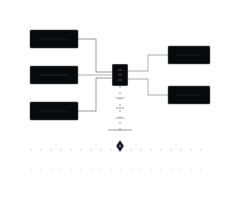
AI addresses this in three distinct ways: voice agents that answer every call and book appointments around the clock, workflow automation that handles insurance verification and recall campaigns, and patient management tools wired directly into Dentrix, Eaglesoft, or Open Dental.
This guide explains how each of those systems works, what they cost, where they integrate with your existing software, and what a realistic implementation looks like. It is a working overview of the technology for practice owners who want to understand what they are buying before they act.
what AI actually does in a dental practice#
three problem areas: phones, admin workflows, patient management#
Dental AI is not one product. It is three distinct systems that solve three distinct problems:
- Voice AI solves the phone problem: missed calls, after-hours bookings, and the staff time consumed by routine scheduling calls.
- Workflow automation solves the admin problem: manual eligibility checks, recall campaigns that do not happen, appointment reminders that require staff effort.
- Patient management integration solves the data problem: siloed information that requires manual entry, scheduling conflicts, HIPAA-compliant data handling.
Understanding which problem costs your practice the most is how you determine where to start.
what AI handles today vs. what still needs a human#
Some tasks AI does well: answering calls and booking appointments, sending confirmation and reminder sequences, running eligibility checks against insurance databases, sending recall messages to overdue patients, logging call summaries to the patient record.
Other tasks still need a person: genuine clinical judgment, complex insurance dispute resolution, emotional situations that require human empathy, cases where a patient's history creates unusual scheduling requirements that were not anticipated in the call flow design.
The right deployment design distinguishes clearly between these two categories. What falls in the first group gets automated. What falls in the second gets escalated to a human with context.
the integration question: why AI without PMS connectivity falls short#
The most common failure mode in dental AI deployments is an agent or bot that is not connected to the practice management system. Without PMS connectivity, the agent cannot see real-time appointment availability, cannot verify whether a caller is an existing patient, cannot pre-populate the appointment record with intake information, and cannot update the schedule when a booking is made.
An AI system with no PMS connection is essentially a message-taking service that sounds more natural. An AI system with deep PMS integration is a full front desk extension, reading from and writing to the system your practice already runs on.
voice AI: answering every call#
why dental practices miss 35-68% of inbound calls#
The structural reason is staffing: front desk staff are busy with in-office patients, are on lunch, or are handling one of the other fifteen tasks that a dental front desk manages at once. The phone rings. It goes to voicemail.
Dental practices miss between 35% and 68% of inbound calls depending on practice size and staffing (Resonate App, 2025). 80% of those missed calls are patients attempting to book an appointment (Peerlogic, 2024). 47% of appointment requests occur outside normal business hours, when no one is there to answer.
For a practice receiving 100 calls per week at a 40% miss rate, that is 40 calls per week where the patient either left a voicemail that may or may not be returned in time, or called the next practice on their list.
how a voice AI agent handles appointment booking#
A voice AI agent for a dental practice conducts a natural phone conversation. The call flow looks like this:
- Answers within one ring, introduces itself using the practice name
- Identifies whether the caller is a new or existing patient
- For new patients: collects name, contact information, reason for visit, insurance carrier and ID
- For existing patients: confirms contact details and reason for visit
- Checks real-time appointment availability in the practice management system
- Offers appointment options and confirms the selection
- Creates the appointment record in the PMS with all collected information populated
- Sends a confirmation text or email to the patient
- Logs the full call summary to the patient record
The patient called, had a brief natural conversation, and their appointment is booked. The front desk sees a fully populated appointment record with no data entry required.
after-hours and overflow: capturing the calls your team never sees#
47% of appointment requests arrive outside business hours, evenings, weekends, early mornings. For most practices, these calls go to voicemail. Most of those callers hang up without leaving a message.
A voice agent runs around the clock. Every call at 9 PM on a Saturday gets the same response as a call at 10 AM on Tuesday. The after-hours bookings that previously went to voicemail and were never converted become appointments on the schedule.
Practices capturing an extra 15-20% of appointments outside normal business hours (MIT Technology Review) are not doing so with additional staff. They are doing so with a system that is always available.
patient intake over the phone: insurance pre-screening and demographic collection#
For new patients, the front desk intake process typically involves collecting insurance information and verifying eligibility before the appointment. This is time-consuming: calling the insurance carrier, navigating the verification system, transcribing the result into the PMS.
A voice agent can collect insurance information during the booking call and pass it to a connected workflow that runs the eligibility pre-check automatically. The appointment record arrives in the PMS with eligibility status already populated. The front desk sees a result, not a task.
workflow automation: cutting admin time#
insurance verification: eliminating the manual eligibility check#
Manual insurance verification is one of the highest-time-cost tasks in a dental front desk workflow. An automated verification workflow:
- Reads the appointment record (patient name, insurance carrier, plan ID) from the PMS
- Calls the insurance carrier's eligibility API or web portal
- Retrieves and parses the eligibility response
- Writes the result back to the appointment record in the PMS
- Flags any exceptions (inactive coverage, missing information) for human review
For a practice performing 50 verification checks per week at 8 minutes each, that is 6.7 hours of staff time. Automating the standard checks, which represent the vast majority of verifications, recovers most of that time and concentrates staff attention on the exceptions that actually need judgment.
recall campaigns: automated reactivation for overdue patients#
Recall management is the systematic follow-up of patients who are due for their next appointment but have not yet scheduled. Most practices run recall manually: pulling a list from the PMS, calling or texting patients, and documenting responses. The process is repetitive, takes staff time, and is the first thing that slips when the practice is busy.
An automated recall workflow queries the PMS daily for overdue patients, sends an outreach message (SMS, email, or outbound AI call) inviting them to book, logs responses, and escalates non-responders to a second-touch sequence after a defined interval. The booking link or live agent option is included in each message.
Practices that run automated recall recover patients that would otherwise have drifted to competitors. The revenue from reactivated patients tends to have high ROI because the relationship already exists.
no-show reduction: reminder sequences that actually work#
Practices implementing automated appointment reminders experience 30-45% fewer no-shows than those using manual outreach methods (DentalBase AI, 2026). The mechanism is simple: multiple touches at defined intervals, each including a one-step reschedule option.
A standard reminder sequence runs like this: confirmation immediately after booking, 48-hour reminder, day-before reminder, same-day morning reminder. Each message contains a way to reschedule without calling. That single design choice, removing the friction of having to call, is what converts intent-to-no-show into an actual reschedule.
how much admin time automation realistically saves#
Dental practices spend 30-40% of staff time on administrative tasks that are automatable (DentistryDashboard, 2025). Practices report 25-30% administrative cost reductions after implementation.
The time savings cluster around insurance verification (6-10 hours/week), appointment reminders (2-4 hours/week), recall outreach (4-8 hours/week), and call handling (variable, but often 15-25 hours/week across the full team).
patient management: the integration layer#
Dentrix, Eaglesoft, and Open Dental: how AI connects to each#
The three dominant practice management systems have different API access profiles:
- Dentrix offers the Dentrix Developer API and supports integration with verified partners. Appointment writing, patient record access, and billing code reads are all accessible via API.
- Eaglesoft (Patterson) has more limited native API access but supports integrations through approved partner channels and database-level access in some deployment configurations.
- Open Dental is open source and offers a publicly documented API, making it the most accessible for custom integrations.
Integration depth, meaning what the AI system can read and write, depends on which PMS you run and which access tier your integration partner has. Real-time availability, complete patient record read/write, and billing code access are all achievable on these three systems with the right integration approach.
what the AI reads vs. what it writes to the practice management system#
Reads: Patient name and demographics, insurance information, appointment history, provider schedule, available appointment slots, outstanding treatment plans.
Writes: New appointments (date, time, provider, procedure code), call summaries, intake information collected during the call, updated contact details if provided.
The distinction matters for permissions design. An AI agent that only writes appointment data does not need access to clinical records. Scoping permissions to the minimum required for the task is both a security best practice and a HIPAA design principle.
preventing double-bookings and schedule conflicts#
Double-bookings happen when two systems have inconsistent views of availability. An AI agent that checks real-time PMS availability before confirming a slot eliminates this category of error. The PMS is the source of truth; the agent queries it live during every booking call.
This is why a direct PMS integration matters more than a generic calendar connection. A Google Calendar overlay that is manually synced with the PMS is not a real-time availability check. It is a delayed reflection that can be wrong.
data ownership and HIPAA considerations#
Patient data collected and processed by an AI system, including call recordings, transcripts, intake information, and insurance data, is subject to HIPAA if it constitutes ePHI. An AI system handling dental calls is almost certainly processing ePHI.
HIPAA compliance for AI systems requires: a Business Associate Agreement with every vendor that processes ePHI, encryption at rest and in transit, role-based access controls, audit logging, and network segmentation for sensitive workloads. For practices evaluating cloud-based dental AI tools, verifying that the BAA covers the AI's inference and data handling, not just storage, is essential.
For a full breakdown of HIPAA requirements for AI systems, see Building HIPAA-Compliant AI Systems.
costs and realistic ROI#
what dental AI tools cost in 2025-2026#
Pricing varies significantly by approach:
- Vertical SaaS (pre-packaged dental AI bots): $99-$599/month with standard PMS integrations. Fast to deploy; limited call flow customization; template-based.
- Custom built voice AI agent: $5,000-$15,000 build fee for a focused deployment (single call flow, one PMS integration, basic post-call workflow). $500-$1,500/month ongoing.
- Full custom system (multi-flow, deep PMS integration, recall automation, insurance verification workflow): $15,000-$35,000 build fee. $1,000-$2,000/month ongoing.
- Self hosted infrastructure (for practices with strict data residency requirements): adds $8,000-$15,000 to deployment costs; significantly reduces ongoing per-call costs at volume.
The dental practice management software market is projected to reach $4.44B by 2031 (Mordor Intelligence, 2025), driven largely by practices investing in integrated AI and automation infrastructure.
where the revenue recovery comes from#
The ROI on dental AI has three primary sources:
- Missed call recovery: Each missed new patient call represents $850 in immediate revenue and up to $8,000 in lifetime patient value (Dental Scheduling Consultants, 2024; Resonate App, 2025). Recovering 15 per year covers most deployment costs on its own.
- No-show reduction: A 30% reduction in no-shows across 200 monthly appointments at $150 average per appointment is $9,000/month in recovered revenue.
- Staff time reallocation: If automation recovers 15 hours/week of front desk time, that is staff capacity redirected to in-office patient experience, treatment plan discussions, and revenue-generating conversations rather than data entry and phone tag.
The average dental practice loses up to $150,000 per year from missed calls alone (DenteMax, 2025). A full AI deployment at $35,000 build plus $18,000/year ongoing pays for itself if it recovers 10% of that loss, which is a conservative assumption.
how to think about the build vs. buy decision#
Vertical SaaS products deploy faster (same day to one week) and cost less upfront. They work well for standard call flows and isolated automations. They break on custom scheduling logic, multi-location configuration, or workflows that span multiple systems.
A custom build takes longer (2-8 weeks), costs more upfront, and is designed around how your practice actually operates. The tradeoff is scope: a system that handles your specific call logic, your PMS, and your downstream workflow needs, not what the template permits.
35% of dentists globally are implementing AI in their practices in 2025 (GoTu, 2025). The practical question for most practices is which approach fits their specific workflows and technical environment.
where to start: a practical roadmap#
step 1: quantify the missed call problem first#
Pull your phone data for the last 90 days. How many calls came in? How many were answered? What times were the misses concentrated? What was the after-hours volume?
This gives you the revenue case for a voice AI deployment. Even a rough estimate, say if we answered 60% more calls and converted 30% to bookings at $850 each, tells you whether the economics work before you spend a dollar on technology.
step 2: map your highest-volume admin workflows#
List the administrative tasks your front desk performs most frequently. For most dental practices, the top five are: appointment scheduling, insurance verification, appointment reminders, recall outreach, and new patient intake data collection. For each task, estimate the weekly staff hours.
This reveals where automation pays for itself fastest. Insurance verification that takes 8 hours/week is a different business case than a workflow that takes 30 minutes.
step 3: choose the integration approach that fits your PMS#
Identify your practice management system and what integration options are available. If you run Open Dental, you have more flexibility. If you run Dentrix, you need to work within the Dentrix API's access model or through a Dentrix-certified partner.
The integration depth you can achieve with your PMS determines what the AI system can and cannot do. Getting clarity on this before you select a vendor saves you from discovering its limits after you have already signed up.
FAQ#
How is AI used in dental practices? The main uses are voice agents that answer calls and book appointments around the clock, workflow automation for insurance verification and recall campaigns, and patient management tools integrated with Dentrix, Eaglesoft, or Open Dental. Voice AI typically delivers the most immediate ROI because it addresses the missed call problem directly.
Can AI answer the phone for a dental office? Yes. A voice AI agent handles inbound calls naturally: identifying new vs. existing patients, collecting intake information, checking real-time appointment availability, booking the appointment, and sending a confirmation. The agent operates around the clock, including after hours and weekends.
How much does AI for dental practices cost? Vertical SaaS dental AI tools cost $99-$599/month. Custom built voice AI agents run $5,000-$15,000 in build fees plus $500-$1,500/month ongoing for focused deployments. Full custom systems with deep PMS integration and workflow automation run $15,000-$35,000 in build fees plus $1,000-$2,000/month ongoing.
What dental practice management software integrates with AI? Dentrix, Eaglesoft, and Open Dental all support AI integration through their respective APIs or certified partner channels. Open Dental is the most open to custom integration. Dentrix integrates through the Dentrix Developer API and verified partners. Eaglesoft integration typically requires a partner relationship with Patterson.
Does AI reduce no-shows in dental practices? Yes. Practices implementing automated reminder sequences report 30-45% fewer no-shows than those using manual outreach (DentalBase AI, 2026). The key is multi-touch sequences with easy reschedule options built into each message.
What workflows can be automated in a dental office? The highest-ROI automatable workflows: appointment booking (phone and web), insurance eligibility verification, appointment confirmation and reminder sequences, recall campaign outreach, post-appointment review requests, and new patient intake data collection. Together, these account for 30-40% of front desk staff time at most practices.
If you want to know where to start for your specific practice, Silverthread Labs builds custom voice AI and workflow automation wired directly into dental practice management systems. A free automation audit covers your call volume, your PMS, and what a deployment would realistically deliver, no commitment required.