AI Appointment Booking Agent
Phone tag is how appointments get lost. A patient calls, reaches voicemail, moves on. A staff member calls back, leaves a message, and nobody's following up on either end. The slot stays open because the original confirmation never happened. An AI appointment booking agent closes that loop on the first call: it confirms availability, writes directly to your calendar or scheduling system, and kicks off a reminder sequence before the caller hangs up. No callbacks, no manual entries, fewer no-shows.
What an AI appointment booking agent does#
Handles the full booking call, start to finish#
There's a meaningful difference between an agent that takes a message and one that actually books the appointment. The first automates message-taking. The second means the caller's slot is in the calendar before they hang up, confirmation is sent immediately, and the reminder sequence has already started.
That's the difference between saving your front desk 20 minutes per day and replacing the booking call entirely.
Customers are more comfortable with AI handling appointment bookings than almost any other AI use case: 40% acceptance rate, the highest in the category (Vendasta / Conversational AI research, 2025). The technology isn't the barrier. What matters is whether the agent is built to match your actual scheduling logic, not a generic booking flow.
Writes directly to your calendar or scheduling system#
Every build includes calendar write integration. The agent checks real availability, books the slot, and the confirmation reflects what actually got written to the system. For healthcare environments, this includes direct write to EHR scheduling modules via FHIR or native API -- no separate sync step, no parallel records to reconcile.
Sends confirmations and reminder sequences automatically#
Right after booking, the workflow fires: confirmation via your preferred channel (SMS, email), then a reminder sequence timed to your no-show targets. The combination that consistently reduces no-shows is confirmation on booking, reminder 48 hours out, reminder 2 hours out. Timing and channel mix are configured to your patient or client population, not hardcoded defaults.
How it works#
The inbound call: availability check, booking, and confirmation#
The caller says why they're calling. The agent checks availability against their preferences (day, time, provider if relevant), offers options, confirms the selection, collects required information (contact details, reason for visit), and books the appointment. The caller gets a verbal confirmation before hanging up; the written confirmation follows within seconds. A standard booking call runs under 4 minutes.
Rescheduling and cancellation handling#
Rescheduling is where most booking agents fall apart. They either can't handle it, or they create duplicate records that someone has to clean up later. We build rescheduling logic into every booking agent from the start: the agent finds the existing appointment, modifies or cancels it, and books the replacement in a single transaction. Cancellations release the slot immediately and, if you've configured it, trigger an automated waitlist notification.
Waitlist management and slot filling#
When a cancellation opens a slot, the agent notifies waitlisted callers automatically and handles the rebooking in the same call -- or by placing an outbound call to the next person on the list. Waitlist logic fills idle slots without requiring staff to manage the list.
The workflow behind the call: what happens in n8n after booking#
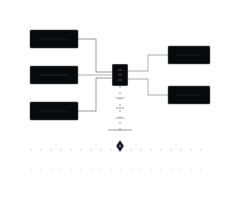
The post-booking workflow in n8n runs automatically after every confirmed booking:
- Confirmation message -- SMS and/or email to the caller, immediately
- Reminder sequence -- timed at your specified intervals before the appointment
- Staff or provider notification -- if relevant to your workflow
- CRM or patient record update -- appointment status, notes from the call
- Intake trigger -- if you're using an intake agent, the intake call can be queued automatically at a configured lead time before the appointment
This is the layer that actually moves no-show rates. In the data, AI reminders and confirmations reduce no-shows 25-40%: a multi-location hospital study saw a 25% reduction over six months; El Rio Health cut no-shows by 32% and recovered $100,000/month in revenue (Droidal / El Rio Health case study, 2025).
Calendar and system integrations#
Google Calendar and Google Workspace#
Full read/write integration with Google Calendar: availability checks, booking creation, event modification, and cancellation. For Google Workspace teams, the agent can handle multi-provider scheduling across individual provider calendars.
Calendly#
We integrate with Calendly's API for read/write booking operations. The agent checks real Calendly availability and creates bookings directly, so your existing Calendly setup stays the source of truth. The voice agent is just an additional booking channel on top of it.
EHR and practice management systems (Epic, Athenahealth, Kareo, Jane)#
For healthcare and dental practices, we build direct integration to your EHR scheduling module. Supported systems include Epic, Athenahealth, Kareo, Jane App, and others with scheduling APIs. The integration method depends on your EHR's API access: FHIR R4 for the major platforms, proprietary APIs for others. The agent books directly into the patient's record -- not a side system that needs manual syncing.
The AI medical scheduling software market is projected to grow from $204 million in 2025 to $1.9 billion by 2034 at a 28.16% CAGR (Neuwark, 2026). EHR-connected scheduling is quickly becoming table stakes rather than a differentiator.
Custom scheduling systems via API#
If you're on a custom scheduling system or a platform not listed above, we assess API availability during scoping and build to spec. Most scheduling systems have APIs. The question during scoping is authentication method and endpoint structure -- we've yet to encounter a modern scheduling system that was genuinely not connectable.
No-show reduction: what the data shows#
Clinics using AI appointment scheduling report 40% fewer scheduling-related support calls and 20% higher patient throughput (AI Appointment Scheduling for Healthcare, Neuwark, 2026). The throughput gain comes from two things: fewer empty slots from no-shows, and faster rebooking of cancellations through waitlist automation.
AI voice agent booking pilots cost $2,000-$5,000 with 4-6 day setup and save $36,000-$60,000 annually for typical SMB operations (AgentVoice / P0stman research, 2025). The direct cost case is easy to make when no-shows are already measurable. The harder number is opportunity cost: slots that go unfilled because the booking process has too much friction -- missed calls, voicemail loops, drop-off. That's usually the bigger figure, and it's the one that changes most when you put a well-configured booking agent in place.
What's included in our build#
Voice agent build and conversation design#
We design the complete booking conversation from scratch: greeting, availability inquiry, option presentation, information collection, confirmation, and edge cases including provider preference, accessibility requests, and first-time vs. returning patient handling. Everything gets tested against real call scenarios before go-live, edge cases and failure modes included.
Calendar integration and write-back configuration#
Calendar or scheduling system integration is built and validated during the engagement. We run live test appointments to confirm write-back before go-live, and configure conflict detection so the agent won't double-book across providers.
Reminder sequence setup#
We set up your post-booking reminder workflow in n8n: intervals, channels, message content, and opt-out handling. The full sequence is tested with a real test booking before the agent goes live.
Testing, QA, and go-live support#
QA covers the full booking flow, rescheduling, cancellation, waitlist logic, and edge cases. We monitor call handling during the go-live window and resolve any issues in real time -- not in a support queue the next day.
FAQ#
How much does an AI appointment booking agent cost? Standard builds with calendar integration and reminder sequences run $2,000-$5,000. Engagements with EHR integration or multi-provider scheduling logic cost more. Platform operating costs are separate.
Can a voice AI agent book appointments into Google Calendar or Calendly? Yes, both are fully supported. The agent checks live availability before offering options and writes directly to the calendar. There's no confirmation step that requires a human in the middle.
How does an AI booking agent reduce no-show rates? Immediate confirmation plus a timed reminder sequence. Confirmation on booking, reminder 48 hours before, reminder 2 hours before is the pattern that consistently produces 25-40% no-show reductions in published studies. Timing and channel (SMS vs. email) are configured to your population.
What calendar and EHR systems does an AI booking agent integrate with? Google Calendar, Calendly, Epic, Athenahealth, Kareo, Jane App, and most platforms with scheduling APIs. We assess integration feasibility during scoping. If a system has an API and you need it connected, that's typically a question of how, not whether.
How long does it take to set up an AI appointment booking system? Most builds go live in 2-4 weeks. EHR integrations with more complex API authentication typically run 4-6 weeks.
Contact us to scope a booking agent for your practice or business. See also: AI receptionist if you need full inbound call coverage beyond booking, after-hours and overflow coverage if your booking gap is primarily nights and weekends, and the voice agents overview for the full service range.