AI Receptionist for Small Business
Small businesses answer only 37.8% of inbound calls. Of the callers who don't get through, 85% never call back (Resonate App, 2025). If your front desk is busy, your team is in a meeting, or the call comes in after hours, that lead is gone. An AI receptionist built by Silverthread Labs answers every call, 24 hours a day, 7 days a week, including nights, weekends, and holidays. It handles your actual call flow: your FAQs, your routing logic, your CRM fields. Not a generic phone tree.
what an AI receptionist actually does#
answers every call: 24/7, nights, weekends, holidays#
The most basic thing an AI receptionist does is pick up. Every time, immediately, no hold music, no voicemail. That alone closes off a category of lost leads that most businesses have quietly accepted as the cost of being busy.
What happens after answering is where it gets more interesting. The agent identifies why the caller is calling, handles what it can handle directly, and routes or escalates what it can't. Every call is logged.
the 37.8% problem: why most calls go unanswered#
The gap between calls received and calls answered is structural, not a staffing failure. Front desk staff are doing other things. Peak call volume rarely matches staff hours. After-hours calls go nowhere. The average SMB loses $126,000 per year to missed calls; for home services businesses, a single missed call costs approximately $1,200 (Dialzara, 2025).
The cost math is straightforward enough: $29-$499/month in platform costs versus $3,700-$5,000/month for a full-time human receptionist (Dialzara, 2026). The comparison isn't close for most SMBs. The harder question is whether the AI receptionist actually handles your calls well, which is why we build each one from scratch rather than deploying a template.
what your callers hear vs. what they experience with voicemail#
80% of callers who reach voicemail hang up without leaving a message (Resonate App, 2025). The ones who do leave a message have already hit friction and are waiting for a callback that may or may not come quickly.
A caller who reaches your AI receptionist gets an immediate conversation. Their question gets answered, their appointment gets booked, their message gets relayed, or they get transferred, all in the same call. 97% of SMBs using AI voice agents reported increased revenue (2talk Business Communications Survey, 2026). The gap isn't about the technology. It's about whether someone picks up.
how it works#
inbound call handling and natural conversation#
The agent answers using your chosen persona and greeting, then works through a natural conversation to figure out what the caller needs. It's not a menu system. Callers speak normally, the agent handles intent, and the conversation adapts. We design the call flow around how your calls actually come in, not a generic template.
intelligent call routing and warm transfers#
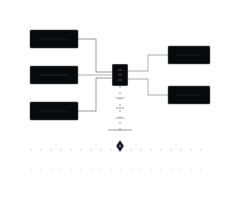
When a call needs to reach a specific person or department, the agent handles the routing. For warm transfers, we configure the agent to brief the receiving party before connecting the caller. Routing rules cover business hours, staff availability, call type, and priority level.
FAQ handling: hours, pricing, location, services#
The most common inbound calls are fully handled by the agent without escalation: hours, pricing, directions, service availability, appointment availability. We train the agent on your specific answers during the build process, and update the FAQ library as your information changes.
message taking and CRM logging#
When a call doesn't end in a direct action (booking, transfer, answered question), the agent takes a structured message and logs it to your CRM automatically. Message fields, CRM destination, and log format are all configured during the build. Nothing lands in your team's inbox waiting to be manually entered.
escalation: when and how it hands off to a human#
Every agent we build has explicit escalation logic: the situations where it routes to a human instead of handling the call itself. We define those triggers with you during scoping. Caller urgency, specific topics, VIP identification, or any pattern where human judgment matters. Escalation can mean a live transfer, a Slack alert, an SMS to a specific person, or a flagged CRM entry for urgent callback, depending on what fits your workflow.
what's included in every build#
custom call flow design and persona#
The call flow covers greeting, intent identification, FAQ handling, booking paths, routing logic, message taking, and escalation triggers. The agent's voice, tone, and name are chosen or designed to fit your business. We don't hand you a voice and flow you've never approved.
CRM and calendar integration#
Every build includes integration to your CRM and scheduling system. Common targets: Salesforce, HubSpot, GoHighLevel, Pipedrive, Zoho, Google Calendar, Calendly, and industry-specific EHR systems. If your CRM has an API, we can connect it. Data fields, logging format, and trigger conditions are set up to match your existing workflow.
n8n workflow orchestration for post-call actions#
A call doesn't end when the caller hangs up. Post-call actions, CRM entry, calendar event, Slack alert, email follow-up, SMS confirmation, run automatically via n8n. The caller's conversation produces a structured outcome in your systems without anyone on your team having to touch it.
edge case handling and fallback logic#
Real calls don't follow scripts. The agent is built with fallback logic for calls it can't handle, callers who are confused or getting emotional, technical hiccups, and the specific edge cases that come up in your call patterns. We test against your actual scenarios before go-live.
testing, QA, and go-live support#
Before launch, we run structured QA: scripted test calls across the full call flow, edge case scenarios, and CRM logging verification. We're available during the go-live window to handle anything that comes up in the first days of live traffic.
cost comparison: AI receptionist vs human coverage#
monthly operating cost breakdown#
A full-time human receptionist costs $3,700-$5,000/month in salary and benefits, before employment taxes, training, and turnover. An AI receptionist runs $29-$499/month in platform costs, plus a one-time build fee for custom configuration.
The more useful comparison isn't AI vs. human, it's AI coverage vs. no coverage. At $126,000/year in missed-call losses for the average SMB, a mid-tier AI receptionist pays for itself quickly. Whether it replaces a human position or fills a gap that was never covered is a different question for each business.
what you stop paying for#
Front desk staff who were fielding calls between other tasks get that time back. Practices and firms paying for after-hours answering services typically drop those contracts once an AI receptionist is live. The FAQs that were eating 20 minutes a day stop landing on anyone's to-do list.
when to supplement with a human, not replace#
The AI receptionist is not the right answer for every call. In businesses where relationships are highly personal, or where callers frequently arrive distressed or in complex situations, the agent handles routine volume and escalates the rest. That's actually the design: high-volume routine calls go to the agent, the calls that need a person get a person. The math still works because routine calls are usually most of the volume.
FAQ#
How much does an AI receptionist cost compared to a human receptionist? AI receptionist services run $29-$499/month in platform costs versus $3,700-$5,000/month for a full-time human. The one-time build cost for a custom AI receptionist is additional, but the operational cost difference is permanent. Most SMBs break even within the first 1-2 months of deployment.
Can an AI receptionist handle call routing and transfers? Yes. Routing logic and warm transfer configuration are included in every build. The agent routes based on call type, caller identity, time of day, staff availability, and any other criteria relevant to your operation. Warm transfers include a brief to the receiving party before the caller connects.
What tools and integrations does an AI receptionist work with? We integrate with your CRM (Salesforce, HubSpot, GoHighLevel, Pipedrive, Zoho), your calendar (Google Calendar, Calendly, and most scheduling systems), and your communication tools (Slack, SMS, email) for post-call actions. Industry-specific EHR integrations are available for healthcare and dental practices.
How long does it take to set up an AI receptionist? Most builds deploy in 2-4 weeks from the scoping call. The timeline depends on call flow complexity, the number of integrations, and how quickly we can finalize the FAQ and routing logic with your team.
What happens when a caller needs to speak to a real person? The escalation logic we build handles this. When a caller's need or tone triggers an escalation criterion, the agent routes the call: live transfer, SMS alert to a specific team member, or a flagged CRM entry for urgent callback. Escalation thresholds are defined during the build process.
Contact us to talk through your call volume and current coverage gaps. Related: AI appointment booking agent for booking-heavy operations, AI lead qualification agent for sales-focused call flows, and after-hours and overflow coverage if your main gap is outside business hours.