Niggle.ai
A 300-page textbook is not a study tool. It is a storage format. Niggle.ai reads it, then builds the flashcards, quizzes, and notes that actually prepare you for the exam.
Industry: Education, EdTech | Stack: Next.js, Supabase, TypeScript, LLM APIs, Document Parsing, Vercel | Status: Live | Visit Niggle.ai
what Niggle.ai does#
Niggle.ai is an AI study assistant that processes educational content and converts it into active learning materials. Upload a PDF, a document, or paste a YouTube video URL. The AI reads the content, then generates five types of study output: structured notes, concise summaries, flashcard sets, quizzes with tracked progress, and an interactive Q&A interface where you can ask questions and get answers grounded in the uploaded material.
The premium plan is $9.99/month with unlimited file uploads. It is built for students who would rather spend their study time learning than organizing.
the problem with passive study materials#
Students spend a disproportionate amount of study time on low-value activities: rereading highlighted passages, scrolling through lecture slides, rewatching recorded lectures at 2x speed. The research on learning science is clear. Active recall (testing yourself on material) and spaced repetition (reviewing at increasing intervals) produce significantly better retention than passive review (Dunlosky et al., 2013, Psychological Science in the Public Interest).
But creating active recall materials takes time. Building flashcards from a 50-page chapter is an hour of work before the actual studying begins. Writing practice quiz questions requires understanding the material well enough to generate wrong answers that are plausibly correct. Most students skip this step, not because they do not know it works, but because the overhead is too high.
The premise behind Niggle.ai: offload that conversion work to the AI. The student uploads the source material and gets study-ready materials without the hour of prep.
what we built#
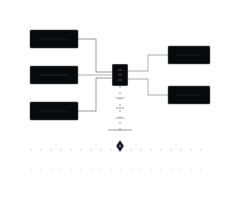
The document ingestion pipeline accepts PDFs, documents, and YouTube video URLs. Each format has its own processing path: PDFs go through a parser that handles text extraction, table recognition, and structural analysis; YouTube videos come in through transcript extraction.
The trickier part was getting the parser to understand structure, not just extract text. A raw text dump does not produce good flashcards. The parser needs to know which content is a definition, which is an example, which is a core concept versus supporting detail. That distinction is what makes the generated study materials worth using rather than just technically present.
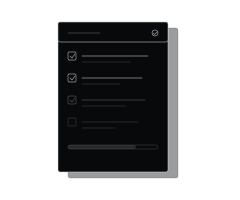
From there, each output type has its own generation logic. Notes are structured and hierarchical, organized into a form a student can review without going back to the source. Summaries are shorter and built for triage: is this document relevant, and what does it cover? The flashcard module extracts question-answer pairs, generates plausible wrong answers for multiple choice, and organizes cards by topic. Quizzes go further, with questions at different cognitive levels (recall, comprehension, application) and per-topic progress tracking that adapts which cards get surfaced again.
The Q&A interface is probably the most used feature in practice. After uploading a document, students can ask questions about it in plain language. "What are the three causes of X described in chapter 4?" The AI answers from the uploaded content, not from general knowledge. For students studying dense material they do not fully understand yet, that is genuinely useful.
Architecture:
- Next.js App Router with TypeScript for the application layer
- Supabase for authentication, database, file storage, and user progress tracking
- Document parsing pipeline with format-specific handlers for PDFs, documents, and YouTube transcripts
- LLM integration for note generation, summarization, flashcard creation, quiz generation, and Q&A
- Progress tracking system with per-topic mastery metrics
- Stripe integration for subscription billing
- Vercel deployment
capabilities#
- PDFs, documents, and YouTube video URLs as input
- AI-generated notes, summaries, flashcards, quizzes, and a document Q&A interface
- Progress tracking with per-topic mastery metrics across study sessions
- Adaptive review spacing based on individual performance
- Unlimited file uploads on the $9.99/month premium plan
results#
- Live platform with an active student user base
- 5 output types from a single upload (notes, summaries, flashcards, quizzes, Q&A)
- Multi-format support: PDFs, documents, and YouTube videos
- Delivered for a US edtech client
If you are working on an education tool or need a document processing pipeline, see our Custom AI Solutions service or book a free Automation Audit.