EagleUp Game
Where tabletop tactility meets digital interface design.
Industry: Gaming | Stack: Figma, Design Systems, Game UI | Status: In Development | Client: Italy
what EagleUp game is#
EagleUp is a tabletop RPG and videogame hybrid: a game that preserves the social, strategic depth of physical tabletop role-playing while translating the experience into a digital format with live visual feedback, interactive HUDs, and connected multiplayer lobbies.
Our engagement covered the visual design layer: style guides, lobby screen design, heads-up display systems, and the design language that gives the game a coherent identity across every screen a player touches.
This was a design engagement, not a full stack build. What we delivered was the visual and interaction foundation the development team builds on. The development work happens on their side.
the design problem: tabletop feel in a digital shell#
Tabletop RPGs work because of physicality. The weight of dice, the texture of character sheets, the spatial arrangement of tokens on a board. These are not decorative. They are interaction patterns players have internalized over decades. When you move a game like this into a digital format, the first instinct is to make it look like a videogame. That instinct is wrong.
Players coming from physical tabletop games do not want a generic fantasy MMO interface. They want the warmth and tactile logic of the tabletop experience rendered on screen. A map should feel like a map you could fold, not a level you respawn into. The HUD should support the story rather than announce itself.
That was the core problem on this project. Every screen we designed had to answer the same question: does this feel like EagleUp, or does this feel like every other game?
what we designed#
style guide and visual language#
We developed EagleUp's style guide from scratch: typography choices, color palettes, iconography systems, spacing rules, and component patterns that carry across every interface in the game. It is the reference document for every designer and developer who touches the UI going forward.
The visual direction had to hold two things at once. Warmth mattered: organic textures, hand-drawn elements, muted earth tones that evoke physical game materials. But so did legibility: clean type hierarchy, consistent spacing, interactive affordances that are obvious without being clinical. Getting those two things to coexist without one winning was the actual design challenge.
lobby screens#
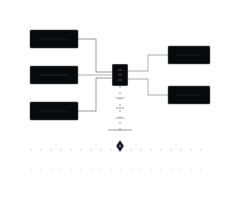
The lobby is the first screen a player sees. We designed lobby screens that handle the practical requirements (player roster, game settings, session management, invite flows) while reinforcing the game's identity. The visual treatment draws from tabletop culture. It should feel like sitting down at a table with friends, not entering a matchmaking queue.
HUD design#
The HUD is where tradeoffs get expensive. During gameplay, every element on screen competes for the player's attention. Too much information breaks immersion. Too little leaves players lost mid-session.
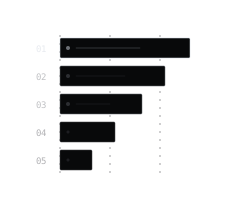
We designed EagleUp's HUD around what the player needs at each moment in the game: health, resources, turn order, available actions. Narrative moments get more breathing room; active turns get denser layout. The information hierarchy changes with context rather than staying fixed.
component system for development handoff#
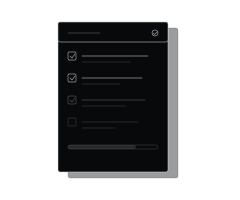
Every screen we delivered was built from a structured component library in Figma: buttons, cards, modals, input fields, status indicators, and navigation elements all documented with their states (default, hover, active, disabled) and usage guidelines. The development team receives a system they can implement consistently, not just a set of static mockups to interpret.
key capabilities#
- Style guide covering typography, color, iconography, spacing, and component patterns.
- Lobby screens: session management that doubles as the game's first impression.
- HUD systems built around context-sensitive information density.
- Component library with documented states, variants, and handoff guidelines.
- Visual and interaction design tuned for players coming from physical game backgrounds.
results#
EagleUp is in development. The design deliverables are complete and the development team is building from them now.
This project is representative of a specific kind of engagement: design-only work where the visual and interaction layer needs to be settled before the first line of game code gets written. We have worked this way before, and the handoff matters more than it sounds. Developers move faster when the system is clear. They make fewer interpretation calls, fewer "I'll ask the designer later" decisions. That is what a well-documented component library actually does.
Need UI/UX design for a product, game, or application? See our UX/UI Design services or book a free Automation Audit.