AI automation for insurance agencies
Independent insurance agencies miss roughly 30% of incoming calls when relying solely on human staff (Sonant.ai, 2025). After-hours claims calls, the ones customers make most urgently, go unanswered. Policies lapse because renewal follow-up slips. And CSRs spend most of their day on questions that do not require their judgment.
AI voice agents and workflow automation address all of these directly. Claims resolution time drops by 75%, from 30 days to 7.5 days on average. Cost per claim falls 30-40%. And the automation plugs into the AMS platforms agencies already run, so there is no parallel system to maintain.
where insurance agencies lose time every day#
Agency owners know their cost center by name. It is not strategy or client relationships. It is repetitive call handling, manual data entry, and administrative processes that consume CSR hours without generating revenue.
repetitive calls consuming CSR hours#
Most inbound calls to an insurance agency are routine: policy status, coverage questions, certificate requests, billing. These calls need accurate information retrieval, not judgment. They currently route to CSRs who are capable of more complex work.
Insurance call handling runs $2.70-$5.60 per interaction on average (Aircall, 2025). Voice AI handles the same calls at $0.25-$0.50. That is an 80-90% cost reduction on a call category that does not require a human.
after-hours claims calls going unanswered#
When a policyholder calls at 9pm about a car accident or burst pipe, they need an immediate response. A voicemail message does not cut it. A voice agent that answers, captures the First Notice of Loss details, gives the policyholder guidance, and creates a claim record does.
65% of insurance customers consider switching providers after a single bad communication experience (AgentZap, 2025). A missed after-hours claims call is not a minor inconvenience; it is a retention problem.
renewal follow-up falling through the cracks#
Outbound renewal sequences slip when CSRs are busy handling inbound calls and claims. Policies lapse because the follow-up that should have started 45 days before expiration either never ran or stopped after the first unanswered call. Automated renewal campaigns run on schedule regardless. The sequence keeps going.
manual claims intake slowing resolution#
FNOL call handling takes around 18 minutes with manual intake. AI voice automation brings that to under 6 minutes (multimodal.dev, 2025). The structured data from an automated FNOL call is ready for routing immediately: no transcription delay, no data entry, no wait before the claims workflow starts.
services we build for insurance agencies#
voice AI agents for claims intake, policy questions, and renewals#
Our voice AI agents for insurance handle inbound call volume across these categories:
- FNOL and claims calls: structured intake covering the claim facts, policy identification, and immediate guidance to the policyholder
- Policy and coverage inquiries: responses to common questions pulled from policy data in your AMS
- Renewal and billing calls: confirmation of renewal terms, payment instructions, and CSR routing for anything outside normal parameters
The agents run 24/7. After-hours claims calls get the same structured response as business-hours calls. Call handling cost drops 80-90% compared to CSR handling for the same call types.
workflow automation: FNOL to adjuster assignment#
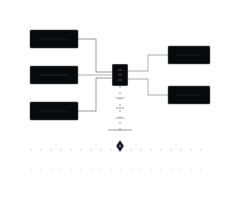
Our insurance workflow automation handles the claims process from first notice to adjuster assignment:
- FNOL data from the voice agent populates a structured claim record
- Policy coverage is verified automatically against the AMS
- Documentation request goes to the policyholder
- Fraud flag checks run against the claim profile
- The claim routes to an adjuster based on claim type, geography, and availability
- The policyholder gets status updates at each stage
CSRs receive a complete claim record ready for review, not raw call notes.
policy renewal and lapse prevention campaigns#
Automated renewal sequences fire based on expiration dates pulled from your AMS. Outbound contacts go at 45 days, 30 days, 14 days, and 7 days before expiration. If the policyholder does not respond to automated contacts, the sequence escalates to CSR outreach.
document processing and status notification workflows#
Certificates of insurance, policy document requests, and claim status inquiries are high-volume, low-judgment transactions. Automated workflows handle intake, document retrieval or generation, and delivery confirmation, with every transaction logged in your AMS.
how we have helped insurance agencies#
claims cycle time reduced by 47-75%#
Agencies using FNOL automation with downstream claims routing have cut claim cycle time by 47-75% versus fully manual processes. The main reason is that the claim no longer waits at each handoff: it moves to documentation without waiting for a CSR to finish a call, and it routes to an adjuster without someone manually checking availability.
CSR time shifted from data entry to coverage decisions#
When voice agents absorb 40-50% of inbound call volume and automation handles claim routing and documentation, CSRs spend their time on the work that actually needs them: coverage analysis, complex claims, client relationships. The roles get harder to automate, not easier.
after-hours coverage without after-hours staff#
The voice agent runs at midnight the same way it runs at 2pm. Agencies that provide 24/7 first-response without paying for 24/7 staffing have a real advantage on retention with customers who call outside business hours.
why Silverthread Labs for insurance automation#
AMS-native integrations: Applied Epic, HawkSoft, EZLynx#
We build native integrations with the AMS platforms independent agencies run. Claim records, policy data, and renewal triggers write back into Applied Epic, HawkSoft, and EZLynx directly. The automation works as an extension of the existing AMS; it does not create a parallel data layer that needs manual reconciliation.
infrastructure hosted in your environment#
For agencies handling PII and sensitive financial data, the self-hosted AI infrastructure option keeps everything in the agency's own environment. No policyholder data goes through third-party AI APIs. Audit logs stay under the agency's control. Data handling requirements are met by how the system is built, not by what a contract says.
engineers who understand the full claims lifecycle#
Insurance automation built by people who do not understand claims tends to break at the non-standard cases: complex coverage, disputed claims, fraud flags. We scope insurance engagements with explicit attention to exceptions: what happens when a claim falls outside normal parameters, and how the system gets a CSR involved without losing any of the context already captured.
frequently asked questions#
How can AI automate insurance claims processing?
Voice agents handle FNOL intake during the first call, capturing incident facts, policy details, and initial documentation in a structured format. Workflow automation handles what comes next: documentation requests, fraud checks, adjuster routing, status notifications. The combination cuts claims process time and manual labor by 47-75% compared to fully manual handling.
What insurance workflows should be automated first?
Start with FNOL intake. It has the most direct effect on claim cycle time and policyholder experience. After that, renewal follow-up, because it is the workflow most likely to slip when staff are busy. Routine inbound call handling is the third priority: policy questions and billing inquiries that take CSR time without requiring their expertise.
Can AI handle after-hours claims calls for insurance agencies?
Yes, and it is one of the clearest use cases. The agent answers, captures FNOL data, gives the policyholder immediate guidance, and creates a structured claim record for CSR review when the office opens. If the situation is urgent, it can route to an on-call contact based on criteria you define.
What AI tools work with Applied Epic or HawkSoft?
We build direct integrations with Applied Epic and HawkSoft via their APIs. Claim records, policy data reads, and renewal event triggers connect directly between the automation layer and the AMS. Integration scope and specific capabilities get assessed during the scoping call.
How much does AI automation cost for an insurance agency?
Voice agent deployment with AMS integration typically runs $12,000-$28,000 for the build, with ongoing infrastructure at $400-$1,000 per month. Full claims lifecycle automation adds to that depending on scope. Most agencies reach ROI within 60-90 days from lower CSR labor costs and better renewal retention.
Ready to see what automation looks like for your claims workflow? Request a free audit and we will map the process gaps and integration options before any scoping conversation.