Business OpenClaw Deployment
If your team is already running OpenClaw on individual machines without shared governance, you don't have a deployment. You have shadow AI. OpenClaw doesn't ship with RBAC, audit logging, or the compliance controls enterprises need before an AI agent can touch production data and business systems. This page covers what a production-ready business deployment actually includes, what it costs, and how Silverthread Labs builds it.
what business OpenClaw deployment actually means#
why single-user installs don't scale to teams#
A personal OpenClaw install is built around one user, one machine, one set of MCP connections. There's no centralized policy, no way to define what the agent can and cannot do across users, and no audit trail. When five engineers -- or fifty -- each have their own install, you don't have team infrastructure. You have five independent agents accessing business systems with no visibility into what they're doing. That's a different problem than "we need to roll this out."
the gaps OpenClaw doesn't close out of the box#
OpenClaw is powerful. It is not enterprise-ready. Two gaps bite teams first:
No access control. There's no native mechanism to restrict which tools and data sources a given user's agent can access. Developers shouldn't have the same agent permissions as auditors, but OpenClaw has no concept of roles by default.
No audit trail. Every tool call the agent makes -- reading files, querying databases, sending emails -- needs to be logged for compliance and incident response. Default OpenClaw produces no structured audit log.
Then there's a third problem that tends to surface later: plugin governance. With 1,184 confirmed malicious skills in the ClawHub marketplace as of March 2026 (eSecurity Planet / PointGuard AI, March 2026), an unmanaged plugin policy in a business context is a supply-chain risk. An employee installs a malicious skill and the action is invisible to IT.
what a governed, multi-user deployment looks like#
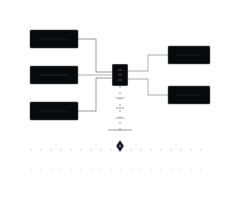
A production-ready business OpenClaw deployment has five components:
- A hardened runtime with CVE-2026-25253 patched on every machine
- RBAC that maps roles to agent capabilities
- An audit log that writes to your SIEM or ELK stack
- A ClawHub trust policy that allows only vetted plugins
- Custom MCP servers that connect the agent to your actual business tools
The deliverable is documented, governable AI agent infrastructure. Getting OpenClaw installed is the easy part.
what's included in a business deployment#
security hardening: CVE-2026-25253 patch and gateway lockdown#
CVE-2026-25253 (CVSS 8.8) enables remote code execution via cross-site WebSocket hijacking. It affects all OpenClaw versions prior to v2026.1.29. We patch every instance in the deployment and lock the unauthenticated gateway before configuring anything else.
22% of monitored organizations already report employees running OpenClaw without IT approval (MintMCP Enterprise Security Report, 2026). So the patch-first step applies whether this is a net-new deployment or a formalization of existing shadow installs. You can't govern what you haven't secured.
role-based access control: Admin, Developer, and Auditor roles#
We configure RBAC with three core roles: Admin (full agent capabilities and configuration access), Developer (tool execution within defined scopes), and Auditor (read-only access to logs and agent state). Roles map to what each user's agent can actually do: which MCP servers it can call, which file paths it can access, which external APIs it can reach. Role definitions are documented and version-controlled so there's no ambiguity about what changed and when.
audit logging: full tool-call traceability with ELK Stack or SIEM export#
Every tool call -- read, write, API call, code execution -- is logged with timestamp, user, action, and outcome. Logs ship to your existing SIEM or to an ELK Stack deployment we configure as part of the engagement.
Retention is set to meet your compliance requirements. ISO 27001 requires a 90-day minimum. Only 52% of enterprises can currently track and audit all data accessed or shared by AI agents (Deloitte State of AI in the Enterprise, 2026). The audit log closes that gap, but only if it's configured correctly from the start -- retrofitting audit logging into a running deployment is significantly harder.
custom MCP servers: connecting OpenClaw to your internal tools#
Generic MCP servers connect OpenClaw to common off-the-shelf tools. Business deployments need connections to your actual systems: your CRM, your project management platform, your internal knowledge base, your databases. We build custom MCP servers for each integration, with appropriate authentication, scope limits, and error handling.
This is the phase that takes the most time and varies the most between engagements. A Salesforce integration with read-only CRM access is straightforward. A connection to an internal system with custom authentication, rate limits, and partial API documentation is not. We scope integration complexity during the requirements assessment.
plugin vetting and ClawHub trust policy#
We audit any existing plugins against the ClawHavoc supply-chain indicators and establish a ClawHub trust policy that defines which publishers and plugin categories are permitted across the deployment. The policy is enforced at the configuration level, not filed away in a document nobody reads. New plugins go through a vetting checkpoint before any user can install them.
handoff documentation and 30-day support window#
Delivery includes: architecture documentation, RBAC role definitions and justifications, MCP server specifications, audit log configuration, and a maintenance runbook. The 30-day support window covers questions, configuration adjustments, and issues that emerge during the initial rollout. Most of the questions we get in the support window are about edge cases in role permissions -- things that only surface once people start using the system.
compliance considerations by industry#
The three frameworks that come up most often are GDPR, HIPAA, and SOC 2. They interact in ways that matter for deployment design, and the answers differ by team.
GDPR and data residency for European operations#
If your team processes data belonging to EU residents, the agent's MCP connections need to respect data residency requirements. We configure OpenClaw to log and process data within your defined geographic boundaries and document the data flows for GDPR compliance purposes. GDPR is usually the first compliance conversation, and it shapes where infrastructure can sit.
HIPAA-adjacent deployments for healthcare-adjacent teams#
OpenClaw deployments that touch patient data -- even indirectly, through integrations to scheduling or communication tools -- need HIPAA-appropriate architecture. We build these deployments with encryption in transit and at rest, audit logging that meets HIPAA standards, and BAA-compatible deployment patterns.
HIPAA engagements take longer, partly because BAA requirements vary by vendor and sometimes require negotiation before we can even connect a tool. For practices where data leaving the building is not an option, we offer a fully self hosted path. See the on-premises AI services page for detail.
SOC 2 and audit trail requirements#
The audit logging configuration we build is designed to satisfy SOC 2 Type II requirements for AI agent activity. Logs include the full tool-call chain, user attribution, timestamps, and outcome states. We document the logging architecture to support your auditor review.
GDPR and SOC 2 requirements often overlap on the audit trail side, which is useful if your team is working toward both.
shadow AI risk: 22% of organizations have employees running OpenClaw without IT approval#
This figure from the MintMCP Enterprise Security Report (2026) reflects a consistent pattern: capable tools arrive on desktops before policy does. A formal deployment engagement addresses this by replacing ad-hoc installs with a governed configuration, or by formalizing existing installs under the same RBAC and audit framework.
Shadow installs that have been running for months sometimes have plugin lists that require manual review. We've seen teams where the ClawHavoc audit surfaces three or four plugins that needed immediate removal.
how the process works#
step 1: requirements and infrastructure assessment#
We start with a structured assessment: team size and role mapping, existing tools and systems that need MCP integration, current OpenClaw installs if any, and compliance requirements by jurisdiction and framework. This session typically runs 60-90 minutes and produces the engagement scope document.
step 2: hardened installation and RBAC configuration#
We deploy or patch OpenClaw across your machines, configure RBAC roles, lock the gateway, and enforce the ClawHub trust policy. For deployments with existing installs, we audit and harden in place before making configuration changes. This step usually surfaces the shadow install inventory.
step 3: MCP server development and integration testing#
This is the longest phase -- typically 5-10 business days depending on integration count and API complexity. Each server is built to spec, tested against your actual systems, and validated against role permissions before being promoted to production. Integrations with partial or undocumented internal APIs take longer. We flag those during scoping, not during build.
step 4: compliance review, documentation, and handoff#
We review the deployment against your stated compliance requirements, finalize documentation, and conduct a handoff session with your IT lead and any relevant stakeholders. The 30-day support window starts from handoff.
Most business deployments complete in 5-10 business days from the start of step 2. Compliance-mapped engagements with complex SIEM integration may run 10-15 days.
pricing#
Business OpenClaw deployment engagements are scoped per team after the requirements assessment. Published ranges:
- Small teams (2-10 users), basic RBAC + hardening + 2-3 MCP integrations: from $2,500
- Mid-size teams (10-50 users), compliance mapping + SIEM integration + 4-6 custom MCP servers: $4,000-$6,000
- Enterprise rollouts (50+ users), multi-department compliance mapping, SIEM, custom MCP development: $6,000+
75% of enterprise leaders rank security, compliance, and auditability as the most critical requirements for AI agent deployment (Deloitte State of AI in the Enterprise, 2026). Pricing reflects the compliance depth of the engagement, not headcount alone.
FAQ#
How much does it cost to deploy OpenClaw for a business? Business OpenClaw deployments start at $2,500 for small teams needing RBAC, security hardening, and a few MCP integrations. Mid-size teams with compliance requirements and custom MCP development typically run $4,000-$6,000. Enterprise-scale rollouts are scoped individually after the requirements assessment.
Can OpenClaw be set up for multiple users on a team? Yes, with the right architecture. Out of the box, OpenClaw doesn't have multi-user controls -- those are configured as part of a business deployment. We build RBAC with defined roles so each user's agent operates within the boundaries appropriate for their function.
What compliance controls are needed for enterprise OpenClaw deployment? At minimum: CVE-2026-25253 patching, RBAC with documented role definitions, audit logging with 90-day retention, and a ClawHub trust policy. HIPAA and GDPR deployments require additional architecture: data residency controls, BAA-compatible logging, and encryption standards. We map requirements to your specific frameworks during the assessment.
How do you add audit logging and role-based access to OpenClaw? RBAC is configured at the OpenClaw instance level, mapping roles to allowed MCP servers, file system scopes, and API endpoints. Audit logging is implemented as a structured log export from the OpenClaw runtime to ELK Stack or your SIEM. Both configurations are documented for IT maintainability.
What MCP integrations work with OpenClaw in a business environment? Any system with an API can be connected via a custom MCP server. Common business integrations include Salesforce, HubSpot, Notion, Confluence, Jira, Google Workspace, Microsoft 365, Slack, and internal databases. Integration scope is confirmed during the requirements assessment.
How do you handle existing shadow installs? We inventory existing installs, audit their plugin lists against ClawHavoc indicators, and harden them in place under the new governance framework. Users with existing installs keep their configurations where they're safe -- we don't require fresh installs unless the existing configuration is fundamentally compromised. In practice, most shadow installs have at least one plugin that needs to go.
Contact us to schedule a requirements assessment. Most scoping conversations run 60-90 minutes and end with a clear engagement scope and timeline. See also: personal OpenClaw setup for single-user home installs, and the OpenClaw deployment hub for an overview of all deployment options.