AI Automation for Recruiting & Staffing Agencies
Recruiting agencies run on throughput. The problem is that most of the work between "application received" and "interview confirmed" is still done by hand. Recruiters save 15-20 hours per week once initial screenings are automated, and AI-led scheduling cuts coordination time by 36-60% (Phenom, 2025; HeroHunt, 2025). Agencies using automation process 5-7x more candidates per recruiter, not by working harder, but by removing manual steps that currently eat the majority of recruiter hours.
93% of agency recruiters say AI has had a positive impact on their productivity, with 51.67% calling it strongly positive (Atlas AI Agency Recruitment Report, 2025). Agencies that are scaling right now are not necessarily bigger or better at recruiting. They have better systems.
where recruiting operations break at scale#
Growth in a recruiting agency does not arrive smoothly. It arrives as a wave of new job orders that exceeds what the team can work well. The failure modes are predictable.
the volume problem: more applications, same team#
When a staffing agency wins a new client with 20 open roles, the existing team absorbs the load. More job orders mean more resumes, more screening calls, more scheduling. The team that handled 80 active candidates comfortably now has 160. Placement quality drops. Speed drops. Candidate experience drops. All three at once, because the problem is just math.
resume triage and screening: the hidden time sink#
Recruiters spend a disproportionate share of their week on resume triage: reading applications, making initial qualification calls, and populating ATS fields. This is largely pattern-matching. Does this candidate have the required experience, location, and availability? AI scoring systems do that at volume, consistently, and without fatigue. The judgment calls that actually require a recruiter can get a recruiter's attention.
scheduling back-and-forth as a capacity ceiling#
Interview scheduling is administrative work that accumulates in small, frustrating increments. A single interview might require 4-8 email exchanges to coordinate. Multiply that by a full pipeline and scheduling alone becomes a ceiling on how many candidates a recruiter can advance per week.
what drops through the cracks when recruiters are buried#
When the team is at capacity, the candidates who suffer are the ones who did not make immediate contact. Follow-up sequences slip. A qualified candidate who applied two weeks ago and never heard back has already accepted another offer. There is no record of losing them. The placement just never happened.
what we automate for recruiting and staffing firms#
We build full-pipeline automation for the recruiting workflow, from the moment an application arrives to the moment a confirmed first interview is on the calendar.
resume intake, parsing, and AI scoring#
Every application that arrives, regardless of source, is parsed, structured, and scored against the job requirements you define. The output is a ranked candidate list with qualification reasoning attached, ready for recruiter review. Recruiters spend time on evaluation decisions, not on reading unstructured resumes to pull out the same data points from each one.
automated candidate outreach and scheduling#
Qualified candidates receive automated outreach within minutes of scoring. The message is configured to your agency's voice and the specific role. Candidates reply, and the scheduling system handles the rest: proposes times, confirms the slot, sends calendar invites, logs the interview in the ATS. No recruiter involvement until the interview itself.
ATS updates and status notifications#
ATS records stay current without manual data entry. Every stage change, from application received through screened, scheduled, interviewed, advanced, and declined, updates automatically. Status notifications go to candidates at each stage. The pipeline stays visible without a coordinator whose job is to keep it that way.
voice screening calls for shortlisted candidates#
Our AI voice agents for lead qualification conduct initial screening calls with shortlisted candidates. The agent asks your standard screening questions, records responses, and scores the call against your qualification criteria. The recruiter receives a structured summary, not a 20-minute recording to listen to. Calls happen at any hour, so candidates are not gated to business hours for their first interaction.
reporting and pipeline visibility#
Automated reporting covers the metrics that matter: time-to-screen, time-to-schedule, time-to-placement, pipeline conversion rates by job order and source. Reports are generated on the cadence you define, not assembled manually by someone pulling ATS exports into a spreadsheet.
how the automated recruiting pipeline works#
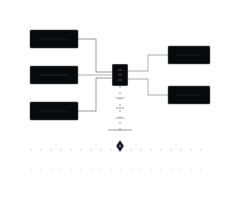
The workflow runs sequentially. Here is what happens from application to confirmed first interview with minimal recruiter involvement.
Step 1: application arrives, resume parsed and scored. The system ingests the application from any source (job board, direct, referral). The resume is parsed into structured fields. AI scoring compares the candidate against the role requirements and produces a ranked score with reasoning.
Step 2: qualified candidates receive automated outreach. Candidates above the qualification threshold receive an automated message within minutes, not hours or days. The message references the specific role and provides scheduling options.
Step 3: AI voice agent conducts initial screening. For candidates who schedule a screening call, our voice agent runs the call: asks your standard qualification questions, probes on any gaps flagged in the resume scoring, and captures responses in structured form.
Step 4: interview scheduled, ATS updated, recruiter notified. Confirmed candidates are scheduled for recruiter or client interviews using automated calendar coordination. The ATS record is updated with screening results. The recruiter receives a summary and a queue of candidates ready for the next stage.
tools and integrations we build against#
ATS: Greenhouse, Lever, Workable, Recruiterflow#
We build native integrations with the ATS platforms recruiting agencies use. Stage updates, candidate notes, and job order data flow between the automation layer and the ATS without manual synchronization. If you use a platform not on this list, bring it to the scoping call.
communication: email, SMS, Slack#
Candidate outreach and status notifications run through email and SMS, configured to your agency's domain and sender identity. Internal notifications for recruiters route through Slack or email, depending on your team's workflow.
calendar and scheduling systems#
Interview scheduling integrates with Google Calendar and Outlook. Candidate-facing scheduling uses a booking flow that checks live availability and prevents double-booking.
workflow backbone: n8n#
Our workflow automation builds use n8n as the automation layer: event-driven, auditable, and running on your own infrastructure. Every workflow step is logged. Logic is transparent and modifiable without replacing the entire system when your process changes.
why recruiting firms work with Silverthread Labs#
built into your stack, not bolted on top#
We do not sell a SaaS subscription. We build automation that lives inside your existing stack: your ATS, your email domain, your calendar system. When it runs, it looks like your operation working better, not a third party tool running alongside it.
voice screening paired with workflow automation#
Most automation vendors in recruiting handle either workflow automation or voice screening. We build both as an integrated system. The voice screening call is not a standalone product. It is a step in the pipeline that feeds its output into the ATS and the downstream scheduling flow.
we scope for your volume, not a generic template#
A five-person boutique agency filling niche technical roles has different automation requirements than a 50-person staffing firm placing healthcare workers at high volume. We scope the build to your actual job order volume, candidate source mix, and qualification criteria, not a template designed for a hypothetical median client.
frequently asked questions#
How does AI automation help recruiting agencies scale without hiring more staff?
The leverage is in time recovery. Recruiters currently spend 15-20 hours per week on initial screenings and scheduling coordination (HiredAI/HRMless, 2026). Automating those steps gives each recruiter 15-20 hours per week back, the equivalent of adding 30-50% capacity per person without a new hire. For a team of five, that is the output of two or three additional recruiters.
What ATS platforms does the automation integrate with?
We have built integrations against Greenhouse, Lever, Workable, and Recruiterflow. We can also integrate with Bullhorn, iCIMS, and other major ATS platforms depending on API access. Integrations are assessed during scoping.
Can AI voice agents conduct screening calls without candidates finding the experience off-putting?
Yes, provided the call is designed well. Candidates who are actively searching and want to move quickly respond positively to prompt scheduling and structured screening calls. The agent is configured to be clear, direct, and professional. If a candidate asks to speak with a human recruiter, the escalation path is defined and immediate.
What is the ROI of AI workflow automation for a staffing firm?
Agencies report 20-40% lower cost-per-hire with AI automation, versus an average U.S. cost per hire of $4,700 (BCG/Second Talent, 2025). Top permanent placement agencies fill roles 14 days faster than non-automated competitors (DemandSage/Staftr, 2025). For a firm placing 100 candidates per year, that speed advantage is often what determines whether a client renews or shops around.
How long does it take to see results after deployment?
Most agencies see changes within the first two weeks: resume scoring is immediate, scheduling coordination drops out of recruiter workflow on day one, and ATS hygiene improves as soon as records start updating automatically. Pipeline metrics, like time-to-placement and conversion rates, typically show measurable change within 30-45 days.
If you want to see what your operation looks like with this in place, request a free audit and we'll scope the gaps and show you what changes first.