AI for Law Firms: Intake, Automation & Private AI
Law firms miss roughly 35% of inbound calls, costing the legal industry an estimated $109 billion annually in lost new client revenue (Law Leaders national audit/CBS42 EIN Presswire, 2025). That figure is based on 557 million annual calls, a 7% conversion rate, and an average new client value of $8,000. The gap is real, but so are the compliance constraints that govern what law firms can actually do about it, and those constraints changed materially in February 2026.
The tools available are AI voice intake agents, automated workflow systems, and private AI infrastructure. All of them have to be built around privilege requirements, not around what happens to be easiest for the vendor.
where law firms are losing revenue right now#
The revenue loss is not an awareness problem. Managing partners and legal operations leads know their intake process has gaps. The question is what to do about them.
only 40% of law firms answer the phone#
Only 40% of law firms answer inbound calls during business hours, down from 56% in 2019 (8am.com Legal Industry Report, 2025). A prospective client who calls and reaches no one does not typically call back. They call the next firm in the search results. That firm answers, and the case is gone.
the $109 billion missed-call problem, by the numbers#
The legal industry collectively loses an estimated $109 billion annually to missed new client calls (Law Leaders, 2025). For an individual firm, the math scales directly: a firm that fields 100 prospective client calls per month, misses 35, and closes 7% of conversations is losing roughly seven new clients per month to call failure alone. At an average matter value of $8,000, that is $56,000 per month in lost intake revenue.
what prospective clients do when no one picks up#
67% of legal consumers hire the firm that responds first, regardless of price or qualifications (Engaged Digital/legal intake benchmarks, 2025). Firms that respond within 5 minutes convert 78% of leads. That rate drops to 22% after one hour (Engaged Digital, 2025). The intake call is the decision point for whether the client hires your firm or the one that called back first.
the compliance constraint that changes everything#
Law firms cannot use AI the way other industries can. The privilege requirement creates a specific constraint on what infrastructure is acceptable, and that constraint became a legal risk in February 2026.
what the February 2026 SDNY ruling actually said#
In February 2026, Judge Jed Rakoff (SDNY) ruled that documents created using a commercial AI tool are not protected by attorney-client privilege. The reasoning: public AI platforms cannot form a confidential relationship, and their terms of service explicitly disclaim user confidentiality (Debevoise Data Blog, February 2026). Work product generated through a commercial AI tool, whether ChatGPT, Gemini, Claude, or similar, may not be privileged in discovery.
This is not a theoretical risk. It is a documented ruling that applies in the Southern District of New York and will be cited in other jurisdictions.
why cloud AI tools create privilege exposure#
The SDNY ruling reflects an underlying architectural reality: when client communications and matter details are processed by a third-party AI platform, those details exist on infrastructure the firm does not control, under terms of service that disclaim confidentiality. A BAA or enterprise agreement does not create a confidential relationship in the legal sense. The privilege doctrine requires that communications be made in confidence to an attorney, and routing that information through a commercial AI API breaks the confidentiality chain.
ABA Formal Opinion 512 and Model Rule 1.6: what the ethics layer requires#
ABA Formal Opinion 512 (July 2024) requires lawyers to understand how any generative AI platform uses client data and implement specific safeguards under Model Rule 1.6. Boilerplate consent language in engagement letters is insufficient (American Bar Association, 2024). Lawyers have an affirmative obligation to investigate how their AI tools handle client data, not just to obtain client consent for unspecified AI use.
what we build for legal firms#
Our work in legal covers voice intake, workflow automation, and private AI infrastructure. Each piece is scoped from the privilege requirement down.
AI voice intake: every call answered, qualified, and logged#
Our voice intake agents for legal answer every inbound call. The agent handles initial qualification by practice area, asking the questions that determine whether the caller is a prospective client, the nature of their matter, and the urgency of their situation. For practice areas where call timing drives conversion (personal injury, family law, criminal defense, estate planning), this matters particularly: a prospective DUI client who calls at 11pm and reaches a voice agent that qualifies them and schedules a consultation does not call the firm on the next block.
The intake agent connects directly to Clio or MyCase. Qualified intake information is logged as a potential matter before the attorney ever reviews it.
workflow automation: from first call to opened matter#
Our legal workflow automation handles the downstream process:
- Conflict check triggered automatically against existing matters in Clio or MyCase
- New matter record created with intake data populated from the call
- Engagement letter generated and sent for e-signature
- Document collection requests sent to the new client
- Status tracking for each step visible to the responsible attorney
Paralegals and legal assistants handle exceptions and judgment calls. Routine process steps run without human involvement.
private AI: contract review and legal research inside your infrastructure#
Our private AI for legal deploys open-weight models inside the firm's own infrastructure, on-premises or in a private cloud environment with documented data residency. Client communications, matter files, and work product are processed locally. Nothing touches external AI APIs.
Contract review, legal research summarization, and document drafting assistance all run inside your network. The SDNY ruling does not apply to systems where no client data leaves the firm's infrastructure.
how it works, start to finish#
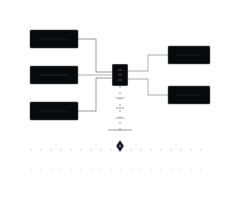
The intake-to-matter flow runs like this:
- The voice agent answers 24/7, asks practice-area-specific qualification questions, and captures the caller's information in structured form.
- That intake data is checked against existing matters in the practice management system. Potential conflicts are flagged for attorney review before any engagement proceeds.
- Confirmed new matters are created automatically in Clio or MyCase, with the intake call summary attached. No parallel data entry.
- The engagement letter is generated from a template configured to the practice area and sent via DocuSign or equivalent. Execution is logged in the matter record.
- Once the matter is open, AI-assisted document review and legal research run on your private infrastructure. Client files are never processed outside your network.
why legal firms choose Silverthread Labs#
we build for the privilege requirement, not around it#
Every architecture decision in a legal engagement starts with the privilege requirement. Data flows are mapped before any system is built. Private infrastructure is the default for any system that touches client matter data. The SDNY ruling is a scoping input, not something we retrofit later.
integration depth: Clio, MyCase, PracticePanther via native API#
We build native integrations with the practice management platforms legal firms use. Intake data, matter records, and document workflows connect through the API, not through copy-paste or CSV imports. The practice management system stays the source of truth.
custom intake logic per practice area, not a generic template#
Personal injury intake is different from estate planning intake, which is different from criminal defense intake. Each has specific qualification criteria, urgency thresholds, and downstream workflow requirements. We configure the intake agent to your actual practice areas, not a one-size-fits-all template.
frequently asked questions#
How much does AI automation cost for a small law firm?
A voice intake agent with Clio or MyCase integration typically runs $10,000-$25,000 for build and integration, with ongoing infrastructure costs of $400-$1,200 per month. Full workflow automation, intake through matter opening, adds to that range depending on scope. We provide fixed-scope pricing after the scoping call.
Does the February 2026 SDNY ruling affect all law firms or just those in New York?
The ruling is binding in the Southern District of New York but will be persuasive authority in other jurisdictions. Any firm handling matters that could be litigated in federal court should treat it as a material risk, particularly firms in personal injury, commercial litigation, and employment law where discovery scope is broad. The safer position is private infrastructure for any AI system that touches client matter data.
Can AI handle client intake calls for practice areas where emotion is high, like family law or criminal defense?
Yes, when the system is designed for it. The intake agent handles the operational steps: identity, matter type, urgency, basic facts. It is not a counseling service, and it does not try to be. For callers in distress, routing to a human is immediate. The value is that the firm's first response happens at all, not that a machine handles the whole relationship.
What happens if the intake AI doesn't recognize a caller's situation?
The escalation path is defined during the build. Anything outside the agent's scope, complex matters, callers who explicitly want a person, callers in distress, gets routed to an on-call line, a priority voicemail, or a next-business-day callback queue with structured notes. Every contact leaves a record.
How do firms handle compliance documentation for AI tools under ABA Opinion 512?
We produce data flow diagrams and infrastructure architecture documentation as part of every legal engagement. That documentation supports your compliance review and any client disclosure requirements under Model Rule 1.6. We do not provide legal advice on compliance obligations; your ethics counsel reviews the documentation against your specific situation.
Ready to scope your intake process? Request a free audit and we'll map the gaps and walk through the architecture first.