AI for Home Services: HVAC, Plumbing, Electrical & Roofing
Home services businesses -- HVAC, plumbing, electrical, roofing -- lose an estimated $50,000-$120,000 per year to missed calls. AI voice agents answer every call, book appointments, and route emergencies 24/7 at $0.25-$0.50 per call versus $6-$12 for a live agent. The math is straightforward. The implementation requires a system built around how field service businesses actually dispatch and schedule, not a generic answering service.
the problem: your techs are on jobs, your phone is ringing#
This is not a staffing failure. It is a structural problem: the people who generate revenue cannot answer the phone while they are doing the work. The phone rings while hands are in a crawl space. The customer hangs up and calls the next number in the search results.
62% of contractor calls go unanswered when crews are on site#
62% of calls to contractors go unanswered when crews are on job sites. Of those unanswered calls, 78% do not leave a voicemail -- they immediately dial a competitor (Suzee AI, 2024). The job that called you is gone before you know it existed.
what happens to callers who hit voicemail#
The decision to leave a voicemail versus hang up takes seconds. In home services, the urgency is often real: a leaking pipe, a heating system that failed overnight, a roof damaged by last night's storm. A caller with an urgent problem does not wait for a callback. They find someone who picks up.
how seasonal spikes multiply the damage#
HVAC businesses face predictable summer and winter call spikes when every technician is booked and the phone volume doubles. Plumbing businesses see similar spikes during cold snaps and storm events. These are the highest-value calls -- emergency rates, premium jobs -- and they arrive exactly when the team is least able to answer them.
what $50,000-$60,000 in missed calls actually looks like#
The average plumbing shop loses $50,000-$60,000 per year to missed calls (Callbird AI, 2024). For an HVAC operation, that figure climbs during peak season.
the math behind missed call losses for a typical HVAC or plumbing shop#
The average cost per missed call in home services is approximately $1,200 (Callbird AI, 2024). A business that misses 40 calls per month -- plausible for a 3-5 technician operation -- is leaving $48,000 per year on the table, before accounting for customer lifetime value. Regular customers who can't reach you don't stay regular customers.
emergency calls: the highest-value calls are the hardest to answer#
Emergency calls carry the highest per-job revenue. An after-hours HVAC emergency or a burst pipe call at 9pm commands premium rates and requires an immediate decision from the customer. The typical plumbing business fields 8-12 after-hours calls per week, each worth $450-$600 in immediate revenue (Callbird AI, 2024). These are exactly the calls most likely to hit voicemail when everyone is out.
quote requests that never become jobs#
Non-emergency inbound calls -- quote requests, service inquiries, maintenance bookings -- go unanswered at high rates too. Each one represents a job with a real probability of closing. The aggregate of missed quote requests across a year makes up a significant chunk of that $50,000-$60,000 loss figure.
how we close the gap#
We build voice agents and automation that cover the operational gap: every call, every hour, without adding headcount.
AI voice agents: answering calls while your techs work#
Our voice agents for home services answer every inbound call. The agent identifies the caller's need, asks qualifying questions appropriate to the call type (service, emergency, quote request), and either books the appointment or escalates. Callers do not get a menu. They get a conversation that ends with a confirmed booking or a routed escalation.
Booking rates have jumped from 10% to 70% with AI voice answering in case studies from Leaping AI (2025). That gap -- between 10% and 70% -- is the revenue sitting on the table.
appointment booking and dispatch automation#
The voice agent books directly into your dispatch calendar. When a customer calls to schedule a furnace tune-up or a plumbing inspection, the appointment goes into the system before the call ends. No call-back list. No sticky notes. The dispatcher starts the morning with a filled calendar, not a stack of voicemail transcripts to work through.
Our workflow automation layer handles the downstream steps: confirmation messages to the customer, technician assignment notifications, and job detail summaries formatted for your dispatch workflow.
after-hours emergency call routing#
After-hours calls need different handling than daytime bookings. An emergency line needs to distinguish between a "my hot water is lukewarm" call and a "water is coming through my ceiling" call -- and route each appropriately. The first gets a next-morning booking. The second gets an on-call technician notified immediately.
We build that triage logic into the agent. The rules are yours -- you define what triggers an emergency escalation. The agent applies them consistently, every call, without requiring a human to make that call at 2am.
seasonal outbound campaigns (HVAC tune-ups, winterization)#
Revenue is not just inbound. Seasonal outbound campaigns -- HVAC tune-up reminders before summer, winterization offers before the first cold snap -- capture jobs from your existing customer base before they call a competitor. We build these as automated outbound sequences connected to your customer list, fired on a schedule you control.
how it works in practice#
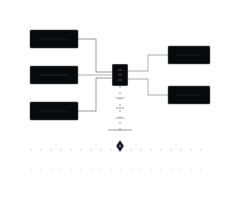
The system is easier to understand as a call flow than as a technology stack.
call comes in: agent answers, qualifies, and books#
A customer calls at 6:45pm. The AI voice agent answers within two rings. It asks about the service needed, collects the property address, checks the preferred appointment window, and confirms availability against the live dispatch calendar. It books the appointment, sends a confirmation text, and ends the call. Total handling time: 90-120 seconds. Zero staff involvement.
integrations: ServiceTitan, Jobber, Housecall Pro, and others#
The voice agent connects to the field service software you already use. We build against ServiceTitan, Jobber, Housecall Pro, and similar platforms. Appointments write into the existing system -- not a separate calendar that creates reconciliation work. Customer records and job history are accessible to the agent in real time.
what happens when a call needs a human#
Not every call should stay with an AI agent. A customer who is upset, a situation that requires technical judgment, an emergency that needs a direct tech conversation -- these get routed to a human immediately. The agent transfers the call, sends the on-call tech a summary of the conversation, and logs the transfer in the job record. Escalation logic is configurable.
results#
booking rates from 10% to 70% with AI answering#
Case studies from Leaping AI (2025) show booking rates increasing from 10% to 70% after deploying AI voice agents. When every call gets answered and every answer includes a booking offer, the conversion rate on inbound calls reflects actual buyer intent -- not staff availability.
emergency recovery: real case numbers#
For a plumbing operation fielding 10 after-hours calls per week at an average emergency job value of $520, capturing those calls with an AI voice agent rather than voicemail represents $270,400 in annual revenue recovery at 100% pickup rate. At a more realistic 60% close rate -- accounting for callers who decline to book -- the figure is $162,000. The cost of running the voice agent is trivial against that number.
why Silverthread Labs, not a generic answering service#
Generic answering services take a message and email it to you. They do not book into your dispatch calendar. They do not triage emergency versus non-emergency calls. They do not connect to ServiceTitan or Jobber. They add a human to the middle of the call -- a human you pay per minute, during business hours, with no emergency coverage.
We build voice agents that handle the complete call flow: qualification, booking confirmation, emergency routing, and CRM update. The system runs 24/7, costs $0.25-$0.50 per call versus $6-$12 for a live agent, and does not take sick days during heat waves.
The work is custom: scoped to your service area, your job types, your dispatch calendar, and your emergency protocols. Not a template. Not a subscription your team has to configure and maintain.
frequently asked questions#
Can the AI agent handle different call types for different trades?
Yes. We configure the agent separately for each scenario: HVAC service call, plumbing emergency, electrical quote request, roofing inspection. Each call type has its own qualification flow, booking logic, and escalation rules. A multi-trade operation gets a multi-scenario agent.
What if a customer asks a technical question the agent can't answer?
The agent is not a technical support line. When a caller asks something outside its scope -- specific repair details, parts compatibility, code compliance questions -- it acknowledges the limit and offers to connect the caller with a technician or schedule a consultation. The escalation path is defined during the build.
How long does setup take?
For a standard voice agent deployment with scheduling integration, we scope 4-8 weeks from kickoff to live calls. That includes integration with your field service platform, configuration of call flows and triage logic, and a test period before going fully live.
Does it work with my existing phone number?
Yes. We route calls through your existing business number. No number change for your customers. The AI agent picks up on that number -- the one that already has your business history and search presence attached to it.
What does it cost compared to hiring a receptionist?
A full-time human receptionist runs $3,700-$5,000 per month in direct compensation, not counting benefits. An AI voice agent runs $29-$499 per month for infrastructure plus a one-time build fee. After-hours coverage -- nights, weekends, holidays -- is included. There is no version of a human receptionist that covers those hours at any reasonable price.
The missed calls are measurable. Request a free audit and we'll calculate the actual loss number for your call volume.